dailynewsnblog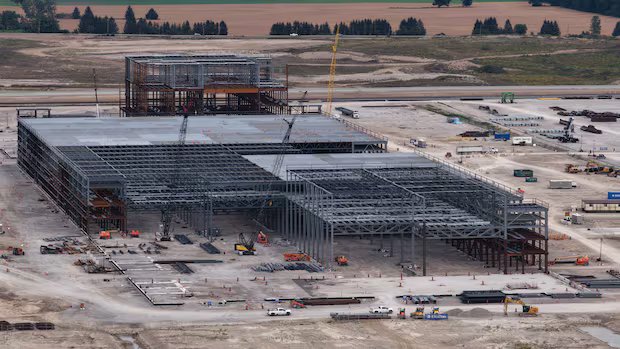
The federal and provincial governments bet billions on the rapid rise of the electric vehicle industry. But major EV and battery projects in Ontario, Quebec and British Columbia have since been delayed, cancelled, suspended, substantially changed — and in one case, gone bankrupt — as automakers and suppliers adjust to weaker-than-anticipated demand.
The latest is Volkswagen’s massive PowerCo battery plant in St. Thomas, Ont., where production has been pushed back two years to 2029, because of “evolving market demand.”
The setbacks are raising questions about whether Canada bet too big on how quickly the EV market would grow. Critics say demand may never reach the levels needed to support the scale of battery production governments sought to attract, while others argue these are temporary delays in the decades-long shift toward electrification.
A million batteries, but for what?
Grieg Mordue, a former Toyota executive and retired McMaster University professor who studied the auto industry, says the St .Thomas plant illustrates two problems with Canada’s EV investment strategy: scale and location.
When the project was announced in 2023, PowerCo said the plant would eventually make enough battery cells for roughly one million EVs a year.
Mordue says that seemed inefficient since Volkswagen’s major assembly operations are in the southern United States and Mexico, meaning batteries produced in St. Thomas would have to travel long distances to reach the vehicles they’re intended to power.

Europe isn’t the obvious destination either, he says, because Volkswagen (VW) already has battery production capacity there.
Even together, VW’s North American plants don’t produce enough vehicles to provide an obvious market for a million batteries a year.
“They got a million batteries,” he said. “What are they going to do with them?”
VW and its PowerCo subsidiary did not respond to a request for comment.

VW has said the plant remains a cornerstone of its North American battery strategy and is continuing construction even as it pushes production back.
VW also said the delay will allow it to incorporate newer battery technology and scale production as demand develops.
It could also have an upside for taxpayers, Mordue said — in the form of a smaller subsidy bill.
Much of the support promised to Volkswagen is still tied to how many batteries the plant produces. With production now set for 2029 and with those incentives scheduled to start declining in 2030 and ending in 2032, Mordue says governments will likely pay “a whole lot less” than the original maximum.
Innovation, Science and Economic Development Canada said in a statement that the federal government has so far contributed $700 million to the construction of the St. Thomas battery plant, noting Ontario is responsible for one third of the $13.2 billion governments have agreed to in production subsidies.
“The government remains engaged with PowerCo on their updated timelines,” the statement said.
Ontario’s Ministry of Economic Development Job Creation and Trade did not respond by deadline.
A bet on the long-term
Still, others argue that looking at today’s EV demand misses the time scale on which investments such as St. Thomas were made.

“These investments are meant to last 50 to 70 years or more,” Joanna Kyriazis, directory of policy and strategy at Clean Energy Canada told CBC News.
She said the current slowdown should be seen as growing pains in an industry that is still transitioning, rather than evidence Canada built too much battery capacity.
There are signs Canada’s EV market may already be recovering after a slowdown.
New registrations of battery-only EVs rose 37.4 per cent in the second quarter of 2026, compared with the same time last year, according to Statistics Canada. When hybrids are included, Canadians registered 58,811 new zero-emission vehicles during the quarter, up 26.7 per cent.
Kyriazis says the investments are about keeping Canada relevant as the global auto industry undergoes a historic shift from gasoline-powered vehicles.

“It’s not a question of maintaining a place in the North American auto indstury. It’s — is Canada going to have an auto industry that survives in the 21st century at all?” she said.
“There’s a clear direction that the global auto sector is going and if Canada wants to have a competitve auto sector into the future, we’ve got to be able to make and sell competitively priced electric vehicles and the parts that go into them.”
Kyriazis says the potential market for these batteries also extends beyond electric vehicles. As electricity grids expand, batteries will increasingly be needed to store power and help balance supply and demand.
The St. Thomas site and a NextStar plant in Windsor, she said, “were looking at a short-term strategy of building batteries that would be used for grid-scale storage while EV update in North American started to sort of even out.”
Kyriazis argues the current U.S. retreat from electric vehicles could prove temporary and that Canada shouldn’t base a decades-long industrial strategy on policies that could change again under a future administration.
There is evidence the EV battery bet may have been early rather than fundamentally misplaced. The wider justification for building domestic battery capacity hasn’t disappeared either.
China produced more than 80 per cent of the world’s battery cells last year, according to the International Energy Agency, leaving governments in North America and Europe to build domestic supply chains in an industry that remains heavily concentrated in Asia.
Will buyers catch up?
University of Guelph economics professor Ross McKitrick is less convinced that time will solve the problem. He said EVs have an established market, but argues governments built their policy around expectations of demand far greater than what has so far emerged.
“What the government’s been trying to do is force that market into existence,” he said. “The numbers just don’t add up.”
McKitrick points to the billions governments offered manufacturers to build EVs and batteries, while simultaneously offering consumers incentives to buy the vehicles as evidence the industry wasn’t able to sustain itself on the scale governments envisioned.
In a 2024 paper published in the Canadian Journal of Economics, McKitrick warned that if Canada’s EV sales requirements rise faster than buyers’ willingness to purchase them, it could hurt automakers and the wider economy.
Ottawa scrapped EV sales requirements in 2026 and is moving repeal the broader federal mandate. It announced replacement emissions standards in February with consultations on the proposed regulations running until October 29.
Electric vehicles still account for a minortiy of new vehicle sales in Canada, despite years of government incentives aimed at encouraging consumers to buy them.
Electric vehicles accounted for 11.7 per cent of new light-duty vehicle sales in Canada in the first three months of 2026, according to Transport Canada, down from a peak of 15.4 per cent in 2024.
“At this point, it’s a niche market,” McKitrick said. “Some households like the product and are willing to pay for it.”