dailynewsnblog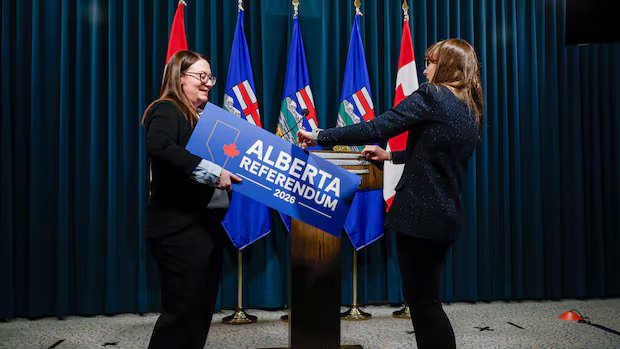
With the possibility of two separation referendums on the horizon, Canadians could be forgiven for wondering what would happen if voters in one province or another decide they no longer want to be a part of Canada.
Alberta Premier Danielle Smith has pledged that her province would hold a referendum in the fall essentially asking if voters want a second binding referendum on separation at a later date.
In Quebec, Parti Québécois Leader Paul St-Pierre Plamondon — who could be premier after October’s election — has promised a secession referendum in his province during a first mandate.
While polls suggest the secessionist vote wouldn’t prevail in either Alberta or Quebec, the process by which a province could withdraw from Canada was laid out in federal law nearly three decades ago.

Alberta Premier Danielle Smith asks Albertans to decide whether to stay in Canada or start a process that could break up the country. Smith joins Power & Politics to defend the move, saying ignoring separatist sentiment doesn’t make it go away.
In the wake of the 1995 Quebec separation vote, the federal government asked the Supreme Court to weigh in on the question of a province pulling out of the federation. The court issued its ruling in 1998, and Parliament followed up by passing the Clarity Act which put that ruling into law.
Here’s a breakdown of what the Supreme Court has ruled, and what is laid out in the Clarity Act.
Clear question, clear majority
Both the Supreme Court’s ruling and the act state that a province could negotiate terms of separation if voters were presented with a “clear question” on separation and a “clear majority” votes in favour of leaving Canada
But both the court and the act say a province can’t just leave on its own. Rather, the provincial and federal governments would have to negotiate with the province that’s trying to leave.
“The Clarity Act is the reflection of the Supreme Court reference. In 1998, the court said that a province of Canada cannot secede unilaterally,” former MP Stéphane Dion, who drafted the Clarity Act, told CBC News in an interview.

The act takes things a step further than the court ruling by carving out an explicit role for the House of Commons, which must weigh in on whether the question itself is clear, and whether or not the subsequent vote yields a large enough majority to trigger secession negotiations.
The idea of a “clear majority” stems from the Supreme Court’s ruling, but the judges didn’t list a specific number, saying it would be for the “political actors” to determine.
What makes a “clear majority” has been a point of debate since the 1990s. Some have argued it means the support of 50 per cent plus one, but Dion argues against the idea that a simple majority voting in favour of separation could kickstart secession negotiations.
“The tradition in Canada is to consider a referendum as a consultation that may have political weight, depending on the context and the result,” he said.
Dion pointed to a 1889 referendum on the prohibition of alcohol as an example. The ban won out with 51 per cent support, but the government of the day decided that wasn’t enough to follow through.

Are we headed toward a three-way race for control of the National Assembly? A new Pallas poll shows the Liberals losing some ground and the CAQ picking up under Christine Fréchette. Qc125 polling analyst Philippe J. Fournier breaks down what the latest numbers tell us.
Under the Clarity Act, if the House of Commons agrees that a clear question leads to a clear majority supporting separation, the federal government could then begin to negotiate secession.
But that would likely require the involvement of more than just the federal government and the province looking to secede: Both the act and the reference case say other provincial governments would have to be involved.
Canada’s Constitution does not mention secession, meaning there would need to be a constitutional amendment — which in part requires a certain level of support from provincial legislatures.
Bernard Funston, who acted as an intervener in the 1998 reference case on behalf of the government of the Northwest Territories, said there’s a more practical reason why the other provinces would have to be involved.
“The number of implications that that province leaving the federation would have for every other province is just astounding,” Funston told CBC News in an interview.
“You pull a thread and you remove a province, it affects Senate seats, it affects how the proportions work in the House of Commons, it certainly affects your civil service, it’ll affect Canada’s debt load — it’ll affect all these other things, and so other provinces have to be involved because you can’t do this sort of thing in isolation.”

When asked about Alberta Premier Danielle Smith’s announcement that voters in Alberta will be asked in a fall referendum whether the province should hold a binding referendum on separating from Canada, Ontario Premier Doug Ford said, ‘I would never, ever put that poll to Ontarians.’
Dion said one province walking away from Confederation would also impact the rights of Canadians both inside and outside that province.
“What is at stake is your right as a Canadian, to be a Canadian with all your rights everywhere in Canada, on each square inch of your country. And if this process goes through, you will not be entitled to be a citizen fully, with all the full rights in part of the country,” he said.
With all that at stake, Dion said negotiations could get “extremely ugly and difficult.”
A number of other jurisdictional issues would need to be settled, including how government services, military, passports and the economy would be impacted.
“Once you get into those negotiations, things are going to turn very muddy very quickly,” Funston added. “It would require us to rethink our entire constitutional fabric.”
Indigenous consultation
Consultation with Indigenous groups is another key aspect to separation that, for now, has scuttled the question originally proposed by the Alberta separation movement.
The Supreme Court ruling says separation negotiations would need to have Indigenous interests “taken into account.” The Clarity Act also explicitly states that the “interests and territorial claims of the Aboriginal peoples of Canada” need to be considered during negotiations.
While those references are somewhat vague, Section 35 of the Constitution protects Aboriginal and treaty rights, and imposes on the government the duty to consult Indigenous communities.

Can a referendum on Alberta separating from Canada still go ahead if it violates treaty rights? Here are the facts.
Funston said given the “evolution of the case law” around the duty to consult Indigenous groups, the references to Indigenous interests in the court ruling and the act likely carry more weight today than they did in 1998.
A newly independent province might have difficulty keeping its same borders because a number of treaties signed between the Crown and First Nations have boundaries that cross provincial lines.
Funston said this is one of the arguments the Supreme Court heard during the reference case, as a number of Indigenous communities inhabit a large portion of northern Quebec and largely didn’t want the province to secede.
Dion said it’s therefore unlikely that a province could leave Canada with its current boundaries intact, and he said negotiations might not lead to a result all parties agree with.
“[That’s] why it’s very important to be sure that at the beginning, at the outset, you have a clear and firm support,” Dion said.
But if negotiations are successful and enough provinces agree to a constitutional amendment, the House would have to approve whatever is negotiated, according to the Clarity Act.
Can a province ignore the Clarity Act?
The Quebec government boycotted the 1998 reference case, arguing that the Supreme Court had no jurisdiction over the issue.
It’s not outside the realm of possibility that a province would attempt to ignore the court’s ruling and the Clarity Act, and declare its independence to the world.
Part of the 1998 reference case actually examined how a province might unilaterally separate under international law on the basis of a right to self-determination. But the court argued that such a declaration would be unlikely to succeed in the Canadian context.
Dion said this is because the right to self-determination applies in the context where a certain segment of a population is excluded from full rights of citizenship.
“If you are in a situation … where part of the population doesn’t have rights of citizenship, they are not considered as citizens by the state and the state imposes its authority on them, then these people in international law may have a claim to not … stay part of this oppressive state.
“But it’s not the situation in Canada,” he said.

Alberta Premier Danielle Smith outlines why a binding referendum question on Alberta separation was not an option.
As the Supreme Court noted in its 1998 ruling, “the ultimate success of such a secession would be dependent on recognition by the international community.”
There are some recent examples where a province or region attempted to leave a parent state to form its own state.
Catalonia attempted to separate from Spain in 2017 but failed to get international recognition.
Some countries,including Canada, recognized Kosovo when it declared its independence from Serbia in 2008. But Serbia has yet to recognize Kosovo as an independent country, and the latter hasn’t been admitted to the United Nations.
“The idea that a province of Canada would accede to international recognition against the will of Ottawa, I think is almost zero,” Dion said.