dailynewsnblog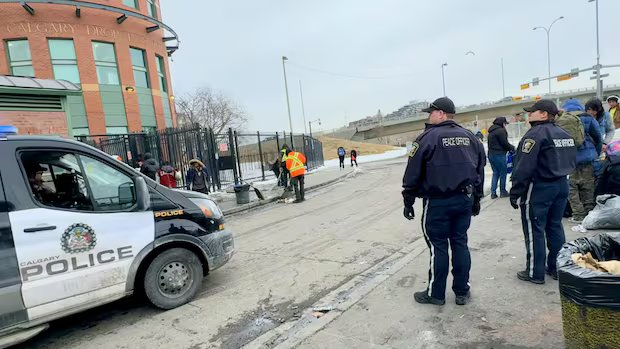
Have you felt unsafe in Calgary? Click the “Join the Conversation” button above. On the app? Join here. Read CBC Calgary’s full series on the impact of social disorder at cbc.ca/yycsafety.

When its current location opened 25 years ago, the Calgary Drop-In Centre was celebrated as much more than a warm place to sleep.
Then-executive director Dermot Baldwin spoke of feeling “peacefulness.”
“Peacefulness in the sense that life should get a lot better for many of us now,” he told CBC Radio’s Calgary Eyeopener on Sept. 7, 2001, the day before opening. “We’re hoping that’s going to make a big difference for thousands of people in the years to come.”
Today, crowds of people linger outside on what’s now called Dermot Baldwin Way, many of them sleeping or openly using drugs. The street requires cleanups twice a day, with peace officers and police on hand to control conflict.
Video taken inside the shelter in March, obtained by CBC News, shows most of the tables in a large common area were full, with people spilling into the adjacent hallway and stairwell. The floors are worn down; the tiled walls discoloured by grime.
Now, the shelter is being pressured by some on city council and business owners to leave the East Village, according to president and CEO Sandra Clarkson. It got a letter from the province in February supporting the idea of decentralization.
“This is a large, congregate setting that was originally designed for a very different population,” Clarkson said in a recent interview with CBC News.
“The ability to meet our mission — to end homelessness, one person at a time — is becoming more and more challenging, because what we’re having to do is crisis management. It’s getting in the way of housing outcomes.”

The six-storey facility cost $15 million to build in 2001, replacing a smaller space next door, with enough beds for 520 people, as well as services like job placement, computer training, leisure activities and a hair salon.
But a lot has changed since.
Today, some 900 people sleep at the shelter in the winter, and many shelter clients are caught in the grip of highly-addictive drugs like fentanyl, which has seen a spike in use since the current location opened.
As the city and street drugs changed, so did the focus of the DI: from the community centre Baldwin envisioned, to a place that gets people housed.
Since 2018, the DI has found housing for nearly 4,000 people, Clarkson says, and fewer than five per cent of those clients have returned to the shelter.
But it’s like trying to dam a flooding river. Clarkson says, for every 50 people the DI houses each month, it welcomes 150 new people.
“What we do works,” said Clarkson. “And is there enough housing out there? No.”
She says staff are overwhelmed by the volume and complexity of clients.
Safety concerns inside and out
Even when it opened, there were concerns about the size of the Drop-In Centre.
In 2001, Mark Smith, then-executive director of Vancouver’s Triage Emergency Services and Care Society, told the Calgary Herald that such a large facility went against current thinking, and that “smaller, more personalized shelters” were best practice.
“It allows you to deal with the residents in a way that has some meaning,” he said. “You’ve got 520 people. You’re not going to be able to do much work with them.”

Today, clients cite safety concerns inside. CBC News spoke with a dozen unhoused Calgarians about their experiences staying at the DI. Numerous people said they fear for their wellbeing there because of violence, theft and substance use, including one former client who shared the video taken inside the shelter.
Clarkson said the DI prohibits the use of drugs and alcohol on the premises, but staff don’t have the capacity to search individuals every time they come in. Clients can put their belongings in “amnesty totes” provided by the shelter: the bags’ contents are not searched, but remain locked up while clients are inside.
It’s not enough to reassure some people.
“That place is like hell,” said Winter Hunter, 20, who has been unhoused since her mother died last year. “The workers there, they don’t really do anything when something happens.”

Hunter alleges she was sexually assaulted in the DI last year. As a result, she’d rather sleep anywhere else — even outside.
“I just stay up all night walking around. It is cold, but once your body gets immune to the cold, it’s OK.”
Clarkson says it’s difficult to comment on specific allegations of violence inside the shelter without hearing all sides of the story. But she said the centre has multiple safety measures in place, such as video monitoring, staff training in de-escalation and a security presence.
She added that the safety and dignity of clients are the DI’s highest priority, and if someone discloses they have been assaulted, the shelter provides immediate medical and crisis care, and outlines other options for support, including reporting to police.
Assault in shelters is a known issue. Calgary police have previously said that over the two-year period between 2022 and 2024, they received 14 reports of sexual assault in local homeless shelters. And a 2024 report blamed a lack of confidence in Calgary’s homeless shelter system for an increase in disorder on public transit.

Police say disorder tied to cluster of services
It’s not only concerns inside the shelter that have people speaking up. Many Calgarians who live or work in the surrounding neighbourhood of East Village told CBC News they feel unsafe.
In 2025, the East Village had a 17.5-per-cent increase in social disorder calls over the five-year average, according to police data. And year over year, the area has one of the highest crime rates compared to other neighbourhoods.
Calgary police Supt. Scott Boyd says a concentration of social agencies in the core draws people in need to the area, including several shelters and the province’s Navigation and Support Centre, where unhoused residents can access critical services and get ID.
As a byproduct, he says the downtown has higher rates of disorder, which can make the public feel uncomfortable, even unsafe.
“The downtown core will continue to see an abundance of those calls until [the cluster of agencies] can be disbanded,” he said.
Province endorses idea of decentralized approach
The province plays a major role in these discussions. In the 2024-25 fiscal year, the Drop-In Centre’s budget was $37.4 million, according to its Report to Community, and two-thirds of that money — more than $25 million — came from the Alberta government.
In February, Minister of Assisted Living and Social Services Jason Nixon wrote Clarkson a letter endorsing the idea of exploring decentralization and said the department will review the proposed transition plans once complete.
“The centre’s proposed approach offers the potential for improved outcomes for those experiencing homelessness, reduced pressure on emergency systems, enhanced safety in and around shelters, and resource optimization overall,” Nixon said in the letter, dated Feb. 26, 2026.
‘The answer isn’t just moving people’
Despite the pressure she’s feeling to see the Drop-In leave the downtown, Clarkson is cautious talking about what decentralization might look like and couldn’t give a timeline for changes.
“We want whatever strategy we develop to be data-informed and driven by outcomes, not politics,” she said. “The answer isn’t just moving people, and it’s not just about building 10 one-hundred-person shelters.”
And putting supportive housing in new areas can be challenging, she said.
“Nimbyism is alive and well in our city, unfortunately. I always say, if you’re not going to say ‘yes’ to affordable or supportive housing, [then] you’re saying yes to encampments, saying yes to visible homelessness. So which do you prefer?”
Edmonton is already taking steps toward a decentralized model.
The non-profit Hope Mission operates four emergency shelters in Alberta’s capital city. The two biggest, Bruce Reith Centre and Herb Jamieson Centre, are a block apart in Chinatown, with a shared capacity of 755 beds. But the need there is so high, surge capacity on some nights has pushed the numbers past 1,000.
Edmonton city councillor Anne Stevenson believes that large capacity puts pressure on the surrounding community in her ward and wants to make both shelters smaller. Last September, city council passed Stevenson’s motion to work with the province on a plan to relocate some of those beds to other parts of the city.
In Calgary, the Drop-In Centre already has four properties off-site. Three are affordable housing sites, with some units dedicated to supportive housing, and the fourth is used by staff and commercial tenants.
One of the centre’s housing properties initially faced fierce opposition, but by the time it opened in 2019, the local community association was cautiously optimistic.
3 new day spaces coming to Calgary
Calgary is also expanding its network of day spaces, where people can hang out, shower, do laundry and access services. Last year, the city added two daytime resource centres: one at the Mustard Seed in the Beltline and one at Journey Church in the northwest neighbourhood of Rocky Ridge. The 2026 city budget includes $5 million for three additional spaces. Their locations have not yet been determined.

Boyd sees potential in these day centres. The Journey Church site has not generated significant new calls for service or crime in the area, he said.
“Done right, those types of day spaces that offer people spots to shower or plug in their phone or just a chance to kind of unplug themselves and feel safe, regardless of where it is in the city, can be really effective.”
But some residents who live near Journey Church are less enthused. When the site opened, neighbours contacted the city with complaints and packed a town hall to voice their concerns.
Back in the East Village, Clarkson says she understands why some people feel unsafe in the area, but says the issues that can lead to disorder — addictions, mental health issues, homelessness — aren’t unique to this city and have become much more visible all over North America.
“What we’re seeing is human suffering in public spaces. That’s what it is, right?”
She says people often look for someone to blame.
“Because we are a service provider, often people will associate ‘well, if the DI wasn’t there, there would be no homelessness.’ Well, what I’d like to get people to understand is the DI exists because there is homelessness. Homelessness doesn’t start here; it ends here. And so is there a better way? We want to find out.”
This article is part of a four-part series on the impact of crime and social disorder in Calgary. Read the full series and share your thoughts at cbc.ca/yycsafety.