dailynewsnblog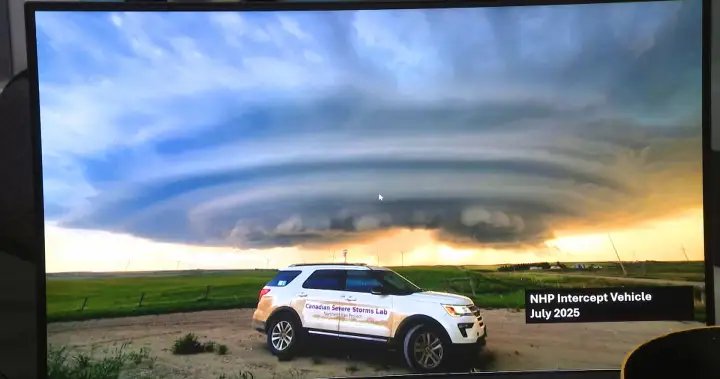
Calgary has a population of more than 1.6 million people, is in close proximity to the mountains and to the prairies, with crops that help release moisture into the atmosphere and the jet stream often over the city in the summertime — all important ingredients for a hailstorm.

As a big city, that makes Calgary “uniquely situated” for studying them, according to Julian Brimelow, director of the Northern Hail Project, located at the Canadian Severe Storms Laboratory at Western University, in London, Ont.
“What the mountains do is they allow the moisture to pull up against them and they also help the air to rise — so as that moist, juicy air, for whatever better word, rises, it fuels the updrafts of these thunderstorms — and then the wind shear, or the strong winds, help organize those storms into hailstorms,” said Brimelow.

Known as the hailstorm capital of Canada, Calgary is located in what is called “hailstorm alley“, an area stretching from High River, west to Rocky Mountain House and to just north of Red Deer.
It is also where the most destructive hailstorms in Canada occur — including one on Aug. 5, 2024 that caused more than $2.8 billion in damage, making it the second most costly natural disaster for the insurance industry in Canadian history.
Julian Brimelow, Director of the Northern Hail Project, shows off one of the specialized pieces of equipment his team uses to collect samples of hail and information on the storms that hit Canada’s “hail alley.”
Global News
On Thursday, Brimelow and other members of his team were hosting a public outreach program at Telus Spark in Calgary, helping to educate people about the science of hail and showing off some of the specialized equipment they use to help keep track of the hailstorms that hit Alberta.

Get daily National news
Get daily Canada news delivered to your inbox so you’ll never miss the day’s top stories.
They include a hail intercept vehicle called Hail Swath, which they use to chase and hopefully get out in front of the storms, to measure their size and impact and to collect samples of the hail.
“This is our fifth year in Alberta. The first four years we’d go in behind and collect this hail as soon as we could — and that’s difficult, especially with the lightning and the rain,” Brimelow said.
“We’d usually try and get there within about 20 minutes, and that was primarily to collect hail that we would feed into many other data streams and research fields that we’re doing.”
This year the team is testing some new instrumentation, including portable weather stations, high-speed cameras, hail catchers that send the hailstones straight into a freezer and hail pads that they want to get dented, helping to measure the size and impact of the hail.
A instrument called a “hail pad” is one of the pieces of equipment researchers from the Northern Hail Project are using this year to collect information on the size and impact of hail storms in western Canada.
Global News
“So there are not many hail sensors around the planet, and we’ve put our hands on the four most popular ones — they all have their strengths and weaknesses,” said Brimelow.
He said the best way to measure hail would be to just leave the instruments out in the field for a few hours, but the chances of getting hit by a storm are very low. This year, they’re “going to the hailstorms,” “and that means getting in front of them, deploying our array, what we call it.”
The team hopes their research will lead to improvements in future weather warnings.
“One of the challenges with weather radar right now is we know if there’s hail in a storm, quite reliably, but it’s more challenging to differentiate between hail sizes or hail amounts,” said Brimelow.
So far this year, the team has done damage surveys on about 35 storms. “You know, what breaks, what doesn’t break, when is it breaking,” Brimelow added, “and for example, we found that wind-driven hail is a really big problem.
“So if you have hail that’s (the size of) walnuts or golf balls, if there are strong winds with that, we have a bad problem that’s got a lot worse suddenly.”
And that type of information, Brimelow hopes, will help with things like the development of more resilient building materials, helping to protect Calgary and other communities from the devastating impacts of future hail storms.

© 2026 Global News, a division of Corus Entertainment Inc.