dailynewsnblog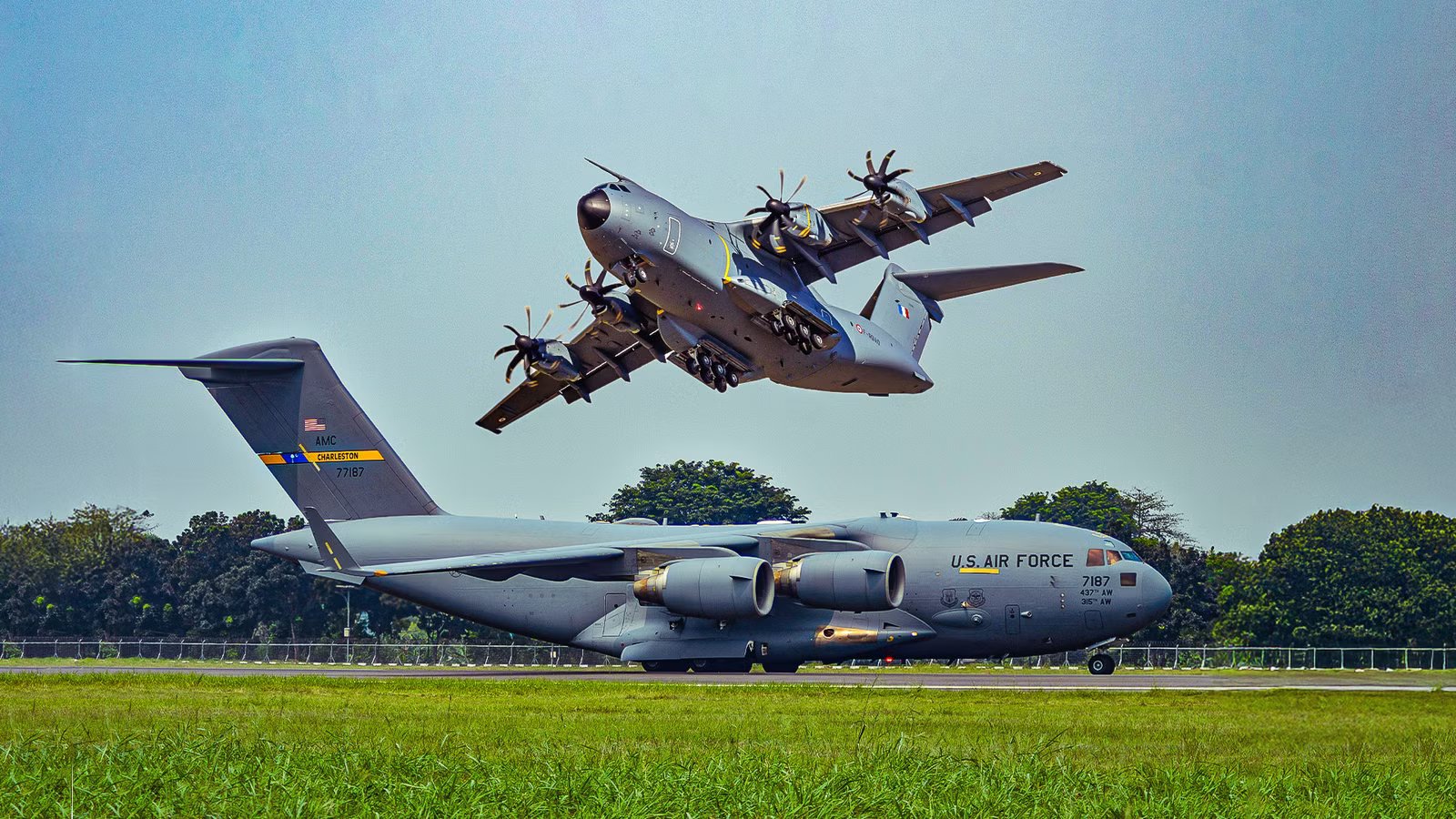
The battlespace of the 21st Century is a lethal grid for military transport planes. The skies over the front line are filled with shoulder-fired missiles and anti-aircraft artillery, while the ground itself is a magnet for incoming mortars and drones. This high-stakes mission is where heavy lifters like the Boeing C-17 Globemaster III and the Airbus A400M Atlas defy the odds through innovative engineering that gives them the performance to accomplish the mission.
Surviving this hostile landscape demands these two iconic airlifters that can drop out of the sky like rocks, stop on a dime, and launch back into the clouds before the enemy even knows they were there. Both planes maximize unique aerodynamics and brutal engine power as forms of tactical survival tools.
Both planes are built to land on airstrips that are a little more than a straight line of dirt, but each solves the physics of assault short-field operations completely differently. Through distinct design philosophies, Airbus and McDonnell Douglas took the simple mission of a cargo run and pushed it to the extreme envelope of what is possible in an aggressive, high-speed combat maneuver.
A Heavyweight Rivalry: C-17 Versus A400M

Payload capability remains the primary differentiator between the two lifters. The C-17 operates as a heavy-lift heavyweight, boasting a maximum capacity of 170,900 lb (77,500 kg). Its expansive cargo bay was explicitly designed around a core American defense requirement: the ability to ingest a 70-ton M1 Abrams main battle tank, cross an ocean at high speed, and land directly on an unpaved frontline airstrip. To achieve that, it is powered by four enormous Pratt and Whitney F117 turbofans which generate a massive combined 161,600 lb of thrust (719 kN).
The most compelling engineering difference, however, is most obvious in the powerplants. The C-17 relies on four high-bypass turbofan engines to sustain its long-range strategic pipeline missions. Airbus took a radically different path with the A400M, selecting four Europrop engines spinning 17.5-foot (5.3 meters) scimitar blades with 11,000 horsepower (8,200 kW), which makes them the most powerful turboprops in the world. This powerplant configuration delivers the instantaneous throttle response required for low-altitude tactical flying and rugged short-field deliveries.
The A400M caps its payload at 81,600 lb (37,000 kg). While the Airbus effortlessly shuttles wheeled infantry fighting vehicles, armored personnel carriers, and attack helicopters, heavy-tracked armor is mechanically beyond its reach. Crucially, the advanced aerodynamics of these swept propellers allow the A400M to sustain a cruise speed of Mach 0.72, just shy of the C-17’s Mach 0.74 jet speed. The Globemaster is the superior global airlifter; however, jet engines suffer from “spool lag,” taking several seconds to deliver full power during sudden tactical maneuvers.
The A400M’s turboprops excel in the thick air near the ground. Propellers accelerate a massive volume of air instantly, giving the pilot immediate throttle response. If the A400M takes ground fire while flying low, pushing the throttle delivers explosive, instantaneous lift. This immediate power makes it a more agile tactical airlifter for evasive maneuvering, canyon flying, and low-level air drops.
The Short Field Champion Of NATO

The A400M is a direct result of a highly specific operational requirement created by the leadership of the North Atlantic Treaty Organization during the late 1980s. The European Air Forces of the United Kingdom, France, Germany, and Spain determined that an operational gap existed between the C-130 Hercules and the C-17. The inability to transport outside cargo like large vehicles in the C-130 was considered a critical limitation. At the same time, the short-field performance of the C-17 could not satisfy all the needs of the RAF or NATO.
NATO nations needed a plane that could land dozens of times on soft, unpaved terrain without ruining the strip. At 310,850 lb (141,000 kg), roughly half the C-17’s weight, and equipped with a high-flotation landing gear system that automatically lowers tire pressure in flight, the A400M has a tiny footprint by comparison. The second major short-field constraint was Foreign Object Damage vulnerability. High-bypass jet engines act like massive vacuum cleaners and turboprops are far more resilient.
The A400M was also built with a compact wingspan of 139 feet (42.4 meters). It was engineered to meet the European Staff Requirement, which demanded a plane capable of landing on a tiny, narrow strip, using its beta-range propeller pitch to execute a U-turn on a runway only 88 feet (27 meters) wide. So while the Atlas delivers the speed of a jet, it also offers the rugged, low-footprint short-field survival mechanics of a workhorse like the C-130.
Not Your Average Milk Run

The C-17 uses a propulsive-lift system where its massive, double-slotted titanium flaps extend directly into the high-velocity exhaust plume of the Pratt & Whitney jet engines. Not only can the plane drop from high altitude to the ground in stunningly quick descents, once it’s there, the engines allow it to reposition itself even on rough terrain. The A400M maximizes the potential of its Europrops by using down-between-engines rotation to optimize the lift pressure under the wing in a different engineering solution to achieve very similar performance on the same mission profile.
Flying low makes a cargo plane an easy target for Man-Portable Air Defense Systems, MANPADS, like the Stinger missiles. These weapon systems are generally unable to reach above 12,000 or 15,000 feet (3,657 or 4,573 meters), while anti-aircraft artillery is also ineffective above about 10,000 feet (3,048 meters). Once on the ground, a cargo plane sitting stationary on a runway is nothing more than a multi-million dollar target. The C-17 can back up on a 2% slope and execute tight 180-degree turns on narrow, primitive runways, getting the payload offloaded and the plane back in the air.
The steep angle of the upward and forward P&W F117 engines is also meant to ensure that debris does not enter the four turbofans and the visibility of the pilots is not obscured, which helps prevent damage by debris and can rapidly taxi and execute a steep takeoff. The Europrops shine most during assault takeoff as they excel in the thick air near the ground.
The Saga Of The Mightiest Airbus

The A400M achieved civil certification in early 2013 and entered active service with the French Air Force that August. In May 2015, a production aircraft crashed during a test flight in Seville, killing four crew members. Investigators traced the cause to an accidental deletion of engine control software during assembly. Despite its turbulent birth, the A400M steadily matured into its intended mission.
The A400M has silenced its early critics by proving itself across multiple theaters. The global fleet has logged over 270,000 flight hours, firmly establishing the aircraft as the logistical backbone for the primary air forces of NATO, including Germany, France, the UK, Spain, and Turkey. Today, Airbus has successfully delivered roughly 137 of the 178 total aircraft ordered.
France and Germany are actively funding a radical shift in the A400M’s operational capabilities, transforming it from a pure transport plane into an offensive combat asset. The platform is being engineered to function as an airborne electronic warfare standoff jammer or even a mothership for future autonomous aircraft. NATO is also working toward a shared multirole tanker fleet with the A400M as the backbone.
Beyond its original European coalition, securing international sales has been a grind. Apart from minor export successes with Malaysia, Kazakhstan, and Indonesia, Airbus has faced a drought of new orders. Unfortunately for the Atlas, nations that do not need its exact tactical-strategic hybrid capability are opting either to stick with the legacy Lockheed Martin C-130 Hercules or buy Embraer’s highly competitive and cheaper jet-powered C-390 Millennium.
The Jewel Of McDonnell Douglas’ Line Up

The C-17 Globemaster III was first developed as the C-X program in the 1980s, with the goal of replacing the aging C-141 Starlifter with a versatile jet capable of combining strategic range with short, tactical landings. In the 1980s, few engines could deliver the necessary 40,000 lb of thrust while maintaining the high reliability required for remote military operations.
When development started, the PW2000 was already a workhorse on the Boeing 757, having entered commercial service in 1984. As of late 2025, current Air Mobility Command projections indicate the C-17 fleet will remain in service until approximately 2075. The United States Air Force has finalized a long-term plan that will keep the Globemaster in service while retiring the older C-5 Galaxy in 2045.
The C-17 has since come to be regarded as the best modern airlifter because of how well it balances the missions of large-scale strategic transport and tactical deployment. To date, 279 examples have been constructed, including the prototypes, with manufacturing running from 1991 to 2015. However, since Boeing took over the plant, discussions have since emerged about starting back up an assembly line.
Catch what other trackers miss
Emergency squawks, holds, NOTAMs — live signals, no signup.
Open tracker
Catch what other trackers miss
Emergency squawks, holds, NOTAMs — live signals, no signup.
Open tracker