dailynewsnblog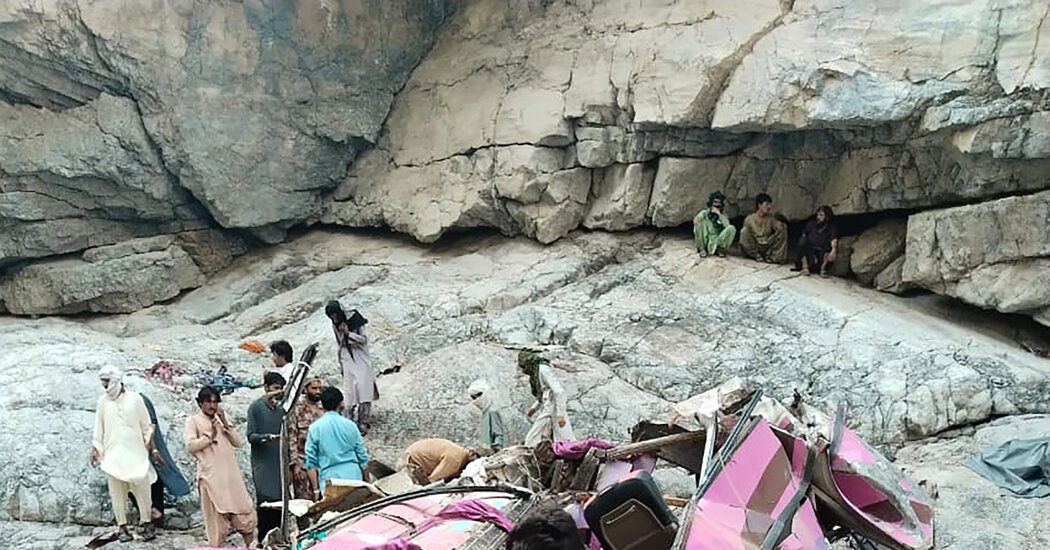
An overloaded passenger bus traveling through a treacherous mountain pass in southwestern Pakistan plunged into a deep ravine on Friday, killing at least 40 people and injuring eight others after a 70-foot fall, officials said.
The bus was taking travelers from Quetta, the capital of Balochistan Province, to Peshawar, the capital of Khyber Pakhtunkhwa, when it tumbled into a gorge, leaving it “completely destroyed,” said Shahid Rind, a spokesman for the Balochistan government.
Mr. Rind said accounts from injured survivors, shared with him by district officials, suggest the driver may have been speeding, and that overcrowding appeared to have worsened the scale of the tragedy.
Although 36 passengers, the maximum capacity, had originally boarded the bus in Quetta on Thursday evening, the driver later picked up additional passengers whose vehicle had broken down, according to Hazrat Ali Kakar, a senior official in the district of Sherani, where the accident occurred.
Rescue operations were slowed by the rugged terrain and the isolation of the crash site, more than 250 miles away from Quetta, officials said. Injured passengers were transported to a hospital 50 miles away from the site.
The crash highlights the dangers of road travel in Pakistan, especially on highways in Balochistan, its largest and poorest province. Balochistan, which borders both Iran and Afghanistan, has some of Pakistan’s highest rates of fatal road accidents, which transportation experts attribute to deteriorating single-lane highways, mountainous terrain, overloaded vehicles and weak enforcement of traffic safety regulations.
Highway blockades and road kidnappings are also frequent, as Balochistan has faced a deadly separatist insurgency for more than two decades.
The stretch of highway where Friday’s crash occurred, winding through the Koh-e-Sulaiman mountain range, is widely regarded as one of the country’s most hazardous. From Balochistan, the highway goes through Khyber Pakhtunkhwa, and on to Islamabad, Pakistan’s capital.
Bus drivers and residents usually avoid this stretch of road after dark because of the presence of armed Pakistani Taliban militants in the area.
But for many who cannot afford other means of transportation, the road is often the only viable option. And the train that connects Balochistan with the rest of the country is frequently subject to bomb attacks by separatist groups.
“Most people cannot even consider traveling by train because of the repeated attacks, and air travel is too expensive for many,” said Syed Akthar Shah, a trader who regularly travels between Islamabad and Quetta.
“And on the highways, you are caught between deadly crashes and armed militants,” he added.
In September, 11 people were killed when a truck veered off the road and plunged into the gorge on the same route. In July 2022, 20 people were killed when a passenger bus plummeted into a ravine in the same region.