dailynewsnblog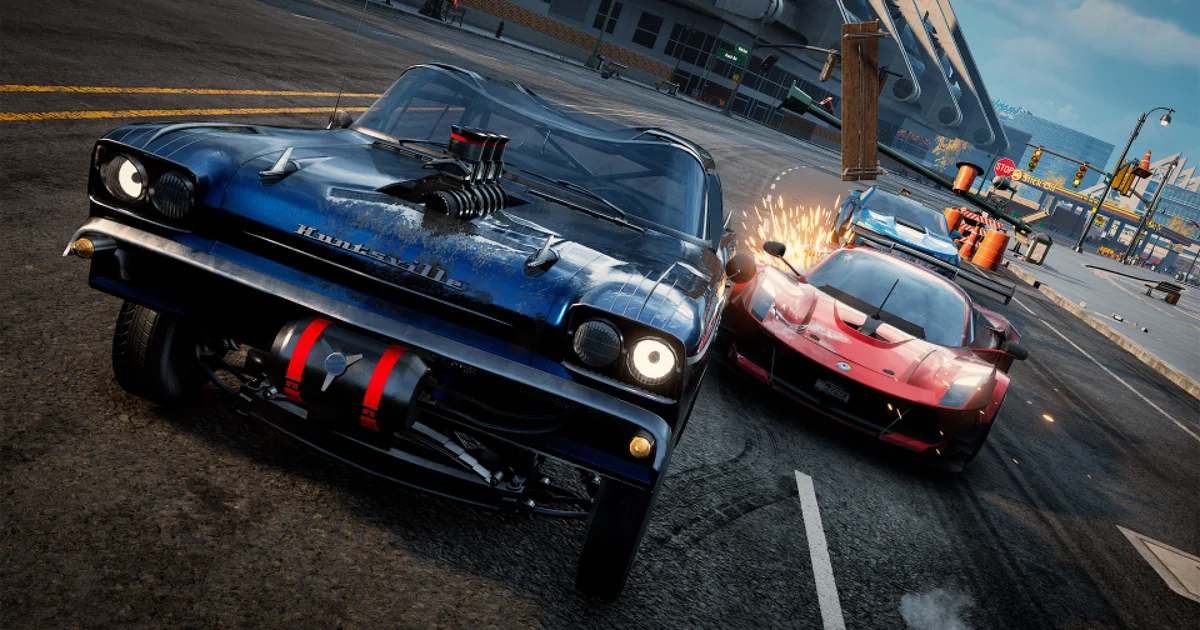
“Wreckreation wasn’t actually an attempt to recreate Burnout,” former Criterion Games studio head Fiona Sperry says as she and her team reveal their latest arcade racer, Wreckreation 2. “I think some people thought it was. But it was actually an exploration of freedom and creativity in racing games, and that was really a continuation of unfinished work at the end of [Burnout] Paradise and also the game we were making before we left EA. It was really about asking the question, ‘What if we gave players an enormous amount of freedom?’”
Whatever the intention, the blend of Burnout-ish arcade racing and player-built, GTA Online-esque airborne tracks that Sperry and studio Three Fields Entertainment put out last year didn’t stick the landing after launching off the release mega-ramp. Since she and some colleagues left EA-owned Criterion in 2014, their efforts have been defined in a lot of folks’ minds – mine included – largely in terms of what they used to do. After Paradise, EA binned the widely beloved and successful Burnout series Sperry and co forged their reputations in, moving Criterion on to Need For Speed. Today, the studio are just one of many working on the corp’s monolithic Battlefield shooters.
Thus, whether fair or not, it’s hard to look at any new game from the likes of Three Fields or the equally ex-Criteriony Fuse Games – the latter being the developers of Star Wars: Galactic Racer – without hunting around for evidence it’s bringing back the rush of slamming a Hunter Cavalry into a wall from behind the wheel of a Carson Inferno Van. This, I’m sure, is both a blessing and a curse for the devs in question, but ironically I think that despite Sperry’s pushback against the idea that Wreckreation was about recapturing Burnout, its freshly announced sequel Wreckreation 2 might be the closest her studio have come yet to achieving that.

Built as a clear reaction to the shortcomings of their last game, by a Three Fields team reborn under the new name When Tides Turn, Wreckreation 2’s designed to be more focused and physical than its unwieldy and awkwardly bouncy predecessor. A vast expanse that’s fairly bland and empty outside of some switchbacked roads has been ditched in favour of map set in and around Heartbreak City, an Eastern US-esque metropolis whose name possibly betrays how its creators were feeling when they set about picking up the pieces following their last game’s release. The driving model’s designed so that cars can much more naturally bump, bash, and grind against each other. Booting up an early build that I’ve been able to whip around after learning about the game for the first time, things instantly felt much closer to Burnout Paradise than any game this set of devs have built since exiting Criterion all those years ago.
Fair enough, I’ve only been able to try a dozen or so events in a limited section of Heartbreak City, with When Tides Turn still at an early stage of development. All of the events will be familiar to any Burnout fan – traditional races, one-on-one face-offs, the classic road rages in which wrecking as many opponents as possible is the key, and wreckonings, that being the name adopted for time trials that reward a faster version of the same car. Speaking of cars, this first demo had two – the quick Dearborn & Schaeffer Nightranger hypercar and a brawny 50s muscle car called the Huntsville Nebraska. Rather than a single base version and one special variant you earn by winning its wreckoning, as was the case in Paradise, each of the rides in Wreckreation 2 so far come with two special variants, with each bringing a visual overhaul and step up in performance.
According to Sperry, Wreckreation 2’s been in the works for “about three months” at this point, with only eight weeks of that coming after the studio moved away from supporting the first Wreckreation on a full-time basis. Given that, what they’ve built thus far has largely impressed me. A city with building-lined avenues and narrow alleyways makes for a much more natural setting for road rages in particular than open alpine roads with little scenery. The car collisions are nowhere near as stilted as in the first game, even if the vehicles still feel like they’re lacking a bit of weight on a controller. The drifting’s serviceable, especially when behind the wheel of the rapid Nightranger, if not as seamlessly satisfying as it was in Paradise and its predecessors.

Though, it’s still plain to see at this point that Wreckreation 2 has a long way to go. At least this time that’s an explicit part of the devs’ plan. In their new guise, the team plan to be a lot more open throughout their development process, seeking rounds of player feedback long before the full version releases. For now, this is taking the form of a series of “initially private and then public demos” that’ll increase in size and which Sperry stressed are different to a paid early access period. “We’ll open up a demo for maybe two or three weeks, we’ll do a playtest, then we’ll take it back down, take on board all the feedback and continue to iterate in that way,” Sperry explained.
While it’s similar, in terms of being community-focused, to what the team have been doing with the original Wreckreation after starting a Patreon post-release, Sperry cited some examples which have served as inspirations. “There were a couple of games I’ve followed in the last year, Far Far West and then Paralives,” she said. “They just did this. They developed in the open, it was amazing, I kind of went along on their journeys with them…I think it really is a shift [in norms]. I think Steam makes it really possible to just be able to get your builds out really quick to people and playtest live with them.” Since it seemed a potentially obvious blueprint to draw from, I asked Sperry if any cues had been taken from another anarchic racer being gradually built up over time, albeit via paid early access, in Bugbear’s Wreckfest 2. “Not particularly,” she responded, returning to her previous two examples, which I found intriguing; it suggests to me that When Tides Turn might have deliberately looked beyond their immediate genre competitors when charting a path forwards.

Another key difference under the hood with Wreckreation 2 is the absence of a publisher, like THQ Nordic, who published its predecessor. Instead, When Tides Turn are self-publishing the sequel. Sperry cited this as one of reasons her team have opted to make a sequel rather than continuing to overhaul the first Wreckreation. “It’s been a good relationship with [THQ Nordic], however they, like many publishers, I’m not sure they’re in a situation where they want to have a live development running for two years.” So, When Tides Turn are going it alone, having secured a UK government grant and with hopes of attracting angel investors to partner with, rather than publishers.
As Wreckreation 2 ploughs on, the aspect of the game I’m most intrigued to see grow and take shape is its worldspace. As of right now, you’ve got a city that’s not too bad a place to drive around, if rather generic and lifeless aside from traffic and parked cars. As in the first Wreckreation, this new game’s slated to be getting a mode that’ll let players create their own versions of its map by building the likes of floating tracks and adding jumps wherever they like. That’s got its own appeal, but what made Paradise City such a wonderfully engrossing automotive playground was its deeply handcrafted feel. Around every corner was a run down an alley and through some jumps or other obstacles, which developers had clearly set up as stunt paths or inventive shortcuts. Sometimes, these paths lead to stunting areas off the beaten path to explore, such as the abandoned quarry.

I asked When Tides Turn if they’d drawn any inspiration from specific areas or sections of Paradise City when making their own metropolis, and surprisingly, Sperry cited its predecessor Burnout Revenge as more of an inspiration, noting the job it did of “layering shortcuts and layering verticality”. For me, Wreckreation 2’s Heartbreak City would ideally lean as hard into that dev-crafted environmental depth as possible. However, the need to leave space for players to fill out the place is tough to balance with that, as the first Wreckreation demonstrated. What does give me hope that When Tides Turn can strike a better balance with it this time is that they were very open about it being something they continue to grapple with. “As we pushed further towards creativity, further towards player expression, we did move away from some of those principles that made arcade racing compelling,” Sperry admitted when running through what lessons have been taken from Wreckreation 2’s predecessor. “We did have debates about that.”
If they can nail it, perhaps Wreckreation 2 will be the game that finally convinces folks like me to stop simply yearning for Burnout as we remember it from back in the day. Not a one-to-one recreation of Criterion’s car smashers, but a worthy successor that builds on their legacy, rather than blending an imitation of it with a box of race creation tools.