dailynewsnblog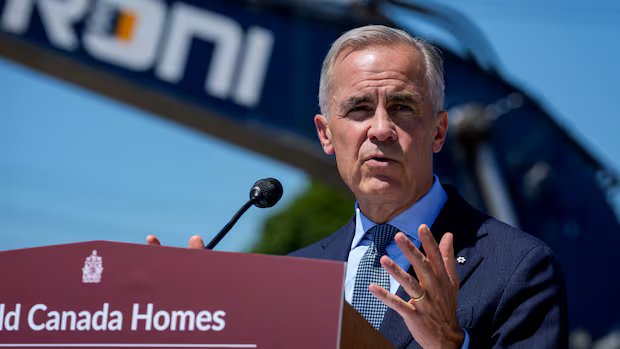
A little more than a year ago, Prime Minister Mark Carney stood in Ottawa in front of a backdrop of partly constructed, prefabricated houses to announce the launch of Build Canada Homes, the federal government’s initiative to tackle the housing crisis and speed up residential construction.
The agency promises to scale up the delivery of affordable housing at a time when industry leaders are raising the alarm about the lagging pace of housing development across the country.
So far, Build Canada Homes has committed to supporting the construction of roughly 19,000 affordable units across the country — only about 2,000 of these are currently being built.
“I think we can always go faster,” Dave Wilkes, president and CEO of the Building Industry and Land Development Association based in Toronto, said in an interview. “I like to say I work for an industry that measures patience in terms of seconds.”

To be fair, the federal housing agency did only become a Crown corporation in July, shortly after the Build Canada Homes Act received royal assent. A large portion of the past year has been spent clearing bureaucratic hurdles, securing land transfers and signing intergovernmental deals.
“This is just the beginning,” Build Canada Homes spokesperson Joshua Coke told CBC News in an emailed response to questions. “Canada’s housing sector is under unprecedented pressure, with demand for affordable homes far exceeding current supply.”
The housing agency primarily focuses on building non-market housing, where rents are typically linked to income rather than market rates, but it is also partnering with developers to build affordable homes for Canada’s middle class.
“Combatting this housing affordability challenge requires more homes to be built, more quickly, and at greater scale,” Coke added.
Ottawa’s long absence from housing market
Kevin Fettig, president of CMI Financial, a mortgage lending and investment company, points out that the Canadian government — under both Conservatives and Liberals — effectively stopped funding and building new affordable housing for roughly three decades.
In the late ’80s and early ’90s, federal debt was ballooning as governments repeatedly ran deficits. Fettig, who worked on monetary policy for the Bank of Canada during that time, says home prices had skyrocketed, which pushed the central bank to increase interest rates. “We saw mortgages at 14 per cent, so there were high defaults in that period.”
Shifting fiscal priorities saw Ottawa reduce spending on housing initiatives, cut the federal co-operative housing program and eventually pull the plug on building any new affordable housing units altogether.
“They basically decided to not finance that area anymore,” Fettig said. “There hasn’t really been a focus on affordability. It sort of crept up on us.”
Federal Housing Minister Gregor Robertson agrees that Ottawa had been absent from the housing affordability picture for a long time.
“The leadership was not there. We’re changing that now,” Robertson said in an interview.

The Toronto Region Board of Trade released a report on Thursday urging the province to amend zoning and building code as Ontario falls short of its housing goal. CBC Talia Ricci breaks down why finding a solution is necessary for affordability.
Fettig believes the approach of Build Canada Homes, providing tools to builders, developers and community partners to speed up residential projects, will yield positive results over time.
“It’s hard to fill that gap in a hurry. We’re on the right track, but it’s going to be, more than anything, a question of time and effort and financing to get there,” Fettig said.
Significant supply gap
Even the market-priced segment is lagging.
Over the past two years, housing starts have hovered around 250,000 annually, according to the Canada Mortgage and Housing Corporation (CMHC). “We still need to keep doubling the pace of current housing starts if we are to restore 2019 affordability across the country,” CMHC chief economist Mathieu Laberge said.
In its latest report, CMHC says roughly 417,000 to 469,000 units must be built every year by 2036 to reach that goal.
That supply gap is “putting future affordability at risk,” according to Laberge. He notes a significant “pent-up demand” from younger Canadians and newcomers.
Even though non-market housing represents about five per cent of overall residential construction, Laberge says the entire housing spectrum is needed to address the ongoing affordability challenges.
“There’s no wrong supply in this case.”

Wilkes from the Building Industry and Land Development Association says the HST rebate and reduction in development charges in Ontario helped recalibrate some of the country’s most overheated housing markets, such as Toronto and its surrounding suburbs.
“The combination of people not having to pay as much because of the HST [rebate on new homes] and builders being able to make sense of the numbers, we are seeing more and more supply come,” he said.
Last month, Ottawa announced a partnership with the government of Alberta to build at least 1,460 affordable apartments and townhouses through Build Canada Homes — a new supply that’s “much needed here in this province that’s growing very fast,” the federal housing minister said.
When asked for more information on the planned developments in Alberta, Build Canada Homes said in a statement “it is not in a position to share details regarding individual projects under consideration at this time,” including details about location, affordability mix or timelines.
Part of the new Crown corporation’s mandate is to promote modern methods of construction, such as modular, factory-built, panelized and prefabricated housing, which can help shorten construction timelines.
“We’re doing everything we can to modernize the industry and make sure that we can build faster and more affordably,” Robertson said.