dailynewsnblog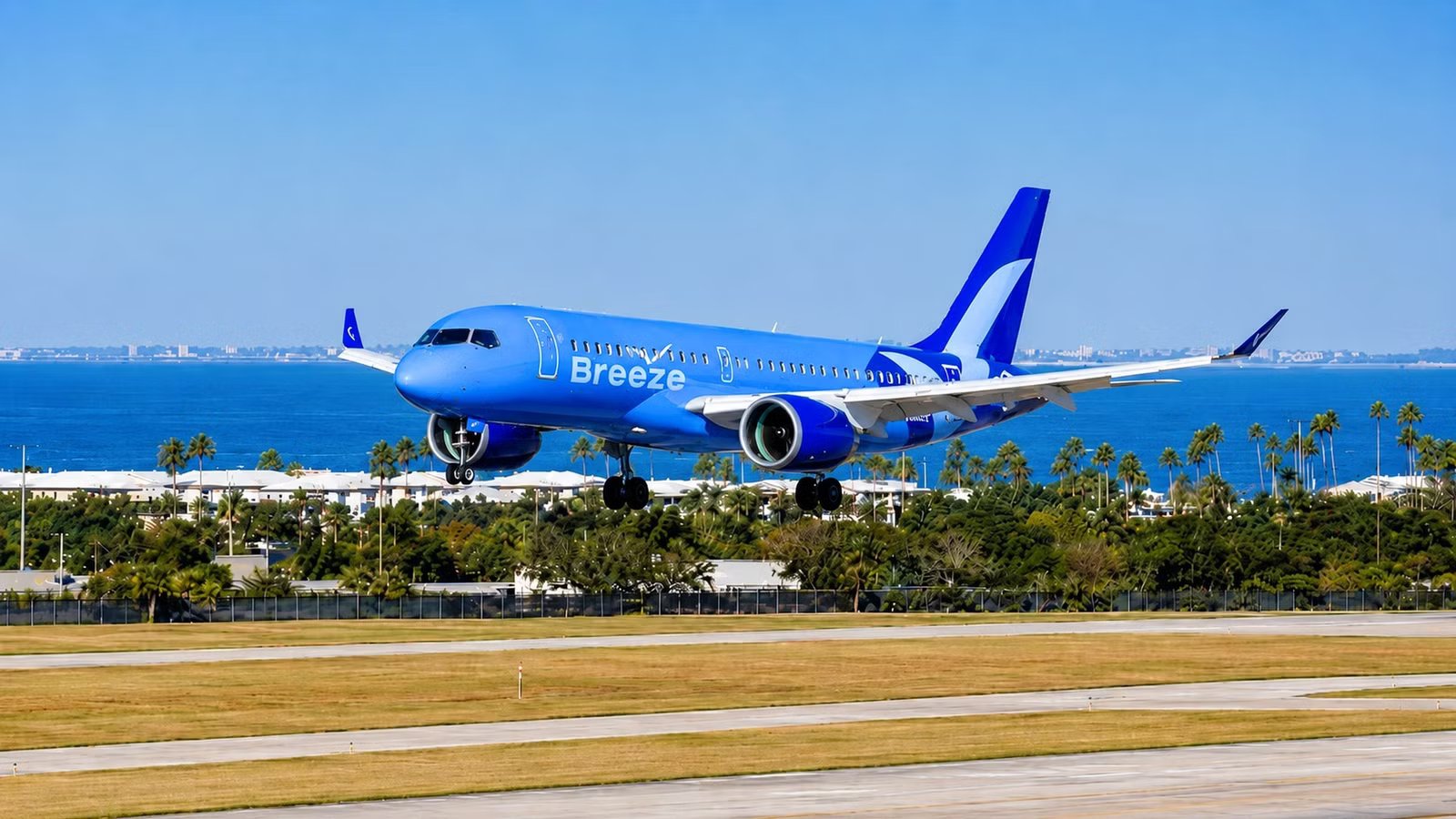
Breeze Airways is turning 2026 into the year of its international break-out. The airline launched its first international routes at the start of the year, and just yesterday, it launched its first international route from Tampa International Airport (TPA). The new nonstop flights to Nassau’s Lynden Pindling International Airport (NAS) represent the first of five new international routes starting from Tampa by the end of the year, amidst a much larger expansion for the carrier.
The new Tampa routes are central to a broader international push by Breeze, which has become the fastest-growing airline in the US. The airline began this year with a purely domestic network, but within a year, will have added 14 international routes across five countries: Mexico, the Bahamas, Costa Rica, Jamaica, and the Dominican Republic.
For now, these are ‘close-in’ international markets focused on leisure demand. However, there is also a larger ambition: using the range of the Airbus A220 to eventually operate longer international routes, including possible transatlantic service.
Tampa Becomes An International Launchpad

Breeze launched its Tampa–Nassau service yesterday, marking the airline’s first international route from Tampa. The 90-minute flight operates on Thursdays and Sundays, departing Tampa at 7:25 AM and returning at 9:55 AM. The new route operates twice-weekly and gives Breeze a foothold in one of Florida’s most natural leisure international markets: short-haul Caribbean and island destinations. It also makes Nassau part of a rapidly growing Tampa network that has become one of Breeze’s most important focus cities.
Origin | Destination City | Start Date | Frequency |
|---|---|---|---|
Tampa | Nassau, Bahamas | June 11 | 2x weekly |
Tampa | Punta Cana, Dominican Republic | July 2 | 2x weekly |
Tampa | San José, Costa Rica | October 3 | 1x weekly |
Tampa | Cancún, Mexico | December 19 | 2x weekly |
Tampa | Montego Bay, Jamaica | December 19 | 2x weekly |
The Bahamas service is only the beginning. Breeze is also adding nonstop flights from Tampa to Punta Cana in the Dominican Republic in early July, followed by San José in Costa Rica in October, with Cancun in Mexico and Montego Bay in Jamaica added in mid-December. This means that by the end of the year, Tampa will have five international Breeze routes, making it the airline’s clearest international gateway.
Loading map…
Drag to explore
The Tampa expansion is significant because Breeze is not just adding international routes. The airline has announced eight new nonstop routes from Tampa International Airport so far this year, lifting its TPA network to 37 nonstop destinations and making it the third-busiest Breeze airport. That gives Tampa a special role in Breeze’s network: not quite a hub in the traditional legacy-airline sense, but increasingly a critical platform for the airline’s next stage of growth.
From Zero To 14 International Routes

Breeze’s international expansion is happening quickly. The airline launched its first international route in January from Norfolk International Airport (ORF) to  Cancun International Airport (CUN), and has since added a series of similar leisure-focused routes from cities that often have limited or no nonstop international options. By early January 2027, just a year later, the carrier is scheduled to operate 14 international routes.
Origin | Destination | Start Date | Frequency |
|---|---|---|---|
Norfolk | Cancun | January 10 | 1x weekly |
Charleston | Cancun | January 17 | 1x weekly |
New Orleans | Cancun | February 7 | 1x weekly |
Providence | Cancun | February 14 | 1x weekly |
Raleigh-Durham | Punta Cana | March 4 | 2x weekly |
Tampa | Nassau | June 11 | 2x weekly |
Tampa | Punta Cana | July 2 | 2x weekly |
Tampa | San José | October 3 | 1x weekly |
Tampa | Cancun | December 19 | 2x weekly |
Tampa | Montego Bay | December 19 | 2x weekly |
Pittsburgh | Cancun | January 7 | 3x weekly |
Pittsburgh | Punta Cana | January 7 | 3x weekly |
Columbus | Punta Cana | January 8 | 2x weekly |
Richmond | Cancun | January 8 | 2x weekly |
The pattern is clear. Breeze is choosing proven leisure markets rather than untested international destinations. Cancun appears seven times in the planned network, while Punta Cana International Airport (PUJ) appears four times. These are among the most established international vacation markets from the US, with strong tour, resort, and visiting-friends-and-relatives demand.
For a still-young airline making its first move outside the US, that is a lower-risk way to start. There is also a competitive angle. Breeze is moving into the kind of international leisure space where carriers like JetBlue and Frontier Airlines have historically been strong and are continuing to expand.
However, Breeze is benefiting from the vacuum left by Spirit Airlines, and is also adopting a different approach. Instead of focusing on the largest hubs and densest markets, it is targeting secondary cities where nonstop international options are thinner or nonexistent. That fits Breeze’s broader model: linking underserved city pairs with nonstop flights that larger network carriers are less likely to prioritize.

This Is Breeze Airways’ New Busiest Airport: Is It Where You Think?
A new airport has overtaken Orlando as Breeze Airways’ biggest base this summer.
The A220 Makes Longer Routes Possible

For now, Breeze’s international network is built around relatively short routes to the Caribbean, Mexico, and Central America. But the aircraft behind the expansion is capable of more. Breeze has built its future around the Airbus A220-300, a narrowbody aircraft with the range, fuel efficiency, and size to open thinner routes that would be difficult to operate with larger aircraft. That is why Breeze’s international ambitions have always carried a longer-term transatlantic question.
Founder David Neeleman has previously talked about using the A220 for longer international flying, including potential service to Europe. There were plans to launch transatlantic service last year, but those plans appear to have been shelved in its first international wave. However, the transatlantic logic is obvious: if the airline can make underserved domestic city pairs work, it may eventually try to apply the same model across the Atlantic.
If Breeze eventually crosses the Atlantic, the most logical first routes would likely be from the Northeast to Ireland, the UK, or other Western European markets. These would not be trunk routes such as New York to London. Instead, they would most likely be thinner, secondary-market routes from bases where it already has a strong presence, such as Rhode Island T. F. Green International Airport (PVD) or Bradley International Airport (BDL), where Breeze could avoid direct competition with the largest transatlantic operators.
For now, though, Breeze appears to be taking a measured approach. Its first international phase is about proving the basics: international operations, customs and immigration handling, aircraft utilization, airport partnerships, and demand from smaller US cities. The airline is also expected to add up to 12 new A220s this year, giving it more flexibility to experiment. The close-in international routes launching this year may not be long-haul, but they are an important first step toward a larger international network.