dailynewsnblog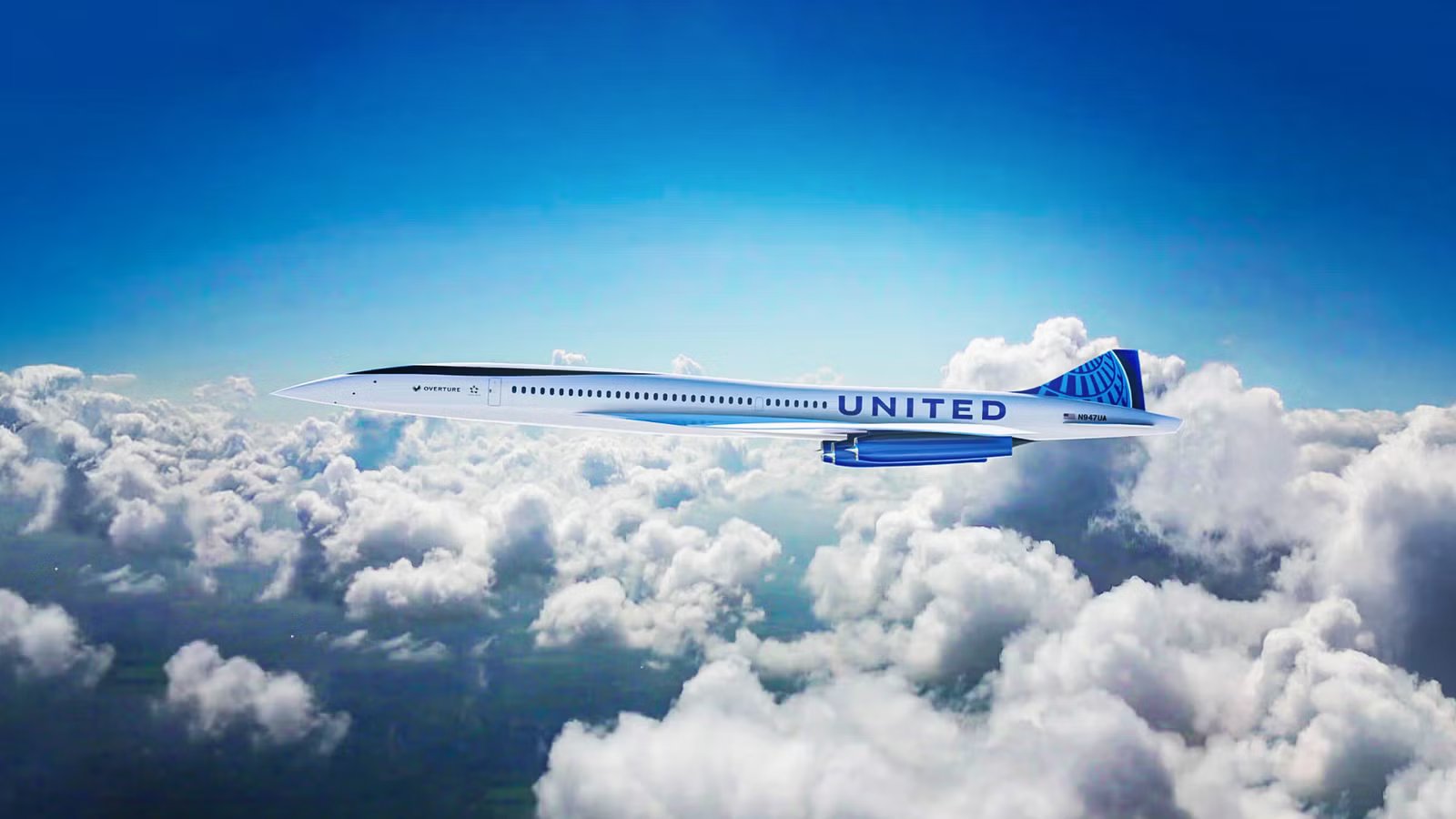
Is supersonic travel actually coming back? Boom Supersonic’s Overture project is striving to do just that and deliver a commercial supersonic airliner that makes financial sense, especially now as the company has moved beyond the XB-1 demonstration phase and into the world of real airliner production. It is no longer enough to rely on the excitement of speed alone; the focus now shifts to whether the Overture can survive the harsh economic realities that eventually grounded the Concorde.
The history of commercial supersonic travel is littered with technical marvels that failed as business models. Boom Supersonic has achieved notable milestones, such as the XB-1 reaching supersonic speeds in 2025, but going from these somewhat small achievements in the grand scheme of things to a mass-produced, 64–80 passenger airliner is an entirely different scale of challenge. This article will explore whether Boom can navigate the certification of both a clean-sheet airframe and an all-new engine simultaneously, all while proving that high-speed travel can be profitable in an era currently defined by operational efficiency and rigorous sustainability targets.
The Long Road Ahead

Boom Supersonic has proven that the aerodynamics for supersonic flight are viable with the XB-1, but expanding that into a passenger airliner remains a profound challenge. The independence of a startup allows for rapid innovation, but it also strips away the massive institutional support and decades of certification expertise that companies like  Boeing or Airbus hold. Like with any startup project, the engineering hurdles are surmountable, though the economic and certification risks create a narrow path for success, making the Overture, at least for now, a moonshot rather than something that can be fully validated.
Unlike the government-subsidized development of the Concorde, which prioritized national prestige over profit, the Overture will need to satisfy private investors and airline balance sheets from day one. Boom is attempting to certify a clean-sheet airframe and a proprietary engine, the Symphony, simultaneously, a process that has historically consumed over 10 years for established giants. The reliance on non-binding orders from carriers like  United Airlines,
  American Airlines, and Japan Airlines suggests genuine interest, but these agreements provide little protection against the inevitable delays and cost overruns inherent in clean-sheet aerospace manufacturing.
The true test lies in whether Boom can scale production to meet its ambitious timeline without the luxury of a legacy supply chain or a global maintenance network. History shows that even with superior technology, an aircraft can fail if it lacks a robust ecosystem to support it in operation. If the Overture arrives late, costs more than anticipated, or fails to integrate seamlessly into existing airport infrastructure, its speed advantage will be secondary to its economic failure, echoing the lessons of the Concorde era, where technical brilliance was overshadowed by commercial isolation.
Flying Fast Is Not Enough

The engineering challenge of breaking the sound barrier is often the primary focus when making an aircraft fly at supersonic speeds, but the true hurdle for Boom lies in integrating a high-speed, specialized aircraft into a global network built for subsonic reliability. For an airline, every one of these factors – fuel burn, parts availability, and airport compatibility – acts as a potential friction point that could turn a technical marvel into a financial liability.
Boom will need to prove that the Overture is more than just a faster airplane and is something that is a viable fleet asset like any of the other widely used commercial aircraft in service today. The company has shown a commitment to 100% sustainable aviation fuel (SAF) to meet modern emissions mandates, which currently face significant supply constraints and may prove to be a challenge if supply does not improve. Also, the establishment of a global maintenance, repair, and overhaul (MRO) network that can support a clean-sheet design is something that will take many years to achieve, especially given the robustness of what a manufacturer like Airbus or Boeing has.
Additionally, the ability to ramp up production to a target of 33 to 66 aircraft annually to achieve necessary economies of scale will not be easy in a time of production backlogs across the industry. Unlike legacy manufacturers, Boom does not have a 50-year legacy of airport ground support or spare parts logistics to lean on, making every operational decision a test of the company’s ability to build an entire support ecosystem from scratch.
The cautionary tale here is the Airbus A380, which serves as a stark reminder of the risks associated with highly specialized aircraft. Much like the Overture aims to be, the A380 was an engineering masterpiece that demanded unique airport infrastructure, specialized gate configurations, and high-density passenger loads to be profitable. When market demand shifted or operational costs spiked, the A380 became a logistical burden for many carriers who found it too expensive to operate on routes that did not perfectly fit its high-capacity niche. For Boom, the danger is that the Overture could similarly find itself isolated, a premium asset that only makes financial sense on a handful of specific long-haul routes, leaving operators exposed if global travel patterns or fuel costs fluctuate unexpectedly.
Preparing For The Worst

The relationship between Boom Supersonic and major carriers like United, American, and Japan Airlines is best described as a strategic hedge. While these airlines have placed a combined 130 conditional orders and pre-orders for the Overture, these agreements are largely designed to secure a spot in line with minimal financial risk. For the airlines, the public relations benefit of appearing future-forward is significant, but there is a clear consensus among leadership that it is too early to go all in. It seems this small group of airlines is not banking their fleets on a 2029 entry-into-service date; instead, they are keeping a window open, allowing them to make a move instantly if Boom encounters the certification or manufacturing delays that history suggests are almost inevitable.
Independent analysts, such as those at Forecast International, hold a far more skeptical view than the optimistic timelines presented in Boom’s press releases. The central concern is the lack of precedent: no company, not even aerospace giants like Boeing or Airbus, has simultaneously certified a clean-sheet airframe and an all-new engine on such an aggressive schedule. The 2030 target is widely considered highly speculative, with many experts anticipating a drift into the 2030s. The technical burden of proof for the Symphony engine, coupled with the rigorous testing required for the airframe, leaves a very narrow margin for the inevitable engineering setbacks that accompany revolutionary aerospace projects.
Milestone | Boom’s Target | Analyst Projection | Risk Factor |
First Flight | 2028 | 2029–2031 | High (Certification Complexity) |
Commercial Service | 2029/2030 | Mid-2030s | Very High (Regulatory/Tech) |
Order Book | 130+ Units | Niche/Low Volume | Moderate (Market Adoption) |
Engine Status | Proprietary/In-House | Prototype Phase | High (Certification/Testing) |
Interestingly, Boom has demonstrated a shrewd survival instinct by diversifying its engine technology, which adds a layer of credibility that many startups lack. Taking advantage of the Symphony engine’s core technology for industrial power generation, a program dubbed Superpower, Boom is creating a secondary revenue stream that does not rely on the Overture taking flight. Where this may come in handy is that it is a vital safety net; even if the Overture faces multi-year delays or certification hurdles, the company has built a viable, standalone business in the energy sector. It suggests that while the supersonic dream is the headline, Boom’s leadership is pragmatically preparing for a reality where the supersonic revolution takes much longer, or arrives in a different form, than originally promised.
Can It Compare To What Is Already Available?

The most immediate competitor to the Overture is not another supersonic startup, but the highly refined, ultra-premium subsonic experience currently offered by major legacy carriers. The choice for travelers often boils down to a fundamental trade-off of speed versus the ability to work, sleep, and remain productive for the duration of a flight. Modern business and first-class cabins on aircraft like the Airbus A350 or Boeing 787 are essentially mobile offices and bedrooms, designed to make a 10-hour flight feel like a controlled environment where productivity is maximized. The Overture, by contrast, prioritizes the rapid crossing of the ocean, potentially sacrificing the third space comfort that has become the peak for long-haul travel.
Catch what other flight trackers miss
Emergency squawks, holds, NOTAMs — live signals, no signup.
Open tracker
Catch what other flight trackers miss
Emergency squawks, holds, NOTAMs — live signals, no signup.
Open tracker
The pros of the Overture are obvious; cutting flight times in half is a clear win for those whose time is the ultimate currency. However, the cons are equally significant when placed against the flying hotel standard of modern subsonic aviation. An Overture flight, with its narrower fuselage and 64 to 80 passenger capacity, cannot replicate the space, privacy, or amenities of a current widebody premium cabin. Travelers who prioritize the experience of a flight, the ability to enjoy a multi-course meal, change into pajamas, and get seven hours of uninterrupted sleep may find the Overture’s cramped, high-speed environment to be an inconvenience rather than an upgrade. It is a well-thought-through transit solution, whereas the current business class is a far better lifestyle solution.
The view of the Overture being a niche asset is reinforced when you compare it to the current trend of super-first-class suites, which are seeing a resurgence among top-tier global airlines. While Boom pushes for speed, the market is moving toward more luxurious, private, and spacious cabin configurations. For the vast majority of premium passengers, the pain of a longer flight is already solved by comfort, not just velocity. If the Overture can only compete on time and not on the quality of the journey, it will likely struggle to win over the high-value passengers who have become accustomed to the flying hotel level of service.
Managing The Current Reality Of Aircraft Production

The path to commercial viability is not just paved with engineering hurdles, but with a complex web of evolving regulatory and environmental constraints. Boom Supersonic has achieved critical milestones, but the Overture will need to contend with an aerospace certification environment that is more rigorous than anything seen during the Concorde era. A major risk remains the integration of the clean-sheet Symphony engine because, unlike established OEMs that can iterate on proven engine cores, Boom must certify both the engine and airframe at the same time. It naturally creates a compounding risk profile, where a setback in propulsion development can stall the entire airframe program, leaving the company vulnerable to funding gaps and timeline slips that are common in startup ventures.
Environmental and noise compliance is another significant drawback that could limit the aircraft’s operational footprint. The FAA recently took steps in July 2026 to propose a framework for overland supersonic flight based on noise levels rather than a blanket speed ban. These rules are, however, performance-based and require operators to prove that sonic booms reaching the surface remain below strict overpressure limits. Even if Boom achieves this, individual airports retain proprietary authority to restrict operations based on local noise concerns. The Overture’s ability to use existing subsonic infrastructure is a key design goal, but its actual noise footprint, specifically during takeoff and landing, will be subject to the same increasingly stringent ICAO noise standards that govern today’s subsonic fleets.
If the Overture manages to carve out a foothold, it could easily bring with it a fundamental bifurcation in the premium market: one segment for the time-poor traveler who views transit speed as the ultimate luxury, and another for the experience-driven flyer who views the subsonic cabin as a sanctuary for rest. The success of the Overture may therefore rest not on replacing subsonic travel, but on successfully coexisting with it by positioning itself as an ultra-niche, time-saving tool rather than a comprehensive replacement for the current, comfort-first flying experience.
What Lies In Front For The Overture

The reality of Boom’s Overture is that it is still a risky engineering endeavor that has yet to prove itself as a sustainable financial model. The company has achieved critical technical milestones, most notably with the XB-1 demonstrator, but the transition from prototype to a mass-produced, 64 to 80 passenger airliner is an entirely different operational mountain to climb. Supersonic travel is technically possible, but it is not yet economically inevitable, and whether this project marks the return of the Concorde era or simply a footnote in aviation history will depend on the firm’s ability to navigate the complex certification of the Symphony engine and the sheer volatility of commercial aviation economics.
Looking forward, the most critical indicator of success is not the speed of the aircraft, but the maturity of the engine development program. Certification of an all-new engine is a gargantuan task that has historically sidelined or exhausted even the largest aerospace manufacturers. For investors and prospective airline operators, the focus must remain on the Symphony engine’s testing progress rather than the sleek, promotional renders of the Overture itself. If Boom can prove that its powerplants are reliable, maintainable, and efficient enough to operate at a lower cost-per-seat-mile than the Concorde, then the supersonic dream has a chance of becoming a reality.
In the coming years, expect to see a measured, cautious approach from the major airlines that have placed conditional orders. As the planned 2029 to 2030 entry-into-service date approaches, these carriers will be looking for concrete proof of certification timelines and firm operational cost data. The Overture is currently a visionary proposition, and rightly so; it is an ambitious attempt to disrupt a mature industry that values predictability above all else. If it succeeds, it will be because Boom transformed supersonic travel from a prestige project into a repeatable, scalable business, a feat that has never been accomplished in the history of commercial flight.

![United Airlines Launches 2 New Nonstop Routes From This Major Hub [See Flights Now]](https://dailynewsnblog.com/wp-content/uploads/2026/08/shutterstock_2580285303_cropped-1.jpg)