dailynewsnblog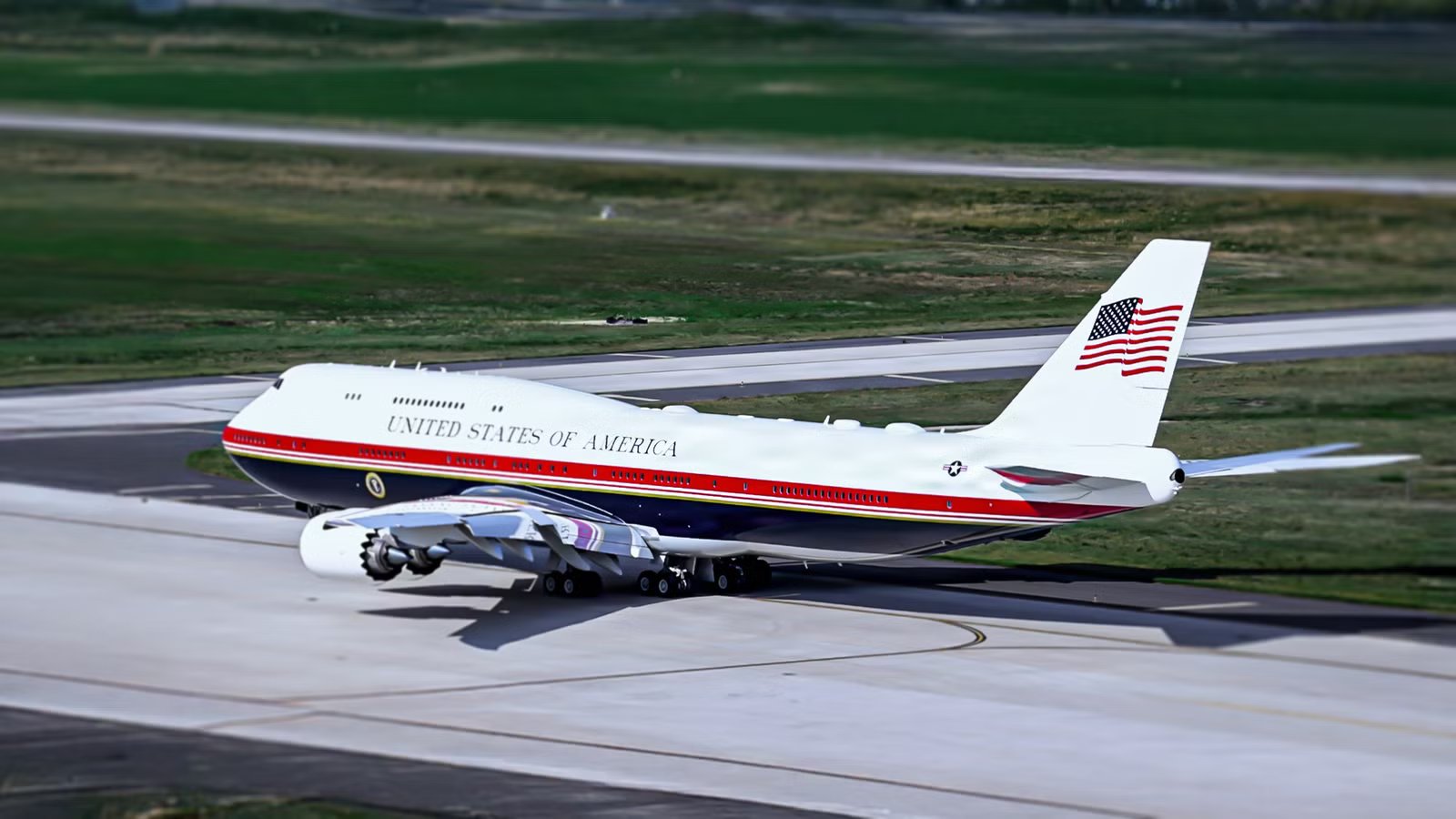
The Boeing 747 may have ended its commercial production run, but two of the most consequential examples ever built remain deep inside a modification program that has stretched years beyond its original timetable.  Boeing’s two purpose-built VC-25B presidential aircraft, which are the long-awaited replacements for the US Air Force’s aging VC-25As, were originally expected to be delivered by the end of 2024. Instead, the first aircraft is now scheduled for roughly mid-2028, while the second is expected around mid-2029, according to the latest program reporting summarized by Yahoo Finance.
That means the aircraft popularly described as the “new Air Force One” remain unfinished even as another Boeing 747-8 has temporarily taken over some presidential duties. This separate, former Qatari 747-8 “Bridge” aircraft carried President Donald Trump for the first time on July 1, 2026, according to Air & Space Forces Magazine. The distinction is important: the Bridge jet is an interim solution, while Boeing’s two permanent VC-25Bs remain an extraordinarily complicated engineering project involving secure communications, defensive systems, specialized interiors, structural changes, thousands of wiring modifications, and requirements unlike those of virtually any other passenger aircraft.
A 2024 Delivery Has Turned Into A 2028-29 Program

The scale of the delay becomes clearer when compared with the original schedule. Boeing signed the deal in 2018 to convert two Boeing 747-8 Intercontinental airframes into the next generation of presidential transports, with the aircraft originally targeted for completion by the end of 2024. Air & Space Forces Magazine reported in December 2025 that the Air Force was instead projecting the first aircraft for mid-2028 to 2029 after a series of earlier schedule revisions.
The two aircraft themselves have an unusual history. They were originally manufactured for Russian carrier Transaero, but were never delivered after the airline collapsed. The US Air Force subsequently acquired the already-built 747-8s, and Boeing began the enormous job of transforming commercial widebodies into VC-25Bs. As The National Interest explains, the conversion requires major changes including presidential mission communications, an executive interior, a medical facility, self-defense equipment, upgraded electrical power, and autonomous ground-operation capabilities.
The result is considerably more complicated than installing a luxury cabin inside a 747, like they do with the BBJ variants. The VC-25B is effectively a national command-and-control military aircraft built within an existing commercial airframe, with systems that must function securely under demanding operating conditions. The current VC-25As entered presidential service in 1990, meaning the Air Force is simultaneously attempting to finish their replacements while sustaining aircraft whose basic 747-200 design dates to a much earlier era of commercial aviation.
The Interior Supplier Collapse Dealt Boeing A Major Blow

One of the most disruptive setbacks involved GDC Technics, which had been responsible for important interior work on the VC-25B. Boeing terminated the supplier in 2021 after alleging that delays in its performance were disrupting the overall program. Air & Space Forces Magazine reported that the resulting dispute and supplier problems contributed significantly to the program falling behind schedule.
The interior of a presidential aircraft is also far removed from an ordinary airline cabin. Spaces must accommodate the president, senior advisers, Secret Service personnel, communications staff, journalists and other members of the traveling party while integrating highly specialized government equipment. Changing suppliers in the middle of such a colossal project involves considerably more than finding another company capable of installing seats, partitions, and cabinetry.
The disruption came at an especially difficult moment. Boeing was simultaneously dealing with pandemic-related labor problems, inflation and supply-chain constraints across its businesses. Former Boeing CEO David Calhoun said in 2022 that COVID-related workforce problems, inflation and supply-chain disruption had affected several fixed-price defense programs, including VC-25B, according to another Air & Space Forces Magazine article. A problem that might have been manageable in isolation, therefore, became another bottleneck in an already extremely constrained production system, creating a snowball effect.
Building A ‘Flying White House’ Is An Engineering Nightmare

Perhaps the biggest explanation for why the permanent VC-25Bs are taking so long is simply what Boeing is being asked to create. A standard Boeing 747-8 already contains an enormous network of electrical, hydraulic, environmental and avionics systems. The VC-25B must integrate an additional layer of mission-specific equipment without compromising the reliability, safety or maintainability of the underlying aircraft.
The modification package includes mission communications, self-defense equipment, a distinguished-visitor interior, integral airstairs, autonomous baggage handling, a second auxiliary power unit and uprated electrical systems, according to Air & Space Forces Magazine’s VC-25 overview. These modifications help explain why describing the VC-25B simply as a modified passenger 747 understates the engineering involved. Boeing must integrate systems developed for completely different purposes while ensuring that the completed aircraft remains certifiable, maintainable, and capable of performing the presidential airlift mission.
Wiring has been a particularly stubborn issue. In Boeing’s 2024 financial reporting, the manufacturer said a $250 million additional charge during the second quarter was driven partially by higher-than-expected costs associated with engineering design changes involving wiring and other structural requirements. Boeing’s annual report subsequently disclosed another $129 million charge later in 2024 related to engineering design changes and schedule delays. More recently, the Government Accountability Office identified wire-bundle fabrication, detailed interior design and rework needed to correct defects in structural modifications as continuing schedule risks, according to Yahoo Finance’s July 2026 report.
Boeing Needs Workers Who Can Actually Be Cleared For The Job

Aircraft manufacturing is normally constrained by the availability of engineers, mechanics, components and factory capacity. VC-25B adds another requirement: many of the people working on sensitive areas of the aircraft need appropriate security clearances. That sharply reduces the available labor pool and means Boeing cannot necessarily move workers, including high-skilled ones from abroad, onto the program as easily as it could when trying to accelerate production of a commercial 737 or 787.
The issue has persisted for years. The Air Force has cited shortages of properly cleared personnel alongside supply-chain disruption as important contributors to the program’s delay. Encouragingly, the latest GAO assessment noted that Boeing had made progress by hiring more qualified mechanics, according to Bloomberg. But adding personnel does not immediately erase accumulated schedule pressure, particularly when specialized workers must address unfinished work and rework while new systems are still progressing through design and certification.
The challenge is magnified by the relatively tiny size of the program. Boeing is building only two permanent VC-25Bs, so it cannot spread development costs or learning across hundreds of aircraft in the way a commercial manufacturer does with a large production program. Every modification is effectively unique, and lessons learned on the first aircraft have limited opportunities to generate economies of scale beyond the second jet.
The Fixed-Price Deal Has Cost Boeing Billions

Why has Boeing absorbed such extraordinary losses instead of simply passing higher costs to its customer? The answer lies in the contract. Boeing’s agreement is a firm fixed-price arrangement worth approximately $4 billion for engineering, development and modification of the two aircraft, meaning the manufacturer bears much of the financial consequences when the work costs substantially more than anticipated.
Boeing has repeatedly recorded additional charges as engineering, supplier and labor problems have accumulated. Its filings show a $482 million charge in 2023, followed by another $379 million during 2024. Earlier charges included a $660 million hit announced in 2022. The company has continued warning investors that additional losses remain possible, while its SEC filings describe VC-25B as a roughly $4 billion fixed-price program.
VC-25B program milestone | Status |
Contract signed | 2018 |
Aircraft | Two Boeing 747-8 Intercontinentals |
Boeing contract value | Approximately $3.9-4 billion |
Original delivery target | 2024 |
Current first-aircraft target | Mid-2028 |
Current second-aircraft target | Mid-2029 |
Major delay factors | Labor, suppliers, wiring, structural rework, interior design |
Contract structure | Firm fixed-price |
Permanent VC-25Bs delivered as of 2026 |
The contract structure was initially attractive to the government because it limited taxpayer exposure to Boeing’s execution problems, but it has proved painful for the manufacturer. Boeing has absorbed billions of dollars in cumulative charges and continues to warn that more could follow. Importantly, that financial reality does not mean Boeing can simply abandon quality requirements to recover the schedule: a presidential aircraft has unusually high reliability, security and mission requirements, making schedule acceleration fundamentally different from speeding up delivery of a conventional airliner.
The Qatari 747 Buys Time, But It Does Not Replace The Real VC-25B Program

The obvious question is whether the arrival of another 747-8 has made Boeing’s delayed aircraft unnecessary. It has not. The US government accepted a former Qatari Boeing 747-8 as an interim presidential transport and pursued an accelerated modification effort intended to bridge the gap between the aging VC-25As and the eventual permanent VC-25Bs. Defense News reported in May 2026 that the aircraft had completed its initial modifications and flight testing ahead of its planned summer debut.
That aircraft subsequently arrived at Joint Base Andrews for commissioning in June and carried President Trump for the first time on July 1. However, its accelerated conversion differs from the much deeper work being performed on Boeing’s two permanent VC-25Bs. Reporting in July indicated that some planned capabilities for the full next-generation aircraft were omitted from the fast-track Bridge conversion in order to get it into service sooner, while further upgrades are expected. Defense News reported on July 20 that additional work was planned for the interim aircraft following questions about its security capabilities.
The permanent VC-25Bs, therefore, remain central to the long-term presidential airlift mission. Current planning puts their deliveries around mid-2028 and mid-2029, but even those dates carry risk: GAO has highlighted unfinished interior designs, wire-bundle fabrication and structural rework among the remaining schedule concerns. After supplier failures, pandemic disruption, clearance-related labor shortages, engineering redesigns and billions of dollars in Boeing charges, the defining challenge is no longer merely getting a pair of 747s airborne. It is completing two aircraft capable of functioning as secure, survivable flying White Houses for decades to come, without creating yet another major schedule reset.

![Air Canada Launches These 3 Massive New Long-Haul Routes [Map & List]](https://dailynewsnblog.com/wp-content/uploads/2026/08/shutterstock_2676944715_cropped.jpg)