dailynewsnblog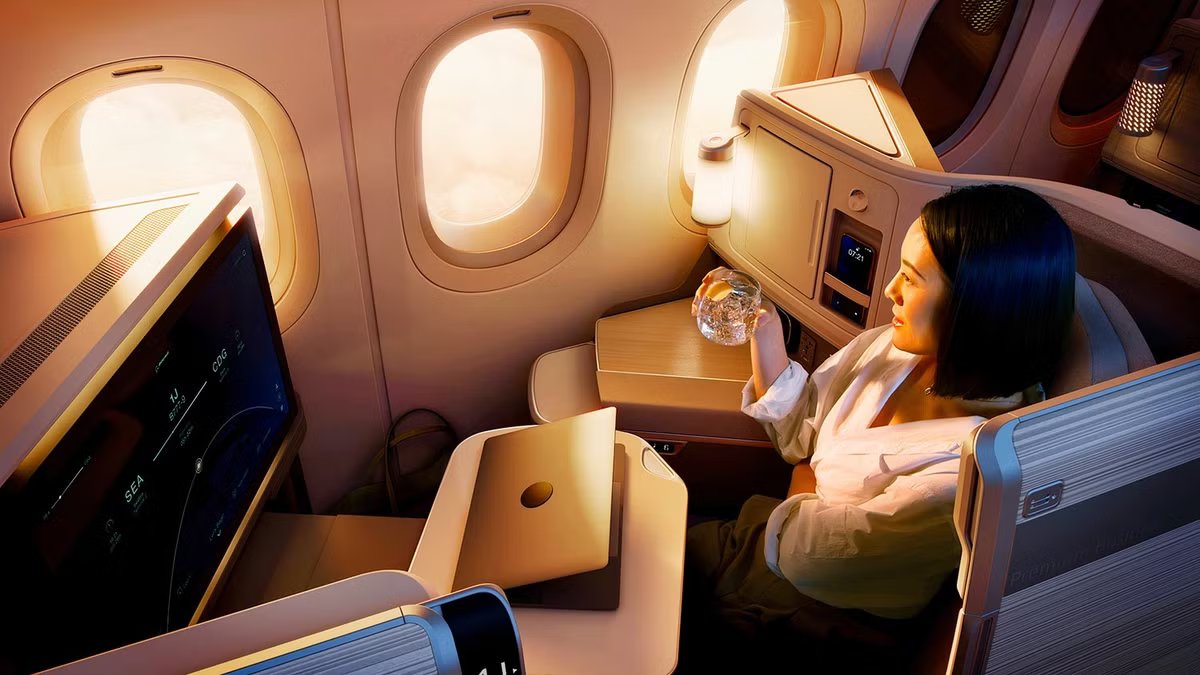
Passengers who have flown frequently on legacy Boeing 777 jets will immediately notice differences when they finally board a Boeing 777X. Its arched ceiling removes the center overhead bins located in premium zones, creating an impression of more space. This cabin is also slightly wider because the fuselage walls are narrower. Passengers can breathe more easily because the cabin is pressurized to a lower altitude and the air is more humid. The windows are also larger and lack pull-down blinds, although airlines can still install them.
The focus should not be on the individual changes, many of which the widebody industry has already seen. For instance, the Boeing 787 already features dimming windows. Instead, Boeing’s engineers have combined a suite of advances to redefine what passengers expect from widebody cabins.
Created Through Pressure From Airlines

The 777 family has always been unique because Boeing designed its cabin with significant airline input. The result has been that customers have continued to put pressure on Boeing in later 777 variants, as has been the case with the 777X. Kent Craver, Boeing’s regional director of cabin experience and revenue analysis, spoke with Aircraft Interiors International about the results of this industry pressure, and the new impetus it has given Boeing:
“You had a great breakthrough with the Dreamliner cabin interior. You need to do it again with the B777X. The B777 cabin is good, the B787 is great, but the B777X needs to be even better.”
“The 777 cabin is pretty tough to beat,” says PJ Wilcynski, payloads chief architect. However, Boeing hopes airlines will find the 777X cabin is even better thanks to its better width, light, attractiveness, and technological development.
The 777X Features Updated Cabin Architecture

All cabins start as a hollow tube which manufacturers and airlines must then fill. Boeing redesigned the 777X’s hollow-tube architecture according to its Sky Interior philosophy, which governs lighting, stowage, ceilings, sidewalls, air filtration, cabin pressure, and humidity in its modern aircraft. The result is improved architecture, despite the 777X having the same cabin cross-section as previous iterations of the 777 family.
First, Boeing’s engineers used the advantages of advanced materials in the sidewalls to make them thinner. This provides an increase in cabin width from 231 inches (587 cm) for the Boeing 777-300ER to 235 inches (597 cm) for the 777X. Airlines now have access to greater flexibility in how they lay out their 777X jets thanks to these four extra inches.
The table below shows specifications relevant to the 777-9 aircraft’s cabin, making use of Boeing’s data:
Cabin highlights | Spaciousness, LED lighting, bigger bins, larger windows |
|---|---|
Cabin width | 235 inches (597 cm) |
Pressurization | 6,000 feet |
Window dimensions | 10.7 inches (27.2 cm) by 18.4 inches (46.7 cm) |
Window area | 196.8 square inches (1,270 square cm) |
Typical two-class seating | 375 to 450 depending on configuration |
The 777X has followed the popular design trend of removing the aircraft’s central stowage bins in business and first-class cabins. The result is a much higher ceiling that makes the cabin feel much more spacious. Reducing the claustrophobic feeling of being aboard an aircraft will let airlines charge more for premium tickets.
Giving 777X Customers A Huge Amount Of Customization

Boeing’s designers have given customers extensive customization options. They now have more choices for customizing sidewalls, stowage bins, ceiling treatments, and even whether the bins are present. Airlines won’t have to design as many of their own customizations, which can greatly increase costs. Airlines will appreciate this flexibility and removal of complexity.
Airlines will also be able to have Boeing configure these customizable presets in complex ways. “Airlines can also have one ceiling treatment in one part of the aircraft and a different ceiling treatment in a different part, with a design cohesion that sees the spaces seamlessly transition from one to the other very elegantly,” explains Kraver.
 Boeing also hopes these customizations will be popular with passengers, particularly frequent long-haul travelers. This means that each time a person boards a 777X, the experience will be slightly different.
Larger Windows Create More Natural Light Than Previous 777s

Another fantastic comfort improvement in the 777X cabin is the windows. They are much larger than those on previous 777 variants. Passengers can enjoy much more natural light, reducing the amount of eye strain and creating a more natural experience. All 777X jets will have windows measuring 162 square inches (1,045 square centimeters). Meanwhile, older 777 variants like the 777-300ER (shown above) have windows measuring 140 square inches (903 square centimeters). This means each window on the 777X is 16% larger than its predecessors.
These windows are not only larger. They also use impressive technology. Instead of pull-down blinds, although some airlines may choose to install them, the windows go dark at night with Gentex Electronically Dimmable Windows (EDWs). The windows have a layer of gel between the panes of glass. They are activated when an electric charge is forced through the gel, which goes dark as a result of a chemical reaction. I remember flying on a Boeing 787 on a return from Kenya well over ten years ago. The technology will be familiar to other regular Dreamliner passengers. Yet, Boeing has made substantial advances to this proven technology for the 777X. The windows will block out 99.999% of visible light and darken twice as quickly.
Finally, Boeing positions its 777X windows higher on the fuselage than in older aircraft. They are also rounder in shape. As a result, you’ll be able to look out of the windows easily while flying, regardless of how tall you are.
The Interiors of the “Terrible Teens” May Never See Operational Use

Boeing currently has a ‘shadow fleet’ of dozens of early-build Boeing 777-9 jets, Simple Flying’s Daniel Osipov reports. These planes have been nicknamed the “Terrible Teens,” and there is a realistic risk that these planes’ interiors may never see active service. The jets, currently stored in Everett, Moses Lake, and Victorville, will need major changes to meet certification standards and enter commercial service. Even then, it may be impossible to deliver these jets, with Emirates and Lufthansa both negotiating against them. They say the aging jets are structurally obsolete and inferior to new-build aircraft fresh off the line.
One of these aging 777X jets, Line Number 1611, has already been scrapped, though Boeing says it was because it was used for structural testing. This aircraft never flew, and Boeing began taking it apart in 2025. The reasoning is that rebuilding the jet would have been too expensive, the project would have been a waste of time and money, and Boeing would have had to sell it at a lower price.
The table below shows the specifications for the 777-9 according to Boeing’s data:
Seats | 375 to 450 (two-class depending on configuration) |
|---|---|
Maximum takeoff weight | 775,000 lb (351,500 kg) |
Range | 8,000 nautical miles (14,800 km) |
Length | 251 feet, 9 inches (76.7 meters) |
Wingspan | 235 feet, 5 inches (71.8 meters) when extended |
Powerplant | GE9X by GE Aerospace |
Earlier this year, rumors suggested United Airlines would buy some of the 777Xs Emirates rejected at a discount, allowing these aircraft’s interior design to enter circulation. United Airlines could become the United States’ first 777X customer at a far lower price. However, the airline has now confirmed that it has “no interest” in purchasing these jets.
A Strike Could Have Caused Delays For 777X’s Interiors Across The Entire Family

It isn’t just certification issues and outdated jets that are slowing Boeing’s plans to revolutionize widebody cabin interiors. Disgruntled workers could push the aircraft’s entry into service further into the long grass. The airline has recently saved 777X certification by offering its engineers a new four-year pay deal.
Under this deal, engineers have received an initial 10% rise. Further pay rises will follow in 2027, 2028, 2029 and 2030. Other changes and perks are also included in the pay deal. Although union members did not unanimously vote in favor of accepting the new contract, enough voted for it to avoid strike action that could have threatened the approaching certification for this much-delayed aircraft.
Towards the end of September, Boeing’s chief Kelly Ortberg confirmed that the planned strike action could have caused a complete certification shutdown. “If we did have a strike, essentially the 777 certification program shuts down until we get the engineers back,” he said, according to The Takeoff Nap. The current strike action has been averted. Yet Boeing’s worker relations have been poor in recent years, so there is always a chance of additional strike action affecting the 777X program.