dailynewsnblog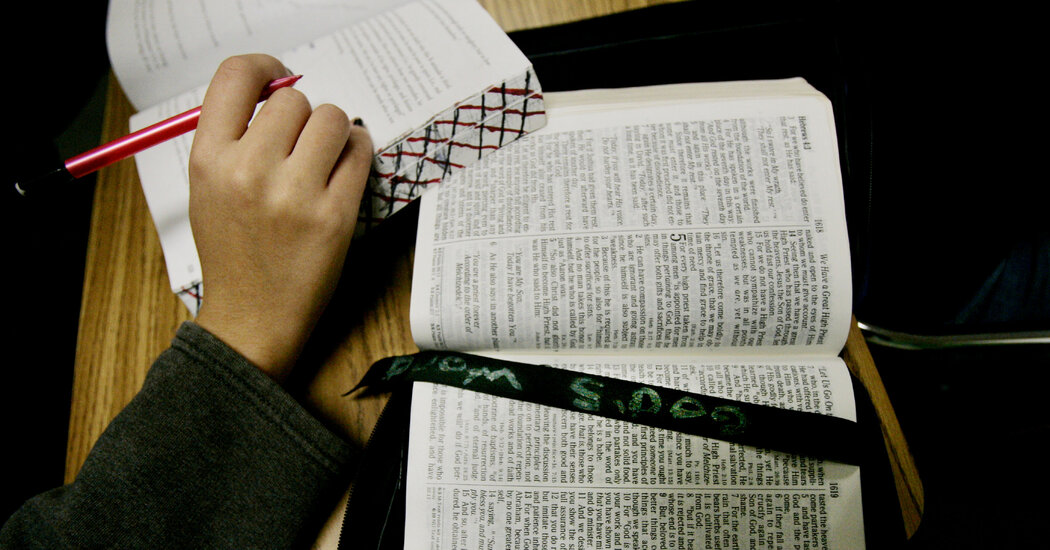
Texas is on the verge of passing a sweeping, new state book list, which will establish for the first time a common set of books that millions of students across the state must read, including excerpts from the Bible.
It is highly unusual — perhaps unprecedented — for a state, rather than a school or a teacher, to mandate a reading list for every grade level for all public school students.
If approved, the list will shape what a generation of Texas students grows up reading. The state is home to more than five million public school students, 11 percent of the total U.S. public school population.
The list was being debated by the Texas State Board of Education this week. It is expected to be approved on Friday. While the specific texts were still being edited and finalized, the list is expected to reflect the priorities of the state board, which has a 10-to-5 Republican majority.
The proposal being considered put a focus on classic literature, with books like “Charlotte’s Web” by E.B. White (third grade), “Night” by Elie Wiesel (eighth grade) and “Hamlet” by William Shakespeare (12th grade).
At least one Bible excerpt is included in most grade levels, starting in late elementary school, which has spurred fierce debate.
Texas education officials say the Bible is an essential piece of literature and important for understanding America’s founding and culture. Critics argue that including it in English class violates separation of church and state, and is part of a broader effort to infuse Christianity in Texas public schools.
“The government of Texas, let alone any American government body, should never be in the business of imposing one religion on everyone,” said Rachel Laser, president of Americans United for Separation of Church and State, which has challenged a law requiring the display of the Ten Commandments in Texas classrooms.
The new Texas list is also an effort to raise the level of rigor and get more students reading. Fewer students are reading full books in English class or at home, and U.S. reading scores are in a decade-long slump. Some education leaders and policymakers believe emphasizing whole books is increasingly essential for combating the rise of tech, specifically A.I.
The Texas list comes in response to a 2023 state law that required state education officials to select at least one literary work in each grade level.
The state board went further, outlining a number of texts in each grade. Texas teachers will still be able to teach books off the list, but they will need to find the time, on top of the ones required.
The selections have drawn criticism for putting an emphasis on older texts, often written by white and male authors, in a state where more than half of students are Hispanic or Black.
“With a list that’s so extensive, would teachers have the time or space to choose texts that are a great fit for their students, their classrooms, their region?” said Markesha Tisby, president of the Texas Council of Teachers of English Language Arts, which has argued for narrowing the list to allow teachers more choice.
“Texas is extremely large,” she said, “and very diverse.”
The list focuses on classic literature
The proposed list for K-12 students before the board included about 200 texts.
For elementary school students, the list included classics like “The Very Hungry Caterpillar” by Eric Carle. It also had a number of books about U.S. founding fathers and historical figures, as well as excerpts from “The Children’s Book of Virtues,” an anthology of stories edited by William J. Bennett, the secretary of education under President Ronald Reagan.
In middle and high school, two main books would be required each year, along with other related poems, speeches, historical texts and biblical excerpts.
For example, 10th graders would read “The Tragedy of Julius Caesar” by William Shakespeare, and “The Inferno” by Dante Alighieri. Among other texts, they would also read the Rev. Dr. Martin Luther King Jr.’s “I’ve Been to the Mountain Top” speech; Edgar Allan Poe’s famous poem “The Raven”; Margaret Thatcher’s eulogy for Mr. Reagan; and an excerpt from the Book of Job.
The list aligns with a classical approach to education, popular with conservatives, that posits students should read texts that have stood the test of time.
“You don’t get to know what a classic is until 50, 60 years after the author is dead,” said Jeremy Tate, the founder of the Classic Learning Test, an alternative to the SAT and ACT.
While deciding upon a shared set of texts is bound to stir debate, he said, “it’s better to have a common canon that can provide some cultural common ground — a basis to argue around — rather than no canon at all.”
Democratic members of the state board and some Texas educators have criticized the list’s lack of diversity across race, geography and time period, arguing that it will make it more difficult to engage students.
“There is a real attempt for students to not see themselves in these lists,” said Jonna Perrillo, an English professor at the University of Texas at El Paso, who noted that there are few Texas authors and few contemporary books on the list, particularly at the high school level.
Biblical passages would be required in most grades
Under the proposed list, students would read at least one Bible excerpt each year, starting in fourth grade.
Excerpts include “The Necessity of Humility” by the Gospel of Luke and “To Everything There is a Season” from the Book of Ecclesiastes. In middle and high school, Bible selections are included in thematic units along with a book. For example, the “Definition of Love,” from First Corinthians, would be taught alongside “Pride and Prejudice” by Jane Austen in 12th grade.
“There is a difference between proselytizing and utilizing great pieces of literature,” said Mandy Drogin, a senior fellow at the Texas Public Policy Foundation, a conservative think tank that has supported the changes.
But the list has drawn objections from teachers, parents, students and religious leaders who testified before the board this week.
David Segal, a rabbi who works for the Baptist Joint Committee for Religious Liberty, testified that the list shows a preference for evangelical Christian versions of the Bible, often the King James version, that risks “an unconstitutional endorsement” of religion.
What’s not on the list
The proposed Texas list does not include some of the most commonly taught books around the country, including “Romeo and Juliet” and “The Great Gatsby,” the No. 1 and No. 2. most assigned books in U.S. high schools, according to the National Council of Teachers of English.
It also avoids some popular classics that have been contested in recent years, like “To Kill a Mockingbird.”
Those books are among the top books currently taught in Texas high schools, according to research by Dr. Perrillo, the UTEP professor, and Andrew Newman of Stony Brook University, who surveyed 1,250 high school English teachers, including almost 200 from Texas, in 2024.
On the survey, Texas teachers reported teaching a variety of other books, including some contemporary novels like “All the Light We Cannot See,” a 2014 novel by Anthony Doerr that won a Pulitzer Prize for fiction.
The question of what to include as essential literature is not new. The College Board, for example, has long encouraged teachers to teach certain texts, like “Frankenstein,” in Advanced Placement literature classes because they are likely to show up on the end-of-year A.P. exam.
And some charter school networks like Great Hearts, which runs schools in Texas and Arizona, and Success Academy, in New York City, have rigorous lists of books that students are expected to read.
But the Texas list would be a rare attempt at creating a shared canon for an entire state. The list was still being edited this week. Texas officials voted to remove a picture book on Noah’s Ark for first graders, for example, but keep a book on Johnny Appleseed in second grade.
If approved, the list would be required to be in place by the 2030 school year.