(Bloomberg) — Treasury Secretary Scott Bessent came to office blasting his predecessor for trying to re-engineer the world’s largest bond market. This week he took a stab at it himself.
Most Read from Bloomberg
By buying back a swath of long-term US debt, which will require selling more short-dated securities, Bessent said Thursday he’ll be doing “what I would call a Treasury twist.” It was a nod to the Federal Reserve’s famous 1960s plan to rejigger Treasury yields. Right now, Bessent said, those yields are out of whack with “equilibrium” levels.
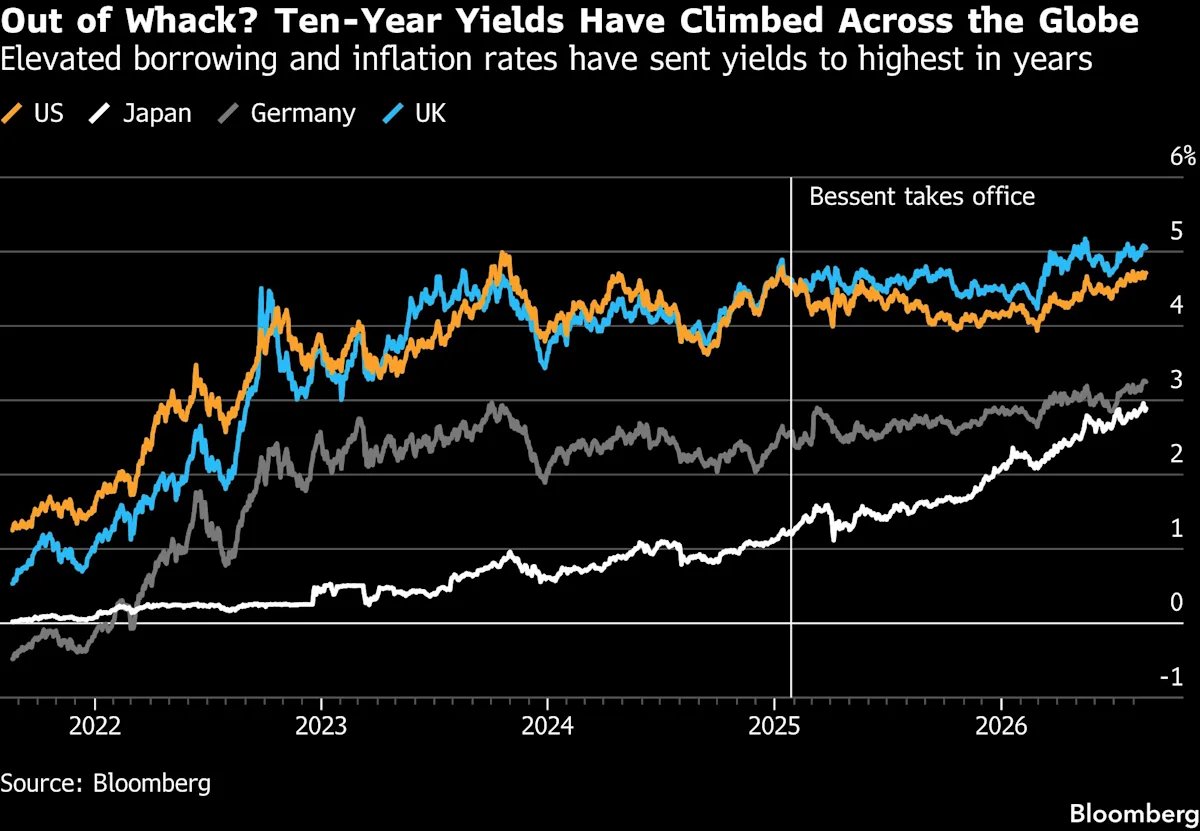
And twist Treasuries did — for a day. Yields on the long bonds dropped sharply on Wednesday after the plan was announced. But then they climbed straight back up. Bessent’s favored 10-year benchmark closed the week at 4.73%, near the highest since he took office.
All of this suggests that the Treasury chief’s drive to get borrowing costs down, especially with November’s midterm election looming, is running into forces beyond his control that are pushing them up.
That includes record debt levels not just in the US, where one gauge surpassed $40 trillion this week, but across developed nations. There’s a surge in corporate issuance too, led by the artificial intelligence boom. Inflation has jumped since President Donald Trump upended energy markets by starting a war with Iran, and confusion over Fed Chairman Kevin Warsh’s strategy is adding to investor concerns.
“Every route to lasting relief for the long end runs through something the administration doesn’t want,” said Matt King, founder of Satori Insights. He said a smaller US budget deficit, a slide in the stock market or a decline in AI investment could bring longer-term yields down.
‘Back to Normal’
Some market participants don’t reckon there was anything out of whack to begin with.
“I think we are back to normal interest rates, 4% to 5% is normal,” Edward Yardeni — who coined the term “bond vigilantes” — told Bloomberg TV about an hour before Bessent’s shock move. And while the Treasury said its intervention was to support liquidity, JPMorgan Chase & Co.’s rates strategy desk reported Thursday that “market functioning has improved notably this year.”
Bessent’s vision of yield-curve control, or influencing rates across different maturities, extends beyond Treasuries. It includes the so-called hyperscalers, companies pouring money into AI and borrowing to do it. Earlier this month, Alphabet Inc. sold bonds ranging up to 40 years.
The investment will pay off eventually in the form of faster and non-inflationary economic growth — but meantime “it is causing a short-term competition for capital,” the Treasury chief said this week. “If I were sitting in the chief financial officer’s seat, I would think about issuing more what’s called the belly debt,” or five-year maturities.
The apparent attempts to shape yields even prompted debate over whether there’s now a “Bessent put,” an echo of the old belief that former Fed Chair Alan Greenspan would always bail out the stock market.
Chris Turner, global head of markets at ING Groep NV, was among those using the term this week, though many doubt that Bessent has the firepower to pull off anything similar for bond yields.
The Treasury didn’t respond to a request for comment about Bessent’s bond-market interventions.
‘Bad Information’
Addressing the climb in Treasury yields, Bessent said investors are acting on “bad information” while he has “asymmetric” access to the real picture.
“There’s been a lot of misinformation in terms of what’s going on with the deficit,” he said, vowing to refocus attention on what he described as Trump’s fiscal-consolidation program.
What Bloomberg Strategists Say…
“Bessent cannot control inflation expectations nor force nominal long rates down, thus the use of buybacks to remove some less-liquid duration securities from circulation. The latest plan though must convince investors that planned buybacks are a bridge to a better debt trajectory rather than an effort to suppress yields without addressing deficits.”
Alyce Andres, MLIV macro strategist. For the full analysis, click here.
In coming days, Bessent said he and White House budget chief Russ Vought “will be examining both on the revenue side and the cost side what we can do.” He suggested a crackdown on fraud, and reductions in transfers to states.
The Elon Musk-led Department of Government Efficiency attempted something on similar lines last year, but fell short of its own estimates for spending cuts.
“We are skeptical the administration can realistically do anything at this point on the deficit that would be material,” Sarah Bianchi, chief strategist at Evercore ISI, wrote in a note.
Besides the Treasury’s interest bill — now running well in excess of $1 trillion a year — Social Security, Medicare and Medicaid spending are the main drivers of a fiscal deficit forecast at around 6% of GDP this year. Overhauling those entitlement programs is “a non-starter in the near term,” and even more so after November if Democrats win at least one chamber of Congress, Bianchi wrote.
Bessent vs Warsh?
What does lie within Bessent’s authority is revamping debt sales and buybacks.
This week’s move came two weeks after a tweak in the Treasury’s broader forward guidance on issuance. That, analysts said, opened the door to potential cuts in sales of the longest-dated securities — the ones with the highest yields.
Such steps look a lot like the debt-issuance tactics of Janet Yellen, which Bessent used to criticize. They also point to an implicit split with Warsh.
Far from calling out yields as out-of-equilibrium, Warsh has come close to endorsing their rise. While the Fed hadn’t tightened policy in the face of higher inflation, “markets have done quite a bit,” he said on July 29. “Market prices will continue to respond in the direction and magnitude they see fit.”
Warsh has his own key communications moment looming, in his speech Friday at the Kansas City Fed’s annual Jackson Hole symposium.
Investors will be watching to see whether he’ll seek to repair credibility after a poorly received press conference last month. Warsh failed to articulate a rationale for keeping rates unchanged, avoided any suggestion they would be raised in the coming months and suggested the Fed’s inflation target could be altered in January.
‘Flip the Script’
“Warsh would really flip the script if he actually explained how they’re going to provide metrics, how he’s using the information, and there’s a game plan for the next three to six months,” said George Goncalves, head of US macro strategy at MUFG. “At least provide markets with what to look out for.”
Warsh wants to revamp the central bank’s balance sheet, which currently features some $4.54 trillion of Treasuries. He’s also spoken of a new “Fed-Treasury accord,” without spelling out what that would involve.
The original pact, in 1951, dramatically limited the Fed’s footprint in the bond market and ended the strategy of yield-curve control. If US policymakers really want to drive borrowing costs down now, it might require a move in the opposite direction.
“Buybacks are more signal than substance” and even larger ones wouldn’t shift market dynamics, according to Rebecca Patterson, a JPMorgan and Bridgewater Associates veteran who’s now a senior fellow at the Council on Foreign Relations. “The more effective — and sustainable — policy approach is through Fed quantitative easing.”
Bessent referred to sustained QE, or Fed bond purchases, as a “perpetual dosing regimen” before he was in office. Warsh opposed QE in the early 2010s when he was on the Fed board, and has been one of its most vociferous critics since.
Absent such an about-face by the duo, it’s investors who are setting the yield curve.
“The economy has been resilient and there is a global competition for capital,” said Priya Misra, a portfolio manager at JPMorgan Asset Management. “It makes sense that rates have been moving higher.”
–With assistance from Alice Gledhill and Jorgelina do Rosario.
Most Read from Bloomberg Businessweek
©2026 Bloomberg L.P.


 dailynewsnblog