dailynewsnblog
Beni is not only changing how consumers discover resale fashion apparel, footwear and accessories, but the app is also changing how shoppers buy products. The app’s tagline, “Shop you style, secondhand,” also zeros in on how personalized the experience is for consumers.
The app searches more than 40 resale marketplaces. Users can upload a photo or use a screenshot, and Beni will search for the closest match. Consumers can shop from Instagram. They can also curate a shop of items and follow other curators.
Here, Kate Sanner, CEO and founder of Beni, tells Sourcing Journal why she launched the app, how it works and the value it brings to the market.
Sourcing Journal: What was the exact “aha” moment or frustration that inspired you to start Beni?
Kate Sanner: The insight behind Beni was that people were being asked to work too hard to shop secondhand. You could find something you loved on a retail site in seconds, but finding it resale meant opening multiple tabs, trying different keywords and sorting through hundreds of listings.
The inventory already existed. The missing piece was making it easy to find.
My background is in consumer marketing, so I think a lot about what actually changes behavior. Asking people to make a more sustainable choice only gets you so far. That choice also has to work for their lives. With Beni, we saw an opportunity to make secondhand compelling on its own merits: better quality, lower prices and access to things you wouldn’t find in stores today.
SJ: How does Beni work behind the scenes?
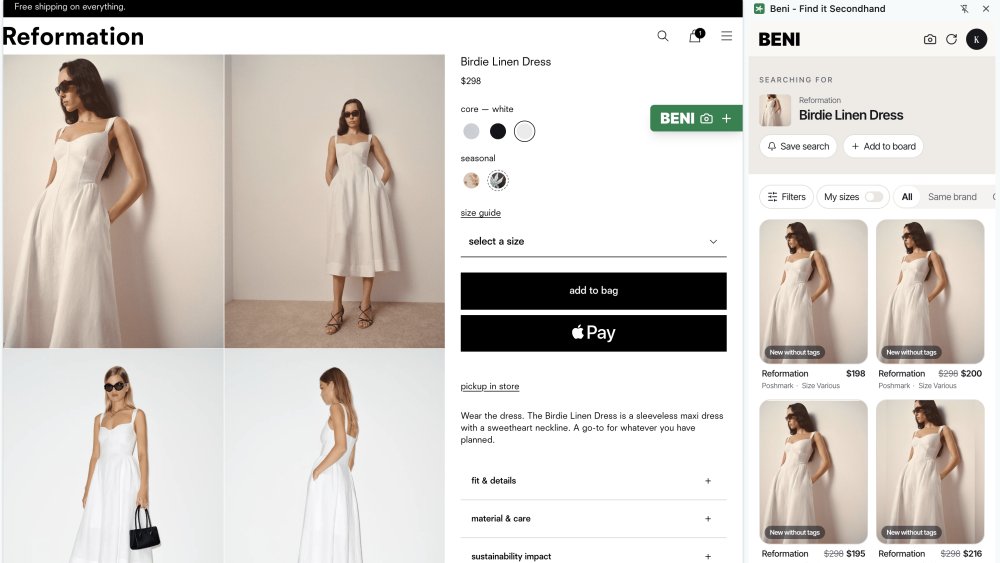
K.S.: There are a few ways in. If you’re browsing a retail site, our browser extension helps you find similar secondhand options. If you see an outfit you love on Instagram or out in the world, you can use a screenshot or photo to search with Beni Lens. You can also search directly using words, brands or a description of what you’re looking for.
Behind the scenes, we bring inventory from more than 40 resale marketplaces into one searchable catalog. Our technology looks at images alongside product descriptions and details to understand what you’re looking for, then helps narrow the results by things like size, brand preferences, and price.
That matters because resale listings aren’t consistent. Two sellers might describe the same jacket completely differently. Visual search helps bridge that gap—you can show us what you mean without knowing exactly what to call it.
SJ: What is Beni’s core value proposition?
K.S.: Beni helps you find the good stuff without spending hours hunting for it.
We bring a fragmented market of amazing secondhand and vintage pieces into one place so you can spend less time searching and get more for your money. Often, that means being able to afford a better-made piece secondhand than you could ever buy new.
The environmental benefit comes from making better use of what already exists. But we want people to use Beni because it’s useful and because they love what they find. Saving money, expressing your style, and shopping secondhand can all be part of the same decision.
SJ: How do visual search and social sharing change discovery?
K.S.: They let discovery start wherever inspiration happens.
You might see a jacket in a friend’s outfit, a vintage dress in a photograph or a post from someone whose style you love. You don’t necessarily know the brand or the right search terms. With visual search, that image becomes a starting point.
Sharing also makes secondhand discovery more social. People can exchange ideas and finds and introduce each other to pieces they might never have searched for themselves.
What excites me is that resale opens up decades of style. You’re able to explore beyond what brands happen to be selling this season and develop a point of view that feels like your own.

Users can grab a screen shot, and Beni will search for the item.
SJ: How does Beni make sustainable habits more convenient?
K.S.: We meet people at the moment they’re already thinking about shopping. If you’re looking at a dress online, Beni helps you check secondhand while that inspiration is still fresh.
We also take away some of the repetitive work: searching individual marketplaces, translating an image into keywords, and checking again when you haven’t found the right thing. With a saved search, Beni can keep hunting as inventory changes.
The goal is to make “check Beni before you check out” feel like a natural part of shopping. You still get the pleasure of discovering something special, with much less work getting there.
SJ: Where do you see Beni heading next?
K.S.: I think the bigger opportunity is helping people build their personal style over time.
Shopping and buying are two different things. Shopping is figuring out what you like: exploring, collecting inspiration, learning about quality, and seeing how other people put things together. Buying is executing once you know what you want.
We want to give people space for that first part, then make the second part easier. That means helping them save inspiration from anywhere, organize it, and find the right piece when they’re ready—even if it takes time for that piece to become available secondhand.
My hope is that resale becomes a natural starting point for finding what you love. It offers an extraordinary range of styles, price points and history. Beni’s role is to make that world easier to explore and participate in.