dailynewsnblog
“That’s tough to think about. It’s a whole lot earlier than the next year and a half that the station’s going to be in orbit, and so thinking about our priorities and what we need to bring home is a big question,” Landon said. “I probably have a better appreciation today for the legacy and the heritage and other hardware to bring home, so that’ll be an interesting discussion, as far as weight and volume.”
The demand for storage on the remaining rides home for legacy and preservation purposes will compete with the station’s primary purpose: conducting and returning science.
Credit:
NASA
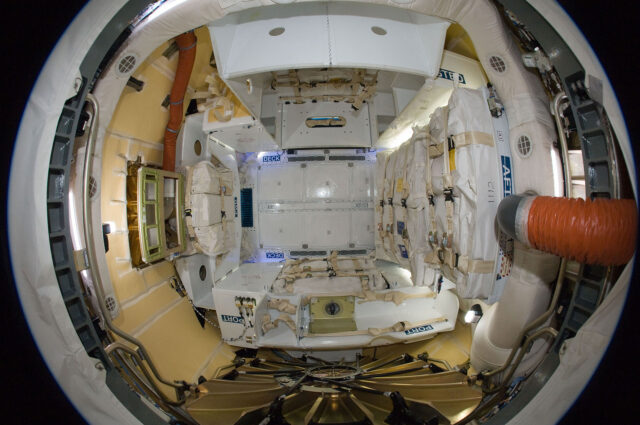
Fish-eye image of the inside of a fully packed SpaceX Dragon cargo spacecraft, like the type used to launch supplies to the International Space Station and return equipment back to Earth.
Credit:
NASA
“We obviously seek to continue to utilize the International Space Station right up until that last moment when Ryan turns the lights out and sends things back home, so there will be drivers to maintain as much science capacity on those final return vehicles as we can,” said Michael Roberts, chief scientist for the ISS National Lab. “But it’s not lost on anyone that there is a tremendous scientific knowledge, as well as historical knowledge, that can be retained from the return of some of that instrumentation that’s up there.”
So the likelihood of returning everything that everyone wants from the ISS before the shipments end is low.
The data that is already on the ground, as well as the hardware that has been brought back over the past two and a half decades, will help fill some of those gaps, but of even more importance will be capturing the stories from the people who put the space station up there and made it into the one-of-a-kind facility it is today, said Brian Odom, NASA’s chief historian.
“The window of that opportunity is going to close so quickly. Let’s get the historians together. Let’s look at this program, people who are familiar, let’s get them in contact with the practitioners, with the engineers, with the scientists, with the astronauts and really determine what have been the big themes,” said Odom, calling for an oral history initiative. “Let’s use this opportunity to do just that, and then begin the process of crafting a narrative.”
Disclosure: collectSPACE’s editor, the author of this article, was also a panel member, representing the worldwide community of space memorabilia collectors.
Watch all three Saving ISS Heritage panel discussions from the 2026 ASCEND conference at collectSPACE.