dailynewsnblog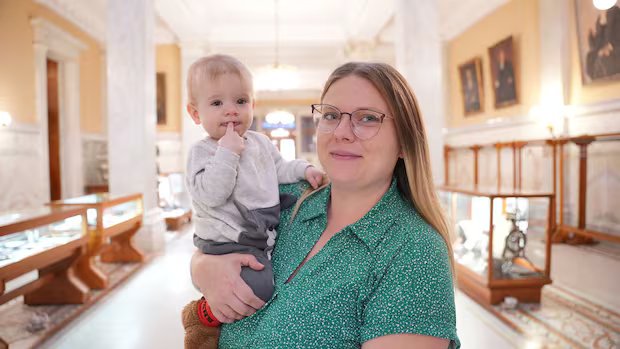
On the hottest days last summer, Lyndsay MacKay would arrive at her 16-month-old son’s daycare to find him in a diaper, his skin sticky and his hair plastered to his head.
He would collapse in her arms. Some nights, he’d fall asleep at the dinner table.
She said she knew the educators were doing what they could: ice cubes in the water tables, offering popsicles, darkening the rooms and placing cool cloths on the infants and toddlers.
“But at the end of the day, they’re still hot, they’re sweaty, they’re exhausted,” said the Toronto mother and early childhood education professor at Humber Polytechnic.
“From a health and safety and from a development perspective, the children are not — the children are almost just surviving the day.”
MacKay is among the growing number of parents, educators, health and legal advocates across Canada lobbying for maximum indoor temperature at daycares, likely 26 C, akin to standards adopted for long-term care facilities in Ontario.
Like seniors, infants, toddlers and preschool-aged children are at a higher risk of developing heat exhaustion and its more severe form, heatstroke.
In part, it’s because they have a higher metabolism than adults, creating more heat in their bodies. And, since their sweat glands are less efficient, it’s harder to cool down. Plus, babies and young toddlers can’t tell caregivers they’re overheated.
What to watch for
Even preschoolers likely can’t recognize what’s happening, said Dr. Kirstin Weerdenburg, a pediatrician in the emergency department at Halifax’s IWK Health Centre.
“They don’t have a way to explain how they’re feeling, so it’s [about] knowing their behaviours and all those other physical signs and symptoms,” she said.
“If someone’s not paying attention to that, they might get, you know, looked over until you get to the more extremes.”

In young children, Weerdenburg said, symptoms can look like fatigue, flushed skin, irritability — even having trouble walking, which is a sign of dizziness.
But heat illness presents on a spectrum, so if kids are acting out of character on a hot day, she said it’s worth paying attention.
Kids can often be treated at home with fluids and a cool room. But extreme cases of dehydration can make babies or young children too tired to drink, so they require IV fluids, the pediatrician said.
In the most severe cases, organs like the liver and kidney can shut down as the body redirects blood to the skin to help cool it. The heart speeds up, causing an arrhythmia, as it tries to pump more blood faster.
Keeping watch in the heat
Watching for signs of heatstroke is stressful for educators, said Amy O’Neil, executive director of Toronto’s Treetop Children’s Centre, noting they’re not health-care professionals and don’t have the training to make a diagnosis.
It’s why she introduced air-conditioning at her child-care centre in 2019, and why she thinks the provincial and federal governments should also consider high temperatures in daycares to be unacceptable.
It’s not a “comfort issue” but a matter of safety, said O’Neil, who is also board chair of Toronto Community for Better Child Care, an advocacy group of parents and educators for well-funded, publicly available child care.
“It’s really hard to understand why the legislation — and in Ontario, it’s the Child Care and Early Years Act — is so clear about maintaining minimum indoor temperatures in the winter, yet it’s completely silent on maximum indoor temperatures during extreme heat.”

New research from the University of B.C. suggests summers are quickly stretching further into the spring and fall. To explain what this means for the Lower Mainland, CBC’s Michelle Eliot spoke with the lead researcher of the study, Ted Scott, who said the change will lead to extreme heat and more forest fires.
It cost upwards of $40,000, between $5,000 and $7,000 for each unit, to install eight air conditioners in June 2019, O’Neil said, paid for from the centre’s reserve fund.
“It’s a lot of money for a non-profit community-based child-care centre to swallow.”

Ontario Premier Doug Ford did say last summer that he would “look at” maximum indoor temperatures in daycare.
“I can’t answer if we’re putting ’em into standards,” he told The Trillium in August 2025 in response to a question about temperature regulations. “We did that with the long-term care, now they all have air conditioning, and so we’ll look at it with the kids as well.”
It doesn’t appear there has been any movement on the issue.
In response to an email to Ford’s office asking about an update this week, the education minister’s office instead provided a statement.
“Licensed child-care operators are responsible for providing a safe environment for the children in their care, including taking appropriate steps to protect them during periods of extreme heat,” said part of the statement from Minister Paul Calandra’s office.
What the regulations say
Other provinces have similarly vague regulations. None have instituted maximum indoor temperatures, though some regions require a heat source in the winter.
In B.C., regulations under the Community Care and Assisted Living Act require only that licensed daycares “provide a healthy and safe environment and maintain emergency response procedures,” according to a statement from the province’s Ministry of Health.
While the regulations do “not establish a specific indoor temperature limit,” the statement notes that provincial health authorities have guidelines recommending the 26 C threshold, though these are not enshrined in law.
In Nova Scotia, a campaign recently launched by the parent advocacy group For Our Kids to regulate temperatures in schools, where many daycares operate year-round. Though the province’s Early Learning and Child Care Regulations includes detailed guidelines about other essentials — providing developmentally appropriate toys, utensils and a safe place and opportunity for sleep — there is nothing about maintaining safe temperatures.
It’s unclear, too, how many daycares across Canada have air-conditioning.
Getting that data and monitoring exactly how hot daycare classrooms are getting is critical, according to Jacqueline Wilson of the Canadian Environmental Law Association. CELA has been calling both for maximum indoor temperature legislation and funding for retrofitting, noting that Ontario was able to do that for the long-term care industry in 2021.

While there’s significant research showing that a maximum temperature of 26 C is appropriate for older adults, children’s bodies may require an even lower threshold, Wilson said.
In its 2025 report on daycare temperatures, CELA suggests the exact temperature should be revisited every two years as more evidence becomes available and summers get hotter. Indeed, Environment and Climate Change released a forecast earlier this year suggesting that 2026 to 2030 is expected to be the warmest five-year period ever recorded.
More wildfires, too
Wildfires are increasing alongside summer temperatures, something Kate Lawes contended with when at her daycare, Tree of Life Nature Play School in Victoria.
She jokingly recalls how her public health authority used to issue “slip, slap, slop” heat advisory notices. Now, they focus on extreme temperatures, wildfires and air quality.
On the warmest days, she used to plan outings by the ocean or the forest — where the temperature would often be five to 10 degrees cooler. But the wildfires and accompanying air quality warnings make that impossible, the daycare manager said, as does opening the windows to allow cooler air inside in the early morning.
“We err on the side of caution,” she said. “Their lungs are still growing and developing.”

She closed her school during the heat dome in 2021 that killed 619 people in B.C. and led to a maximum heat bylaw enacted in New Westminster, B.C., this summer for tenancy buildings.
It also prompted her daycare to buy a heat pump, an electric device that provides cooling in summer and heat in winter, which wasn’t covered by the province’s emergency preparedness fund.
Now the children and staff feel comfortable, she said, and it’s lifted the stress that kids might become sick from the heat.
In Toronto, MacKay is thankful her son’s daycare now has air-conditioning.
“He has energy,” she said. “He’s bright. He’s not a wet noodle — he is a live wire.”