dailynewsnblog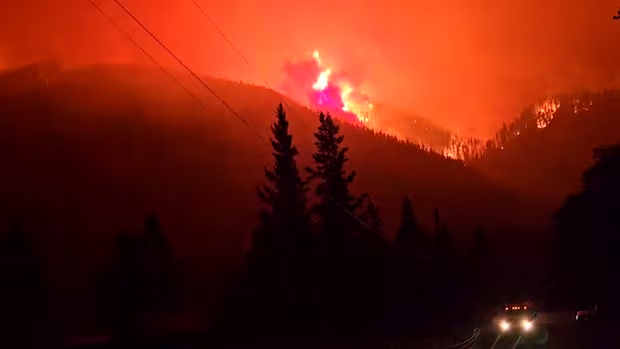

Listen to this article
Estimated 3 minutes
The audio version of this article is generated by AI-based technology. Mispronunciations can occur. We are working with our partners to continually review and improve the results.
In the summer of 2025, wildfires across Canada burned about 73,000 square kilometres of land – more than double the 10-year national average.
In B.C., that year was less destructive compared to the previous two wildfire seasons, according to the province. Still, wildfires burned roughly 8,860 square kilometres of land.
Now, a new report has found that wildfire smoke is a leading source of fine particulate matter (PM2.5) pollution in B.C.
“This isn’t a one-time-in-a-life exposure anymore,” said Prem Gundarah, health initiatives manager with the B.C. Lung Foundation, which released its State of the Air report on Monday.
Gundarah said the biggest takeaway from the report is that B.C.’s air quality is “really worsening” due to wildfires and wildfire smoke.
Microparticles like PM2.5 enter the bloodstream when inhaled, which can immediately cause irritation and have long-term implications.
Gundarah said research shows that regular exposure to PM2.5 can lead to adverse health outcomes, such as increasing the risk of heart attack, stroke, or developing dementia.
It can also affect a fetus during various stages of pregnancy and lead to low birth weight.
Dr. Chris Carlsten, professor of medicine and head of respiratory medicine with the University of British Columbia, explained a process called “oxidative stress.”
He said when PM2.5 hits the airways, inflammation will narrow the size of those tubes, and scar tissue left behind will restrict future movement to open and close when needed.
He also said that heat can lead to a higher respiratory rate, making people inhale more pollutants even faster.
“Visits to hospital, visits to physicians, use of medications for asthma has [all] increased in association with the worsening air quality due to fires,” Carlsten said.
The report estimates that PM2.5 contributes to the premature deaths of roughly 1,900 people in the province every year.
It found that while nitrogen dioxide and sulphur dioxide levels – often associated with transportation and industrial pollution – have generally trended down over the past decade, PM2.5 levels have been rising with wildfire activity. The report shows that nitrogen dioxide levels have generally declined over the past three decades, with sulphur dioxide levels declining over the past ten years.
In 2025, all 52 nitrogen dioxide monitoring stations were below B.C.’s annual target, and nearly all (34 of 35) sulphur dioxide monitoring stations were below the new federal standard.
But 12 of 59 PM2.5 monitoring stations were above the province’s daily objective in 2025.
Simon Fraser University assistant professor and climate change scientist Sian Kou-Giesbrecht said wildfire activity is increasing as a result of climate change.
“These events are becoming more common and they will continue to become more common.”
She said that increased activity can be attributed to higher atmospheric carbon dioxide emissions, driven primarily by fossil fuels, causing higher temperatures.
The commitment to limiting global warming to two degrees Celsius, Kou-Giesbrecht said, is the best line of defence against a future in which the “normal season” would look a lot more like Canada’s record-breaking 2023 wildfire season.