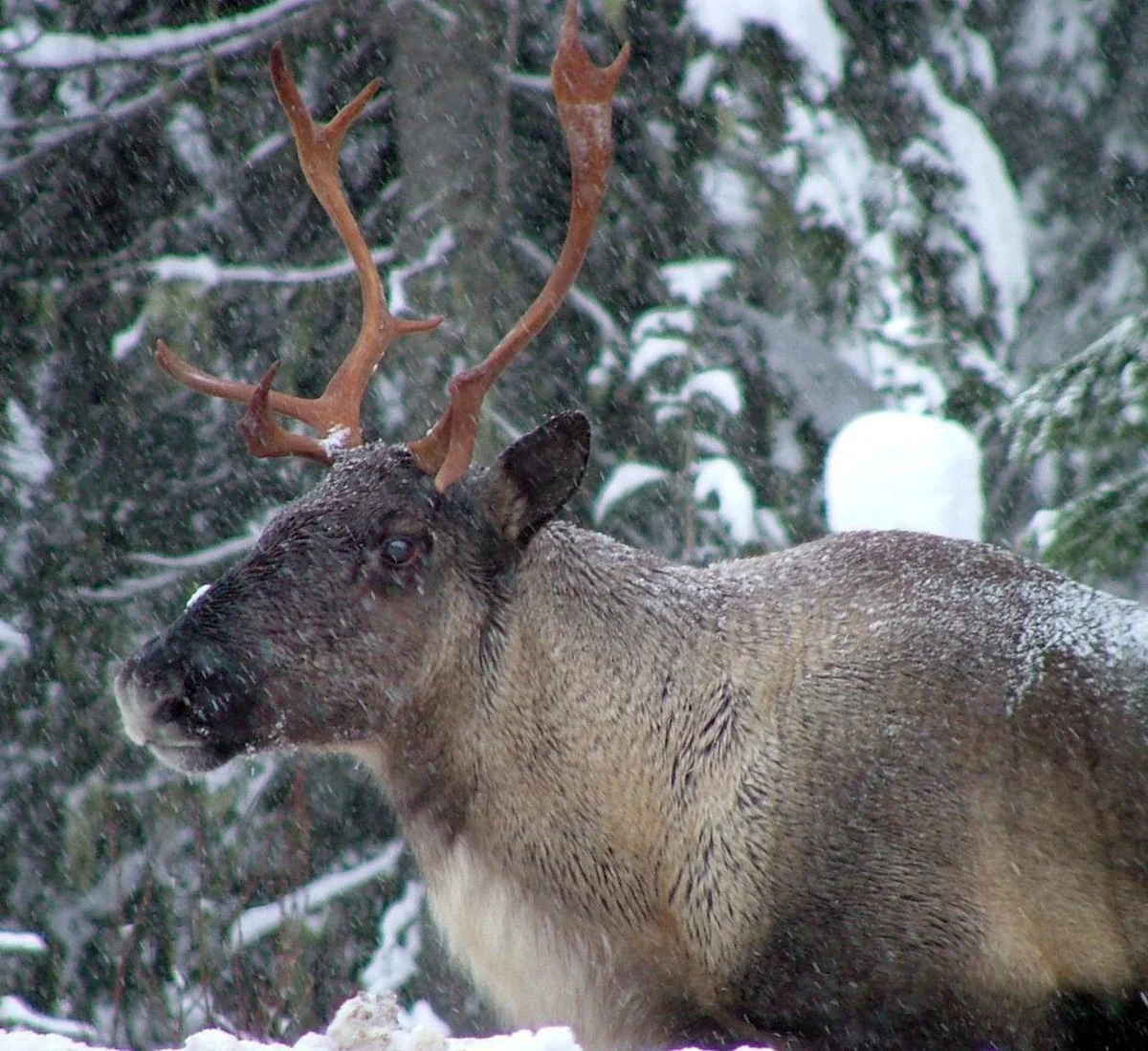
VICTORIA — Mike James doesn’t know yet whether his first grandchild will be a boy or girl, but he hopes they will have a chance to see threatened southern mountain caribou during a future visit to his family’s cabin near Quesnel Lake.
The snowshoe-like hoofs of southern mountain caribou, also called deep snow caribou, allow them to feed on lichens that grow in high-altitude parts of old-growth forest.
The habitat range of the caribou lies mainly in eastern B.C. stretching from the north-central regions of the province southwards, with some pockets in western B.C. and along the U.S. border.
But decades of logging have destroyed their habitat, reducing their overall numbers to fewer than 1,400 spread across 18 herds, according to government figures from 2023.
There are said to be just under 200 in the area near James’ family cabin, but he said he fears for their future after the Ministry of Forests allowed West Fraser Timber to log in the area — even after the Ministry of Water, Land and Resource Stewardship recommended against it.
“It just leaves me speechless,” he said.” How can this be? This is the wolf protecting the hen house.”
Southern mountain caribou were listed as threatened in 2003 under Canada’s Species at Risk Act.
“This was completely egregious,” James said. “How can you be issuing permits for logging, when the scientists, educated biologists, are saying that you are going to adversely impact a nearly extinct protected animal?”
The recommendation against logging appears in a July 2025 memo, which a group of residents had requested and received from the Ministry of Water, Land and Resource Stewardship.
The memo to the Forests Ministry assesses the potential impacts of granting the company permits to log in four areas, and concludes the proposed logging would fall within “core” and nearby habitats used by the caribou.
It says the herd living in the area depends on undisturbed forests not only for food, but also for raising calves and protecting themselves against predators.
Changes to the landscape caused by commercial logging such as cutblocks and roads reduce the caribou’s sources of food, while making it easier for their predators to hunt them, the memo says.
“The loss of mature and old forest will negatively impact this caribou population by decreasing their access to habitat attributes that support their ability to be self-sustaining,” it reads.
The authors say the proposed permits would further disturb habitat that has already been disturbed, as it questions West Fraser’s data.
“West Fraser stated that there will be a total of 200 (hectares) of new harvest for all four (cutting permits), however, the area for the three block we received information for totalled 329.9 (hectares),” it says.
Counting various buffers, the total disturbances could add up to an area of 815.2 hectares, with some overlap with already existing disturbances.
But the memo did not stop the Ministry of Forests from issuing a permit for one of the areas about a month later.
Lucero Gonzales, conservation and policy campaigner with the Wilderness Committee, said it was not clear when the area was cut, but satellite photos taken in early May show the area has already been logged.
She too is concerned that one ministry would permit logging even after another ministry recommended against it.
She said her organization sees only one reason: B.C.’s government, specifically, the Ministry of Forests, is prioritizing industry.
“I believe that right now, the Ministry of Forests is acting with what we can consider as complete impunity in terms of protecting species at risk and protecting the forest in the province,” she said.
“There is no other explanation of why they would decide to ignore not only the advice of another ministry, but their own responsibility to protect species at risk listed under the Species At Risk Act.”
The Ministry of Forests said in a statement that it considers many factors, when it comes to issuing a cutting or road permit.
Those include public safety, the management and conservation of forest resources, and input from experts such as caribou recovery specialists, it said.
“The ministry may refuse to issue a cutting or road permit if it considers the impacts to the above values not acceptable,” it reads.
The Ministry of Water, Land and Resource Stewardship said it has a strong, working relationship with the Ministry of Forests, after The Canadian Press asked the Premier’s Office about the relationship between the two ministries.
“Forests was the decision-maker in this case, and they are obliged to consider a wide range of information and feedback in coming to their decision — both from our staff, other ministries, the public and First Nations.”
The statement says that is “part of the normal course of business” in government.
“We have other files, where the opposite is true, with our ministry as the decision-maker with input from Forests and other partners.”
West Fraser did not respond to a request for comment, but has told residents that it won’t formally apply for a cutting permit for one of the four areas assessed in the memo.
James said he believes West Fraser might be waiting out concerned residents in the area and he is calling for a permanent stop on all logging in the caribou’s habitat.
“This (area) needs to be permanently off limits for any more logging,” he said. “We need to give the caribou an opportunity to rehabilitate.”
Otherwise, he said, his and other grandchildren won’t know what a southern mountain caribou looks like unless they open a book.
This report by The Canadian Press was first published May 16, 2026.
Wolfgang Depner, The Canadian Press


 dailynewsnblog