dailynewsnblog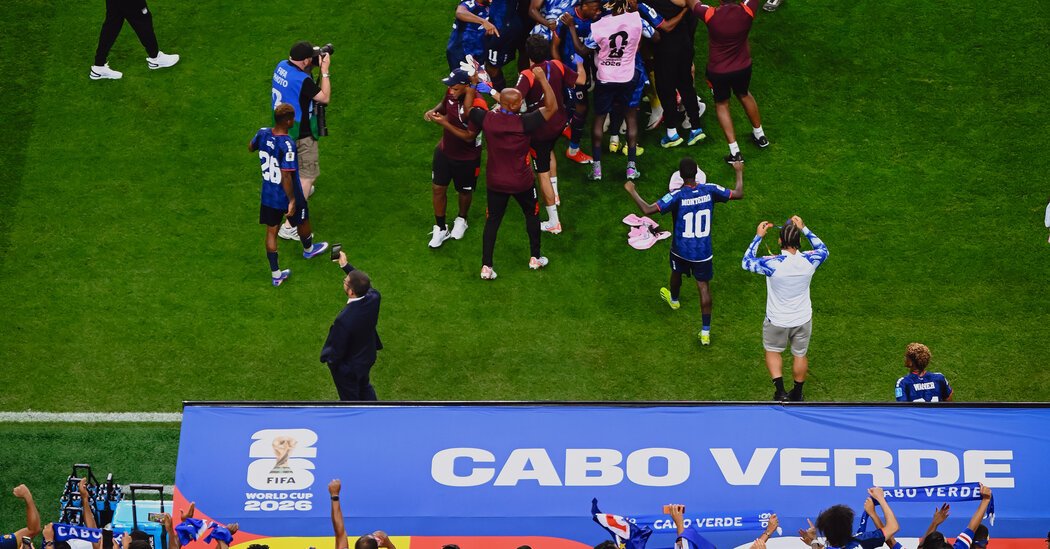
Cape Verdeans in the United States are used to giving impromptu geography lessons to strangers.
Their homeland, they tell good-natured inquirers, is an island nation off the coast of West Africa. It has around half a million residents. It gained its independence from Portugal in 1975.
Those explanations are suddenly becoming less necessary.
Competing in the World Cup for the first time, Cape Verde captured global attention and affection this month by playing tournament stalwarts Spain and Uruguay to draws in its first two matches.
Cape Verde entered Friday’s match against Saudi Arabia with a strong chance of advancing to the knockout rounds — and with a newfound global stature that has delighted and surprised members of the country’s diaspora.
“I told my sisters that it’s going to be the last time you have to say, ‘From the west coast of Africa,’” said Tony De Barros, a Californian of Cape Verdean descent who made the trip to Houston for the match on Friday. “It’s almost as if not just the U.S., but the whole world now, is kind of knowing who you are and where you are.”
Fans of Cape Verde arrived in Houston by the thousands. All over the city, there they were — grabbing coffee in their jerseys in East Downtown, mingling with fans of other countries at FIFA’s official festival, heading down Old Spanish Trail toward the stadium with flags draped over their shoulders.
They knew the stakes, that their team was on the verge of what seemed unthinkable before the tournament. If Cape Verde won, they would advance to the knockouts. If they drew with the Saudis and Spain beat Uruguay, they would still advance.
Mario Fernandes, who moved to the United States from Cape Verde as a teenager, said he had bought tickets to the Houston match long ago, “as soon as they became available.” But did he think then that he would be cheering for a team with a real chance of advancing?
“Realistically, no,” Mr. Fernandes said as he munched on a chicken sandwich in the 93-degree heat outside the stadium, where he had lined up long before the gates opened. “But I’m a man of faith. I believed.”
Mr. Fernandes, a physician assistant, was among many Cape Verde supporters who had traveled to Texas from Massachusetts, the heart of the diaspora in the United States.
Back in New England, red-white-and-blue Cape Verde flags hung from the porches of homes on Friday, and fans with flags hanging from their shoulders strolled the streets of New Bedford, Mass.
Inside a Cape Verdean veterans’ hall in New Bedford, people wore Boston Red Sox jerseys adorned with the Cape Verde flag and dined on Linguiça sausage, a dish commonly served in the islands, as they watched the game on a projector screen at the back of the bar.
Penny Santos, 91, whose parents emigrated from Cape Verde, jumped out of her seat at one point when her team’s goalkeeper made a save.
“Pride is something that you can’t buy,” Ms. Santos said. “It’s something that you can only feel, and somebody has to do this to bring this pride out of you.”
The Cape Verdean community in Massachusetts dates back to the 1800s, when whalers from the islands began settling in New Bedford, a port city south of Boston. Massachusetts is now home to tens of thousands of people with Cape Verdean heritage. The state’s governor hosted Cape Verde’s president in Boston this month.
Many Cape Verdeans said qualifying for the World Cup, especially as one of the smallest countries ever to do so, was a victory in itself. And their pride in the team was not going to suffer even if Friday’s game did not go as hoped.
But especially after their team drew even with Spain, one of the world’s strongest teams, in its opening match, Cape Verde fans began allowing themselves to dream of more than merely participating in the World Cup.
Outside the stadium in Houston, the Cape Verdeans were minor celebrities on Friday. They posed for photos with strangers. They chanted and sang as people in other teams’ jerseys filmed on their phones. They greeted others wearing shark hats, a nod to the team’s Blue Sharks nickname.
Inside, the Cape Verdeans tried their best to coax their team to score. Each time a player in blue unleashed a shot, they erupted in cheers. Each time that ball failed to find the net, they sighed in frustration.
When the game ended in a scoreless draw, nervous energy pulsed through the stadium. Those nerves turned to jubilation moments later when news came of Spain’s victory over Uruguay, ensuring Cape Verde’s place in the next round.
The fans danced in their seats. The players embraced on the field. The flag of a small island nation waved on televisions all over the world, including at that veterans’ hall back in Massachusetts.
“To watch somebody accomplish their goals is a beautiful thing,” Ms. Santos said in New Bedford as towels twirled in the air and people lifted their hands skyward. “That’s what you’re seeing here today.”