dailynewsnblog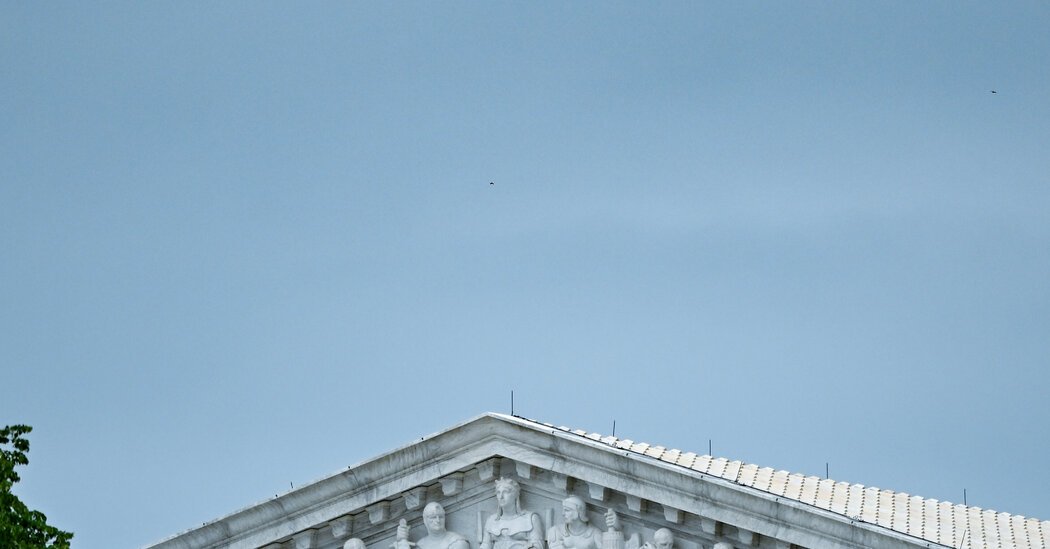
Virginia Democrats suffered a stinging loss in their state Supreme Court this month. Its justices, by a 4 to 3 vote, rejected a voting map that would probably have flipped four seats in the U.S. House of Representatives from red to blue.
What state officials did next baffled election law specialists.
Jay Jones, Virginia’s attorney general, a Democrat, raced to the U.S. Supreme Court, filing an emergency application that relied on a theory that many Democrats had previously argued is extreme and dangerous.
The justices on Friday rejected the application without comment or noted dissent. The episode seemed emblematic, legal experts said of the opportunism and cynicism of the current redistricting wars.
It was not clear, for starters, that the Virginia dispute belonged in federal court at all.
The state court’s opinion turned on a question of state law: the meaning of a phrase in the State Constitution. Whether the ruling was correct or not is, as the justices’ closely divided vote suggests, open to question. But state courts have the last word on state law, and the U.S. Supreme Court cannot second-guess them unless there is a question of federal law in the mix.
When Richard L. Hasen, an election-law specialist at the University of California, Los Angeles, read the Virginia Supreme Court’s decision, he said “it did not even occur to me that there would be a federal issue to take to the U.S. Supreme Court.”
But Mr. Jones identified one: the “independent state legislature” theory.
The theory is based on a reading of the U.S. Constitution’s Elections Clause, which says, “The times, places and manner of holding elections for senators and representatives shall be prescribed in each state by the legislature thereof.”
Proponents of the theory say the clause means that no other organs of state government — not courts, not governors, not election administrators, not independent commissions — can alter a legislature’s actions on federal elections.
The theory was a key element of President Trump’s efforts to overturn the 2020 election. His supporters argued, for instance, that the Pennsylvania Supreme Court had been powerless to extend voting deadlines during the pandemic because it overrode the will of the State Legislature. Democrats were appalled.
The Supreme Court largely rejected the independent state legislature theory in 2023 in Moore v. Harper, over the dissents of Justices Clarence Thomas, Samuel A. Alito Jr. and Neil M. Gorsuch.
That case also concerned a voting map, one drawn by North Carolina lawmakers after the 2020 census. The state’s Supreme Court rejected the map as a partisan gerrymander in 2022 as a violation of the State Constitution. Experts said the map had been likely to yield a congressional delegation made up of at least 10 Republicans and four or fewer Democrats, even though North Carolina is a roughly evenly divided state politically.
Republican lawmakers appealed to the U.S. Supreme Court, saying the state court was not entitled to second-guess the Legislature, invoking, as the Virginia’s Democratic attorney general did here, the independent state legislature theory.
An unusually diverse array of lawyers, judges and scholars urged the justices to reject the theory then. Adopting it, they warned, could have profound consequences for nearly every aspect of federal elections, including by erasing state safeguards against partisan gerrymandering and curtailing the ability to challenge voting restrictions in state courts.
Chief Justice John G. Roberts Jr., writing for the majority, refused to oust state courts from their usual roles. “The Elections Clause does not insulate state legislatures from the ordinary exercise of state judicial review,” he wrote.
Got a news tip about the courts? If you have information to share about the Supreme Court or other federal courts, please contact us.
But he left the door open a crack. “We hold only,” he wrote, “that state courts may not transgress the ordinary bounds of judicial review such that they arrogate to themselves the power vested in state legislatures to regulate federal elections.”
In his application, Mr. Jay said the Virginia Supreme Court had indeed veered outside normal judicial review by misreading the State Constitution.
Travis Crum, a law professor at Washington University in St. Louis, said he was shocked by Mr. Jay’s reliance on the theory.
“Democrats are playing with fire,” he said. “That theory bedeviled the 2020 election and was repeatedly raised by the Trump campaign to challenge pandemic-era election rules and sow doubt about the election’s legitimacy.”
“A Supreme Court victory in the Virginia gerrymandering dispute,” Professor Crum added, could have “come back to haunt Democrats after the 2026 midterms or 2028 presidential election.”
Professor Hasen also called the state’s position self-defeating.
“If the argument won,” he said, “it would signal that the very conservative Supreme Court would be extremely willing to second guess state court interpretations of their election laws as applied to federal elections — a trend that would no doubt hurt Democrats before the Supreme Court’s conservative supermajority.”
Asked for comment on criticism of his litigation strategy, a spokeswoman for Mr. Jay provided a statement that did not address the question directly.
“Today’s one-sentence denial from the Supreme Court of the United States is yet another profoundly troubling example of the continued national attack on voting rights and the rule of law by Donald Trump, Republican state legislatures and conservative courts,” Mr. Jay said in the statement.
The most generous way to look at the state’s filing was as a political rather than a legal document, Professor Hasen said, one bound to lose but useful in other ways.
“I viewed this less as a chance for the state to get the justices to step in and more as a show of force for the party faithful,” he said, “to show that Democrats, like Republicans, are willing to go scorched earth in the new gerrymandering wars.”
That political hardball that has bled into legal arguments is not a wholly new phenomenon.
“There has always been some degree of opportunism in election litigation,” said Rebecca Green, a law professor at William & Mary.
But the recent application may represent something new, she said.
“With respect to the Virginia case, the Democrats’ appeal is part of the gloves-off tactics we’re seeing around the country,” she said. “The phrase has been used a lot in the last few weeks, but it’s spot on: we’re locked in a race to the bottom.”
Gerrymandering has over the years elicited responses that seemed in sync with partisan self-interest.
When Democrats were its main beneficiaries, President Ronald Reagan denounced the practice as “a national scandal” and called for called for “an end to the anti-democratic and un-American practice of gerrymandering congressional districts.”
In the wake of last month’s decision curtailing the Voting Rights Act and allowing states to redraw districts that had protected minority voting power, Mr. Trump called for extreme actions.
“We should demand that State Legislatures do what the Supreme Court says must be done,” he wrote on social media, adding: “The byproduct is that the Republicans will receive more than 20 House Seats in the upcoming Midterms!”