dailynewsnblog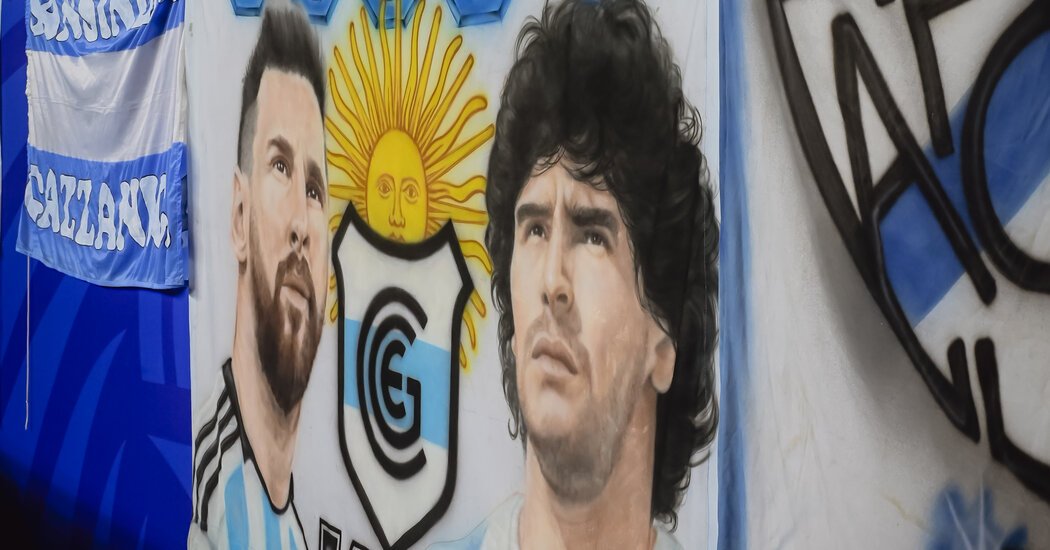
In an army of Lionel Messis outside AT&T Stadium in Arlington, Texas, Juan Manuel Garcia stood apart.
Like the other fans, he wore No. 10 on his back, but that’s where the resemblance ended. Mr. Garcia’s No. 10 belonged instead to Diego Maradona, who remains, in death, soccer’s ultimate superhero and an enduring symbol of Argentina.
Mr. Garcia, 40, from Rosario in central Argentina, was about to watch Messi extend his streak of scoring in every game of the 2026 World Cup as Argentina completed a sweep of the group stage. “Messi might be now be considered a better player, but Maradona is Argentina — and Argentina is Maradona,” he said.
That reverence is everywhere back home. Walls across Buenos Aires are covered with murals of Maradona, and his first club, Argentinos Juniors, has become a living shrine. Big rigs are trimmed with images of Maradona waiting for Messi in heaven. Fans at the World Cup carry enormous flags depicting him from stadium to stadium.
But while Messi’s genius pays off handsomely as sponsors line up for a piece of his celebrity, Maradona’s image is curiously absent from major campaigns. That is the result of a strange, yearslong legal battle spanning continents, jurisdictions and patent offices, one that has split his family apart and left investors fighting over the right to use his likeness.
In death, Maradona’s legacy has proved as chaotic as his life.
Unlike Messi, who has enjoyed a smooth pathway to stardom on and off the field, Maradona lived a life of excess — glorious highs shadowed by criticism and controversy. His death in 2020 brought an outpouring of grief from millions of Argentines, but it just as quickly gave way to recrimination and legal disputes that continue today.
A Family at War
Maradona died without a will after undergoing brain surgery, leaving five acknowledged children. Former associates claimed he had willed the right to exploit his brand and likeness to his sisters rather than his children. A fraud case is ongoing against those associates, who are accused of illegally profiting from his name.
The rights his children insist belong to them under Argentine law have instead become the currency of a bitter family rupture and litigation. Contact between the children and their aunts now runs through lawyers and the courts. “Basically, they’ve decided to be against their nephews and nieces because of money,” said Jana Maradona, 30, one of his daughters.
Sitting in her lawyer’s office — the children have hired several attorneys — Ms. Maradona described feeling despair, anger and disbelief. The family keeps discovering new products bearing her father’s likeness or trademarked name: chips, energy drinks, wine, cigars, even socks.
At the center of the dispute is Sattvica, a company set up on Maradona’s behalf in 2015 by his lawyer and longtime aide, Matias Morla — a figure many in Argentina accuse of having controlled the player in his final years.
Mr. Morla defended the arrangement. Maradona had always supported his sisters financially, he said, and knew that “in his absence they would not have a dignified life.”
Rita Maradona, the sister most involved in the business, sent a brief email in response to questions, agreeing with Mr. Morla’s account. He said the children had a “terrible” relationship with their father before his death and accused them of exaggerating claims that he was cut off from them.
Guillermo Cóppola, Maradona’s former manager and friend, disagreed. Mr. Morla “entered Diego’s life and pushed many people out,” he said.
A ruling in January by a Buenos Aires court confirmed the children as heirs and ordered Sattvica to stop new business and route revenue from existing contracts into a court-supervised account. But those sales have continued, the lawyers for the children said, echoing allegations made in court proceedings, and they believe many more contracts remain undisclosed.
A Brand Worth Fighting For
On and off the field, the diminutive Maradona was box office: a symbol of rebellion, reverence and controversy like few others. Those contradictions crystallized in a legendary performance against England at the 1986 World Cup when he scored the opening goal — the sleight of hand he later called the “Hand of God,” and then minutes later raced through the England defense to score what is remembered as the goal of the century.
Eight years later, his career at the very highest level effectively ended when he became the last player to be banned for doping at a World Cup. Paternity suits, mafia ties and struggles with addiction damaged his reputation in some eyes; to others, especially the working class, those flaws only deepened their devotion.
All of that has made his name enormously attractive to investors — and perilous. Companies from Britain to Italy, India and Dubai have all been trying to do business with the Maradona brand. The New York Times spoke with six people who each claimed to have exclusive licensing deals. All of them believed having a piece of the Maradona legend could be worth a fortune.
Among the most prominent is Stefano Ceci, a Neapolitan pizzeria owner who became a close friend of Maradona’s and has spent years since his death signing licensing deals in his name. To prove his standing, Mr. Ceci produced a contract along with a suitcase of mementos from their life together — including a bag containing Maradona’s hair.
Lawyers for the family have argued in court proceedings that contract was altered to grant Mr. Ceci far more rights than intended. Dimitri Russo, Mr. Ceci’s lawyer, said the contract is valid. He described a deep friendship between the men. Mr. Ceci has tattoos of Maradona, named his daughter MaraDona, and a dog named Diego.
Many of Mr. Ceci’s deals have led to legal troubles and financial losses for those on the other side of them, including a British businessman who spent $200,000 in 2022 to launch a Maradona digital token, known as a NFT, only to be met with rival claims from other companies asserting the same rights.
The highest-profile case involved Electronic Arts and its “EA FC” video game franchise. EA signed Maradona in 2017, but after his death, competing claims over his likeness forced the company to pull him from the game; he was restored in February 2025 after EA made a deal with his children. The Italian club Napoli faced similar legal disputes for selling jerseys bearing Maradona’s image after his death.
Two investors — an Italian businessman, Alfonso Di Prisco, and a British entrepreneur, Sanjay Wadhwani, each spent hundreds of thousands of dollars seeking to secure exclusive global rights to Maradona’s image and ended up in disputes over the terms. Mr. Wadhwani, who signed on as a partner at Sattvica, estimates investors may have lost $5 million to competing ownership claims.
“Sometimes you get burned, sometimes you don’t,” Mr. Wadhwani said. He now believes the rights belong to Maradona’s children.
None of it has slowed Argentina’s pursuit of a fourth World Cup title. If anything, the tournament offers clarity — a chance to honor the man many still consider their country’s purest symbol, undiminished by the legal wreckage he left behind.
“For me, Maradona is a god of football — a god with flaws, a god with mistakes — and that’s what makes him much more human than any other footballer on the planet,” Mr. Garcia said, proud to be dressed as his idol.