dailynewsnblog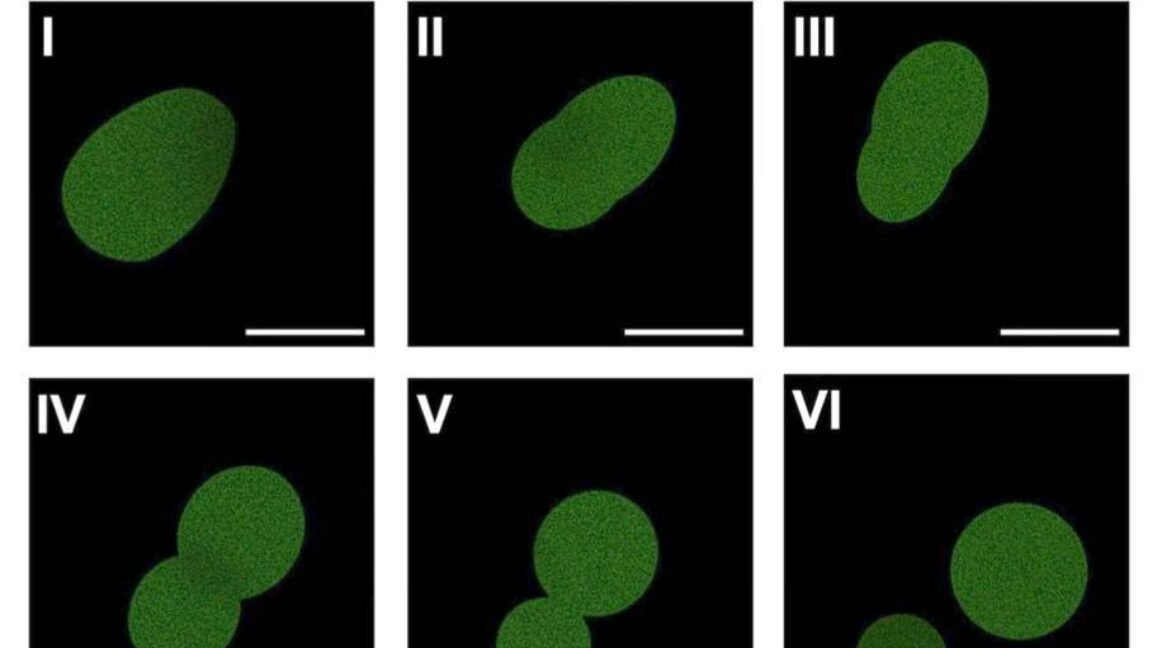
But the complex of proteins needed to make more proteins is far too large to go through a small pore. So the researchers encased these proteins and other large materials in a different membrane and then fed those to the SpudCells. To get the two membranes—one from the SpudCell, one from its food—to interact, the researchers added a tag to the pore protein that they had already been using. They then added something that would interact with that tag to the food membrane. This allowed the two to interact long enough to fuse, spilling the food into the interior of the SpudCell and adding additional membrane material to it.
This “feeding” process allows the SpudCells to continue making new proteins even after they would have exhausted their initial supply of raw materials. The added membrane material also increased the SpudCell’s size, literally causing it to grow.
Normally, cell growth eventually results in cell division, splitting the membranes and their context between two new cells. But the SpudCells had no mechanism for achieving this. Initially, the researchers simply passed them through a wire grid and applied physical force to cause the membranes to split. But they eventually developed a system that could cause the pore proteins to clump by adding certain chemicals to the solution. That altered the membrane’s shape and eventually led to parts of it budding off. While this is a far more random process, it approximates cell division.
So in a limited, carefully engineered sense, these “cells” could feed, grow, and divide, driven by proteins encoded by their own genome. As noted above, though, that genome was only distributed into the next generation of cells at random, and pieces of it were progressively lost over each generation. As a result, no SpudCells were taken past five generations in this work.