dailynewsnblog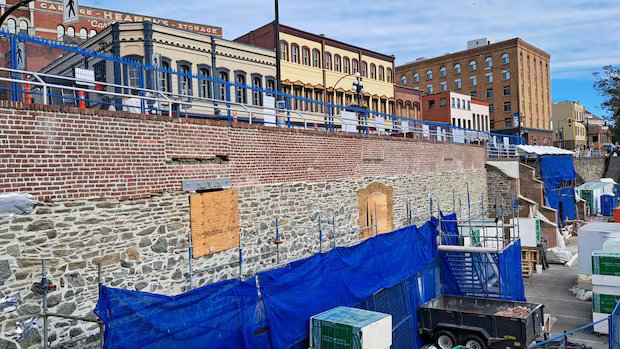

Listen to this article
Estimated 4 minutes
The audio version of this article is generated by AI-based technology. Mispronunciations can occur. We are working with our partners to continually review and improve the results.
It’s the scenic view of the harbour or the eternal search for a space to park downtown that brings most people to the quiet concrete lot between Wharf Street and the ocean in Victoria, B.C.
But the old stone wall tucked underneath Wharf Street is one of the oldest pieces of the city’s colonial past — it contains some forgotten artifacts recently unearthed by a restoration crew.
When built in 1859, the wall made up the lower storeys of the Hudson’s Bay warehouse, a central point of where goods flowed in between the dockyards and Fort Victoria.
Liam Hall, co-owner of Heritage Masonry and Conservation, is part of the team hired by the City of Victoria to reinforce and restore the wall. Part of that work included opening a doorway outlined in yellow bricks, which Hall said had once been an entrance to the building before it was sealed off in the 1960s, to strengthen support holding the street above.
“Once we opened it up, we weren’t really sure what was going to be inside,” he said.
“So we removed bricks and [got] a head inside with a flashlight and [took] a peek into this sort of weird chamber that hadn’t seen sunlight in a long time.”
Quite a bit of what the team found was garbage — construction rubble and debris, along with cigarette packs, soda cans, and broken glass.
But amid the rubble were decorative stone rosettes from the original Turner Beeton warehouse, which stood besides the Hudson’s Bay site before it too was demolished, except for a wall that remains along the harbour.

Hall’s team re-sealed two of the rosettes back inside the chamber with a time capsule. Alongside the rosettes, he included some money, a copy of the Times Colonist newspaper, photos and plans of their work on the wall, and a photo of all the people from the city and crews who were part of the project.
“It’s pretty cool because the world of heritage conservation is ensuring that past stories can be told in a tangible way,” said Hall.
“To be able to physically interact with something that was built by somebody, people who’ve been dead for 100 years, is like a really cool part of it and so by putting in a time capsule it basically leaves our mark on it, which is the layers of history.”
Decades earlier, before the small subterranean chamber was sealed off, it caught the interest of local historian John Adams when he moved to Victoria as an 11-year-old.
He and some friends decided to explore, hoping they might find a secret tunnel.
“One day we came down on our bikes, deliberately with flashlights, we boosted each other up, and we thought that we would end up in a secret tunnel that would lead to Bastion Square, or maybe to Chinatown, who knows,” said Adams.
“Anyway, we were very disappointed because it only went just a short distance under the sidewalk.”

Originally, Adams said the warehouse was 4.5 storeys. Ships could unload directly into the lower harbour side, with an elevated street-level entrance on Wharf Street.
Most of the stone used to build it was local, he said, though the yellow bricks outlining the doorway come from England.
“It was the biggest building on the colony of Vancouver Island for many, many years,” he said.
In the 1930s, when Hudson’s Bay no longer needed the space, they offered it to the province. The warehouse was torn down, with only a lone wall left standing.

Adams came to watch some of the restoration work, and is grateful the city made efforts to preserve the wall and save the rosettes found inside.
“Most people just see it as a wall and have no idea why it’s there, but it really should be preserved,” he said.
“As a historian, it’s rewarding that people do cherish that stuff because we all know that not everybody does.”
Hall says he plans to donate the rosettes, except for the ones kept in the time capsule, to the Victoria city archives.