dailynewsnblog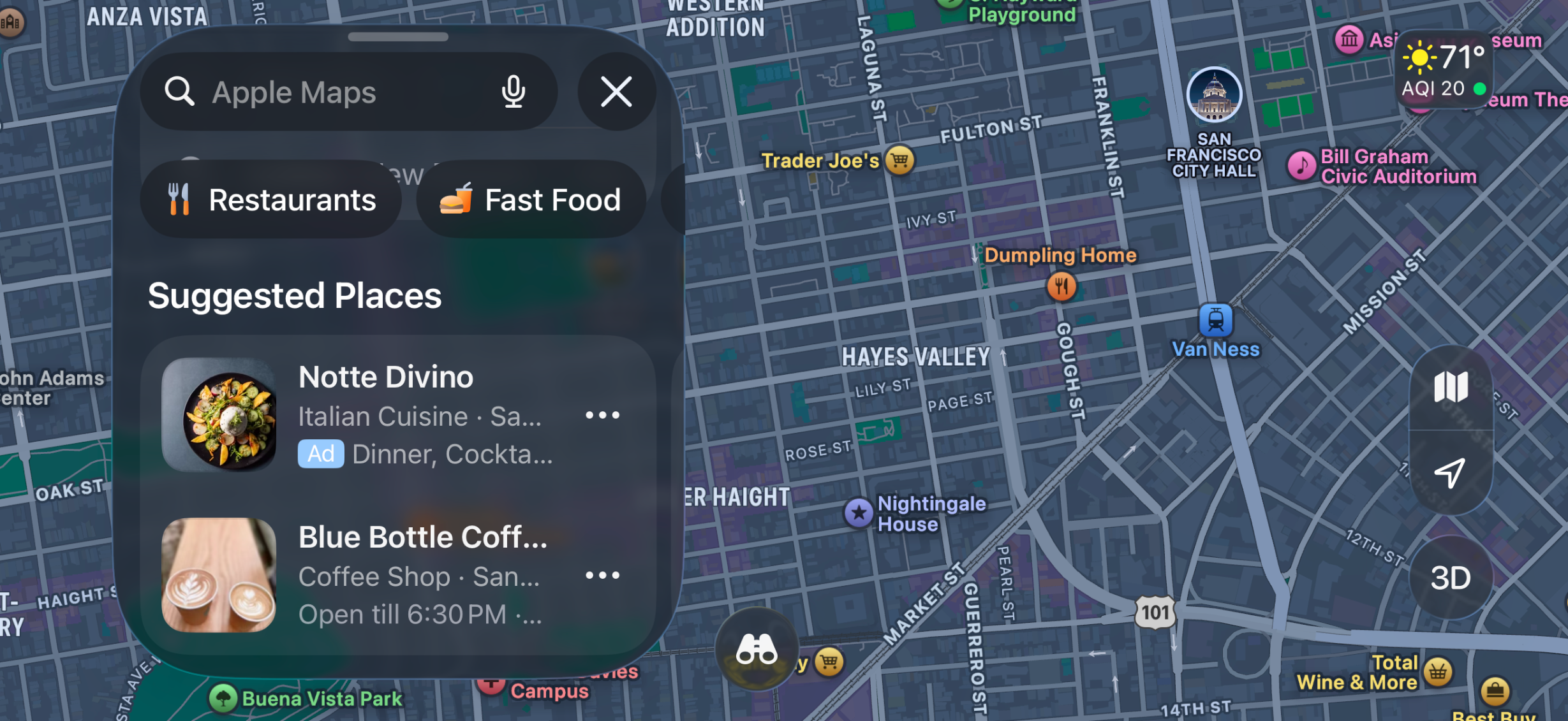
Apple, as expected, has introduced advertisements into its Maps navigation app, though you might not notice them at first.
The company confirmed in March it would bring ads to Maps and other services, including Mail, Wallet and Siri, as part of an Apple Business platform it launched in April. The ads are expected to roll out for Maps in the US and Canada before appearing in other regions.
The only way to tell that you’re seeing a paid advertisement in Maps, at least for now, is a very small “ad” marker. Suggested locations appear alongside ones that aren’t marked as ads.
In CNET’s testing, ads in Maps only appeared next to some search results, and unlike what you’d see in Google Maps, there are so far no sponsored pins. Not every search result showed ads, even in highly populated areas like New York City and San Francisco. So at least on the initial rollout, users might not notice a major design change.
But many say this isn’t a good look for the tech giant. One headline on the popular site 9to5 Mac called the Maps ads “as bad as expected.” The other concern? Apple hasn’t introduced an opt-out toggle for ads, so you can’t even turn them off.
Apple customers on a subreddit devoted to the company were not happy about the ad rollout, with some arguing that paid iCloud account holders should not have to see ads. Others complained about advertising being introduced into the App Store, News and other applications. “This ad overload on everything is getting unbearable,” wrote MarkE2020.
Digital Noise on X predicted that this isn’t the end of Apple’s advertising push. “Music is next,” they wrote.
Apple ads and privacy
As part of the ad rollout, Apple posted about how it’s handling privacy: “Our advertising platform is designed to protect users’ information and give them control over how we use it for advertising.”
The post states that Apple Ads doesn’t buy or share personal information with other companies, doesn’t track users across apps and websites owned by other companies, and doesn’t serve ads to users registered as under 13 years old. Apple Pay transactions, Health app data and Home app data aren’t used to deliver ads.
A representative for Apple pointed CNET to its post about Maps ad privacy, but didn’t comment on whether information from other apps might be used or if it uses anonymized or aggregated user data for its ad business.
In a bid for transparency, Apple says that clicking the “ad” icon shows the information used to serve the ad.
Google vs. Apple navigation tools
At the time of its announcement, there was speculation about how closely Apple’s ad approach would resemble what is seen in Google Maps. Tim Berney, founder and CEO of Oklahoma City-based VI Marketing and Branding, told CNET that Apple is playing a different game and its Maps ads wouldn’t be identical to Google, which seems to be the case.
“Apple will likely take a more subtle, integrated approach,” Berney said. “Where Google Maps or Waze can feel more ad-driven, Apple will make it feel like a recommendation within the experience,” he said.
Some commentators online have speculated whether advertising in Apple Maps is purely a revenue play. But because the move is positioned as part of Apple’s small-business toolset, Berney said ads could be a way for Apple to lure business owners into its own ecosystem of apps and device management platforms. And that would, not coincidentally, put it in direct competition with Google.

See full bio