dailynewsnblog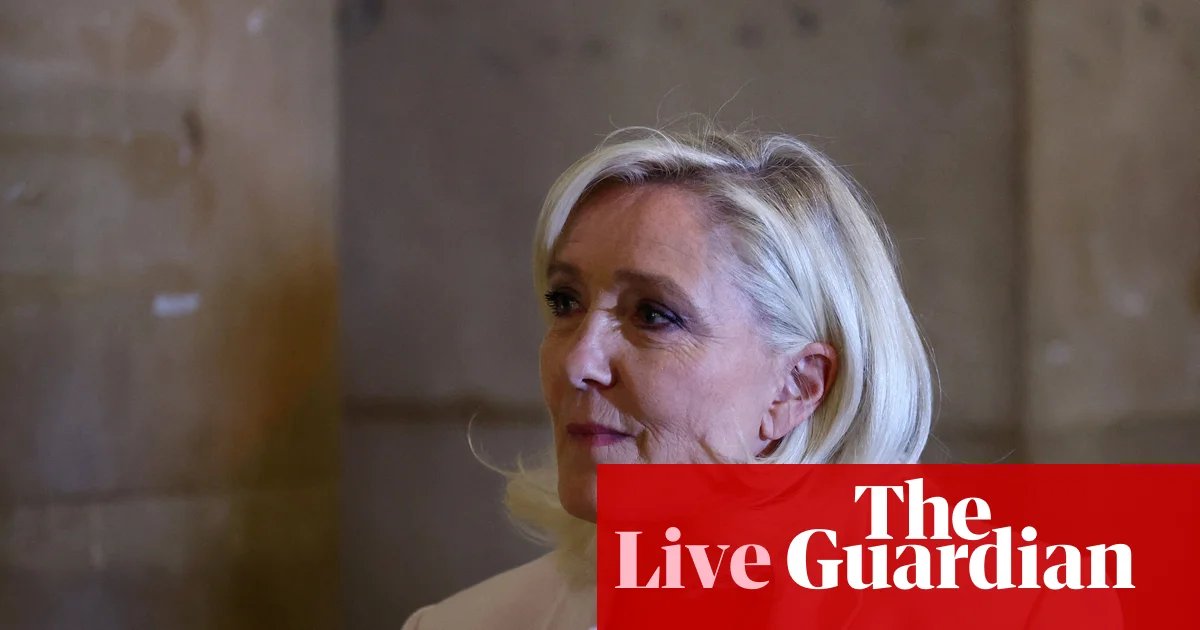
Nato announces plans to invest in antidrone, surveillance capabilities
Meanwhile over in Ankara, Nato keeps announcing new investments with hype videos set to dynamic stock music, including $40bn on antidrone capabilities.

The alliance will also purchase up to 10 Saab GlobalEye surveillance plans to replace its ageing fleet of AWACS early warning aircraft, Rutte said, choosing the Swedish company over US planemaker Boeing, Reuters reported.
Nato will also buy up to five Northrop Grumman MQ-4C Triton high altitude surveillance drones, with Norway, Finland, Germany and Denmark signing a letter of intent for the purchase.
The allies will also work together to acquire, store, transport, and manage stockpiles of critical defence materials, Rutte said.
Key events
Le Pen arrives in court for her appeal ruling
Possible outcomes for Le Pen’s appeal
What to expect from Le Pen ruling in the coming hours?
Marine Le Pen’s political future at stake with ruling on electoral ban this afternoon
Russia following Nato summit with ‘great interest,’ Kremlin spokesperson says
‘The hum of machinery must become a roar,’ as Russia, China, North Korea ‘increasingly working together’ and ‘do not have our best interests in mind,’ Rutte warns
Rutte speaks in Ankara as Nato two-day summit gets under way
‘Important work’ at Nato summit with focus on drone deals, air defence, Zelenskyy says
‘I slept really well last night. And you?,’ Belgian PM’s cat mocks Trump after World Cup win, ahead of Nato summit
At least 18 people injured in Damascus explosions near Macron’s hotel
Nato announces plans to invest in antidrone, surveillance capabilities
Reports of explosions in Damascus, Syria, during France’s Macron visit
Europe faces up to prospect US may be unable to arm Nato allies
Morning opening: Nato summit gets under way with focus on spending, capabilities
Le Pen arrives in court for her appeal ruling

Angelique Chrisafis
in Paris courtroom
Marine Le Pen has arrived in court wearing a light-coloured suit, flanked by her lawyers.
The public seats are full of key figures from the National Rally party, in court for the first time to support Le Pen, including the MPs Laure Lavalette and Jean-Philippe Tanguy.
Possible outcomes for Le Pen’s appeal

Jon Henley
Europe correspondent
Observers have outlined several possible outcomes for Marine Le Pen.
Le Pen’s best-case scenario – deemed by most analysts the least likely – would be acquittal. She acknowledged “a mistake” during the appeal trial, saying some staff paid as EU aides had worked in France, but said she believed such work was allowed.
The court could also find Le Pen guilty, but shorten the ban on holding elected office to two years or less, or lift it altogether. Because the lower court ordered the ban to take immediate effect, Le Pen has been serving it since 31 March last year.
A ban of two years or less, therefore, would expire before the first round of the vote, due on 18 April 2027 – although that does not mean she would definitely run, since any jail term or electronic monitoring would severely hinder her ability to campaign.
“If I’m allowed to be a candidate, but am effectively prevented from campaigning freely – then you understand, that wouldn’t be possible,” Le Pen told French television last week.
I can’t be dependent on a judge to authorise me to campaign.
The appeals court could also order any electoral ban to take immediate effect, as the lower court did. In theory, Le Pen could then appeal to France’s highest court, the court of cassation, which has previously said that it would rule before the election.
However, she has previously said she would be unlikely to take her appeal further, arguing that the uncertainty would jeopardise her party’s chances. “You can’t launch a presidential campaign at the last minute,” Le Pen said during the appeal trial.
Polls suggest that both Le Pen – who transformed the RN from a fringe nationalist movement to the single biggest party in France’s parliament – and Bardella would comfortably win the first round of the 2027 election to reach the runoff.
What to expect from Le Pen ruling in the coming hours?

Jakub Krupa
A word of caution ahead of the Le Pen judgment, which is expected soon.
It could take several hours to read in full – there are 11 defendants on trial, not just Le Pen – meaning updates will arrive in stages.
We need to be cautious about making inferences from partial rulings. Essentially, nothing is confirmed until the entire verdict is delivered.
Our Paris correspondent, Angelique Chrisafis, is in the courtroom and we will together bring you incremental updates here, but just be mindful that we will have to wait until the text is read out in its entirety before drawing any final conclusions.
We may also have to wait a while to hear from Le Pen herself, whichever way the ruling goes.
If she does not speak outside the courtroom, she is expected to appear on TF1 News at 8pm French time (7pm BST).
Marine Le Pen’s political future at stake with ruling on electoral ban this afternoon
Jon Henley
Europe correspondent
Let’s turn our attention to Paris, where we are expecting the reading of the ruling in the Le Pen appeal to start in the next half hour.
Just a reminder of what’s at stake:
Le Pen, France’s far-right figurehead and a leading contender for its presidency, will learn whether she can run in next year’s presidential election when a Paris appeals court rules on her attempt to overturn a ban on holding elected office.
Last year, Le Pen was handed a five-year ban from public office and a four-year prison sentence, with two years suspended, for embezzling European parliament funds.
Along with 24 former MEPs, assistants and accountants, as well as the party itself, the three-time presidential candidate was found guilty of operating a system that used European parliament funds to employ RN staff in France between 2004 and 2016.
Le Pen claimed her party was the victim of a “witch-hunt” and, with 11 others, appealed, denying during the second trial that her party had any system to embezzle the several million euros concerned and saying that it had acted in “complete good faith”.
Today we will learn about the outcome of that appeal.
The ruling will determine whether the far-right National Rally (RN) candidate to succeed the outgoing president, Emmanuel Macron, will be the veteran Le Pen, 57, or her youthful protege, Jordan Bardella, 30.
With her party comfortably ahead in the polls, Le Pen, who came third in the 2012 race and lost runoffs to Macron in 2017 and 2022, has insisted she is prepared for any eventuality.
Russia following Nato summit with ‘great interest,’ Kremlin spokesperson says
Meanwhile, the Kremlin said it would closely monitor the Nato summit in Turkey, saying it remained of “great interest” to Russia.
But Kremlin spokesperson Dmitry Peskov lamented that a series of “confrontational” statements about Russia had preceded the event, without really clarifying what he means by that.
Jakub Krupa
The Nato event is now moving to panels with industry experts, so we will probably tune out for a bit, but you can continue watching our live stream below.
We are separately expecting to hear from Ukraine’s Volodymyr Zelenskyy fairly soon.
And we will soon need to move across to Paris for the major Le Pen ruling (9:44) which is expected to start in about an hour…
Turkey’s vice-president and defence minister Cevdet Yılmaz is speaking next, very much along the same lines.
He understandably also talks about the importance of Turkey in the process as “one of the defence exports around the globe,” saying “hopefully Turkey will be in the first league if we continue with the football analogy.”
Rutte comes back to his strained football analogy again, saying that the winning teams need to “prepare, train, invest, and build trust” and “that is exactly what we must continue to do.”
“The partnership between Nato and industry is the winning one. So now let’s deliver even more, even faster, and together.”
And he ends his speech here.
‘The hum of machinery must become a roar,’ as Russia, China, North Korea ‘increasingly working together’ and ‘do not have our best interests in mind,’ Rutte warns
Rutte continues with the football analogy talking about additional military production space in the alliance and comparing it to football pitches. No, me neither.
But he says that all this ramping up of production is significant, and the alliance is making “real progress.”
“The strategy is clear, but the match is far from over, and to win it, we need all team members to pull their weight, do more, faster, together. We do not have the luxury of time.”
He says Russia is “pouring almost half of its national budget into its war machine,” while China “continues to modernise its armed forces and expand its nuclear capabilities without transparency,” and North Korea supporting Russia.
“We must remain vigilant. These countries are increasingly working together, and that should concern us all, because I assure you they do not have our best interests in mind.”
He says Nato needs “a transatlantic defence industrial revolution” to respond to that, and “the hum of machinery must become a roar.”
“That sounds dramatic, but it can be done.”
He also says that Nato allies need to deregulate in procurement and work on cross-border solutions to move faster.
He also praises Ukraine, saying they “continue to innovate at incredible speed,” including on “unparalleled drone ecosystem.”
He also pointedly pays tribute to other partner countries, including Japan.
Beginning with a unnaturally forced World Cup reference, Nato’s secretary general Rutte begins by saying that “no team wins because of one brilliant player.”
“We need a goalkeeper, you need the defenders, the midfielders, the strikers, and yes, everyone notices the player who scores the winning goal, but behind every successful player and team out on the pitch there are many others on the bench and behind the scenes the coaches, the trainers, the analysts, the people making sure everything works.
Everyone matters, no one wins alone. Nato is much the same.”
He says you need political leaders to set the direction, and armed forces and defence industry to work hand in hand to be “fully engaged in the game, working together for our shared security.”
Unsuprisingly, he eventually concludes the teamwork at Nato is absolutely brilliant.
“This is a team that knows how to score.”
He then moves on to the summary of what Nato achieved in the last year, as it ramped up its defence spending after the previous summit in The Hague.
“The money is there, and much more is coming. But this cash must be put to work,” he says.