By Balazs Koranyi
FRANKFURT, Aug 10 (Reuters) – For anyone in Europe who still thought climate change was a problem for future generations, this summer’s sweltering heatwaves have brought home the reality that its costly and life-altering economic impacts have already arrived.
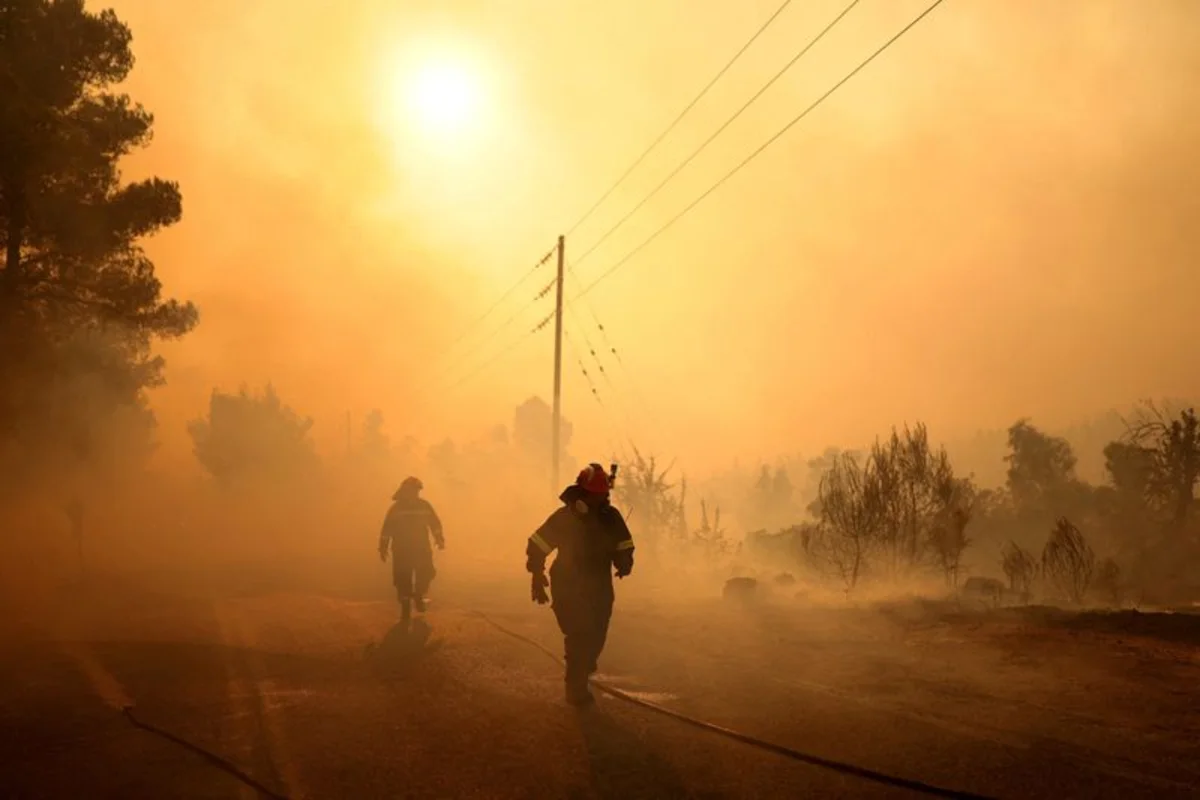
Record heat and droughts this summer – which scientists say are exacerbated by global warming – have wreaked havoc in power production, shipping and public health systems, while this wildfire season is on track to be Europe’s biggest ever.
Together, the hit to the region’s economy can already be measured in the hundreds of billions of euros, economists and academics estimate. But they warn this is just the beginning, as costs are set to rise faster than temperatures.
Climate is changing more rapidly in Europe than on any other continent and the damage is already stretching public finances, setting off wild swings in inflation, redrawing the tourism map, and forcing the bloc to rethink how power is produced and how goods are transported.
“What makes 2026 particularly worrying from an economic perspective is that there are multiple episodes of extreme events,” said University of Mannheim economist Sehrish Usman.
“Take heatwaves, droughts, wildfires… these events are taking place at the same time and mostly in the same regions, compounding their impact,” she said.
RECORD ECONOMIC DAMAGE FROM HEAT
Temperatures hit records in June and July, and the economic damage will likely exceed all previous marks, economists say.
Traffic on the Rhine and the Danube rivers, key cargo arteries, is severely limited because of low water levels, more than a half dozen nuclear generators have shut or curtailed production due to cooling difficulties. Agricultural yield estimates have been cut with crops harvested late, such as maize and sunflower, suffering a 6-7% loss already in July.
Heat curtails human productivity and has already claimed tens of thousands of lives, with Germany alone reporting more than 10,000 heat-related deaths.
Meanwhile, the costs of the emergency response, like fighting fires or curtailing power use, further stretch budgets.
ING estimates that the halt of traffic on the Rhine alone will lower the GDP of Germany, the world’s third-largest economy, by 0.3 percentage points this year, while Hungary’s MBH Bank sees a 0.1 percentage point GDP hit for every week the country’s largest nuclear generator is offline.
Allianz, the German insurer, estimates the two-week June heatwave alone will cut the GDP of Europe by 0.3 percentage points, and climate change will shave 5-7% off growth by 2030 for the most exposed economies like Spain, France and Italy.
“The total bill for this year will be much larger,” said Hazem Krichene, an economist at Allianz. “This figure doesn’t account for the fires, droughts, different flood events or the expected El Niño.”
Given that the euro zone is expected to grow just 1% this year, the hit is sizable.
Yet Usman says the full extent of the economic damage will only be felt several years down the line.
“You’d expect the damage to be largest in the year an extreme event happens and then to fade but we find the opposite,” Usman said. “The economic impact grows over the following years because the extreme weather set off a chain of slow economic consequences.”
SOUTHERN EUROPE TO SUFFER FALLING TOURISM AND RISING INFLATION
Southern Europe could take the biggest hit as temperature spikes are the largest there, cutting tourism income, exacerbating crop failures and inducing outward migration.
“Can you see tourists marching through southern Italy or Spain in 45 degrees? I can’t. So, I think the nature of tourism will change,” ING economist Carsten Brzeski said.
The south may get more year-round tourists but summer peaks will drop as vacationers move north, hitting the southern hospitality industry, Brzeski argued.
The south will also take a bigger food price hit from extreme weather, complicating life for the European Central Bank, which is already struggling to keep inflation at target.
“You see bigger effects of extreme temperatures on food prices in places that are already hotter, so if you’re in Southern Europe, you’ll see a bigger effect,” said Maximilian Kotz, a researcher at the Barcelona Supercomputing Center.
Extreme heat in 2022 lifted euro zone inflation by 0.34 percentage points via higher food prices, with the south taking a disproportionate hit, Kotz estimated.
Meanwhile, a halt in river transport is making it harder for fuel to reach parts of Europe, widening regional price differences.
HEAT STRAINS ON BUDGETS TO PUT PRESSURE ON ECB
“The fiscal consequences fall most heavily on the economies least able to absorb them,” Allianz said in a research note.
Reductions in annual tax revenue from lost output could reach 1.8% in France, 1.3% in Italy and Spain as progressive tax systems mean revenues fall faster than output, it estimates.
Business profit margins will also decline, depressing investment and exacerbating the economic loss.
Costs meanwhile surge, both because governments have to fund the emergency response and must invest, such as in future-proofing power generation or transportation routes.
“A key concern is that countries still rely far too much on ad hoc emergency response, which is both expensive and also often quite inefficient,” said Heather Grabbe, a senior fellow at the Bruegel think tank.
But investors may push back if governments try to spend more. Debt levels are already high – especially in France and Italy – and countries need to invest in defence and the green energy transition.
The dilemma could draw in the ECB, which bought up trillions of euros worth of countries’ debt in the past decade to keep borrowing costs depressed when inflation was too low.
“With such a long list of spending needs, the trend will be towards higher government debt,” ING’s Brzeski said. “This will then mean pressure on the ECB to step in and do more quantitative easing, if there is a sudden selloff in bond markets.”
(Editing by Mark John and Toby Chopra)


 dailynewsnblog