dailynewsnblog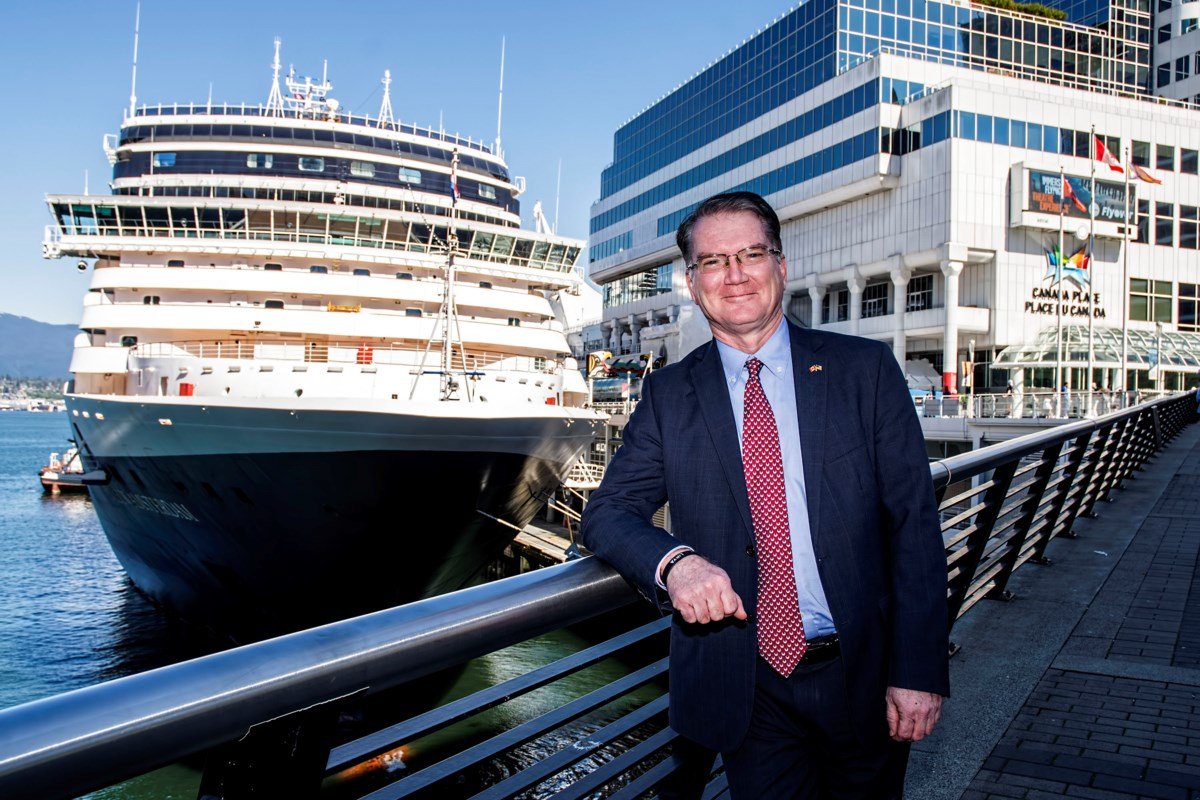
Shawn Crowley says cross-border co-operation remains strong despite political friction between Canada and the U.S.
More than 100 guests mingle on a warm spring evening in a mansion on Vancouver’s West Side.
A hush descends as the top-ranked U.S. official in B.C. starts a speech at his home to members of a visiting Portland, Ore., business delegation as well as many locals.
Political tensions may be swirling between Canada and the U.S. but that was not apparent in American diplomat’s address.
“Most discussions today have been about the great relationship that we have across the border,” U.S. consul general to B.C. and Yukon Shawn Crowley told the crowd.
He mentioned how Canada trades more goods with the state of Michigan than it does with the entire European Union.
“We all read all the negative headlines about the U.S. and Canada, and the relationship, but we also all live in a region that every single day sees the benefit of the co-operation that we have,” Crowley said.
He has been in his role since last summer, and has made efforts to meet local government officials and business leaders.
Greater Vancouver Board of Trade (GVBOT) CEO Bridgitte Anderson watched the speech. So did the neighbourhood’s local MP, Liberal Taleeb Noormohamed of the Vancouver Granville riding.
Anderson said she has met Crowley at least half a dozen times.
“He does a great job of connecting with the business community to understand our issues and to really strengthen those relationships,” she said.
Anderson visited Washington, D.C., in April to meet and lobby U.S. lawmakers alongside representatives at chambers of commerce from Seattle and Portland.
When she returned to Vancouver, Crowley visited her office.
He wanted to get a debrief, and understand how the meetings went, Anderson said.
“I marvel at how much Shawn, as well as past consuls general, has really made efforts to understand the local issues, the regional issues,” she added.

Homeland Security officials based in Vancouver
One concern many Canadians have about their southern neighbour has been actions by U.S. Immigration and Customs Enforcement.
ICE agents have stirred controversy as they have sought to apprehend people not legally authorized to be in the U.S.
Some of their attempts to detain and deport those people have led to high-profile killings, such as the shooting deaths of two American protesters in Minnesota.
CBC reported hundreds of people turned out to a rainy January protest to hold placards outside the offices of Vancouver-based Hootsuite Inc. because the tech firm had a contract with the Department of Homeland Security (DHS), which oversees ICE.
The Jim Pattison Group that month also successfully quelled a boycott of its businesses by cancelling the planned sale of a Virginia warehouse to DHS that would have reportedly seen the site become an ICE processing facility.
Some Vancouver city councillors have aimed to limit ICE’s presence in the region.
Councillors Pete Fry and Sean Orr submitted a motion in February urging council to oppose any ICE deployment in Vancouver at the FIFA World Cup.
While their motion was ruled out of order, they made their point.
“We have DHS here,” Crowley told BIV. “They have been here for—I want to say 20 years. I might have the exact number wrong but they’ve been here for a long time.”
He would not specify exactly how many DHS or ICE representatives are in Vancouver.
Back in 2007, BIV reported that the U.S. consulate in Vancouver had a 12-member Law Enforcement Working Group, which helped prevent cross-border fraud as well as weapons and drug smuggling.
That team also provided consulate security and worked closely with local police forces, then-U.S. consul general Lewis Lukens said at the time.
Crowley said the U.S. has many law enforcement organizations that have representatives in B.C., including those in Homeland Security Investigations.
“Unlike in Canada, where you have the Mounties, who are pretty much all of the federal law enforcement,” Crowley said.
“We have a much larger number of organizations, and so we have many of them here. They are not allowed to carry guns or be out arresting people or doing all that kind of stuff. What they do is they share information every day with the Canadians about cases that involve cross-border crime.”
He said that because drug smuggling is a big issue for the U.S. administration, there are Drug Enforcement Administration employees in B.C. as well.
“That’s a problem in Canada, as you see when you walk around East Vancouver,” he said, referring to illicit drug use. “It’s a problem in the U.S. as well.”
U.S. employees in various agencies also share with Canadians information on issues as diverse as human trafficking, child exploitation and credit card fraud, he said.
“Criminals don’t really know any boundaries,” he said.
Overall, Crowley said he oversees 211 U.S. employees in B.C., including “a large number” who are preclearance officers who work at the border, cruise facilities or Vancouver International Airport.
Other employees work for the U.S. Department of State, he said.
A large team works at the consulate offices on the top floors of the Manulife Place building at 1075 West Pender Street.
They adjudicate more than 80,000 visas per year and provide services to the approximately 275,000 U.S. citizens who live in B.C. and the nearly 6.5 million U.S. citizens who visited B.C. last year, Crowley said.
The staff at the consulate also includes a public affairs team, a political and economic section, a management team and representatives from U.S. law enforcement agencies who liaise with Canadian counterparts.

Peripatetic life
It is a challenge for Crowley to answer simply where he grew up.
The child of a military policeman, Crowley said he moved annually during his childhood.
“I lived in Alaska, New York, New Jersey, Florida, Texas, Pennsylvania—all around the United States,” the 59-year-old said.
Crowley continued that peripatetic life as an adult.
Sometimes that lifestyle has fostered friendships with others who lead similar lives and happen, by coincidence, to be stationed in the same cities or regions at the same time as Crowley.
Mark Glauser, Canada’s deputy ambassador to the U.S. is one of those people.
“We’re both in the foreign service,” he said. “You’ve got a lot of the same kinds of life challenges that come with moving around, but all the same kinds of joys that come with living in lots of different countries.”
Glauser first met Crowley around 1993, when the two were both stationed in Ottawa. They then spent time together in later stints, when they were both coincidentally based at the same time in the Middle East, in Europe and in Washington.
While they discuss their work lives, Glauser said most memories he has of Crowley are of sharing activities outside work, such as going to hockey games in Washington.
A hockey fan, Crowley said he was touched by Canadian generosity when he took two of his three grandchildren, then six and seven, to their first National Hockey League game between the Vancouver Canucks and Calgary Flames.
A Canucks representative came by to give each kid some doughnuts and a team photo.
Some Calgary fans nearby were in good spirits, given that their team was drubbing the Canucks. They had overheard that the youngsters were at their first-ever game. Those fans returned to their seats mid-game with souvenir pucks and other gifts for Crowley’s grandchildren to help them mark the occasion, Crowley said.
He and wife Sabine have two children, both in their 30s.
He met Sabine, originally from East Germany, during one of his many stints in the now united Germany.
She said that while she does not like all aspects of moving a lot, such as packing and unpacking, she is still excited to live in new places.
In part, she said, that joy stems from her experience during childhood and as a teenager, when she said the East German government forbade her to leave the country.
Always interested in foreign affairs, Crowley completed his degree in international relations at Georgetown University in Washington, D.C.
He then went to Bonn, which was the capital of West Germany, to work in the country’s parliament for a year.
He landed a job at a bank in the Cayman Islands before he got serious about working in the foreign service—serious enough that he was willing to go to Kuwait.
“I must have lost my mind because I went to make less money and work for the government in a war zone instead of living in the Cayman Islands,” he said.
Hopscotching around the globe continued.
Most of his posts have been in Europe and the Middle East. Foreign service officers tend to have a regional base, or focus, he said.
Not all stints were in those regions, however, as he spent less than a year in Trinidad and Tobago.
The longest amount of time he has spent consecutively anywhere was four years in Berlin, early this century.
In total, his seven years in combined stints in Washington, D.C. make that the place where he has lived the most.
“Home is wherever the family is at the moment,” he said.
U.S. presence in B.C. pre-dates the province’s founding
The U.S. has based an official in this region since 1865—before B.C. was a province.
“That was Allen Francis—to the Colony of Vancouver Island,” Crowley said after passing a photocopy of a photo of a 19th century diplomat.
People can be caught up thinking about day-to-day news of political conflict between the two nations and not give as much thought to the long relationship between this area and its neighbour to the south, he added.
“Things go up and down over time,” said Crowley.
Regardless of the administration, the job of consul general includes aiming to strengthen U.S. diplomatic and business ties to the province.
“It’s happened for as long as there’s been a consulate,” he said.
Crowley said he has met Premier David Eby “a few times,” including at least once alongside U.S. Ambassador to Canada Pete Hoekstra.
One topic that emerged at that meeting was B.C.’s ban on allowing new U.S. alcohol imports, although Crowley is circumspect about how much time they spent discussing the issue.
“When we do diplomatic discussions, we don’t come and say it in the newspaper the next day,” Crowley said. “We did have a very good talk. The ambassador and the premier don’t agree on some things.”

Policy issues come to the fore
Crowley tends to be diplomatic when discussing issues but he can also be direct.
B.C.’s ban on new U.S. alcohol imports is one topic that gets him riled.
It hurts the province’s “best friends,” namely wineries in Washington, Oregon and California—businesses that helped B.C. counterparts when deep freezes in successive years killed a substantial amount of buds and vines in the Okanagan, he said.
“I’ve discovered that in the northwest, between Washington state and B.C., people have much more in common than they do, for example, between Washington state and Washington, D.C., or between B.C. and Ottawa.”
The biggest issue on the horizon is what happens to the trade pact the U.S. has with Canada and Mexico—known in Canada as CUSMA.
By July 1, officials must notify their counterparts whether they want to renew CUSMA for a 16-year period or agree to an annual review process.
Crowley said with $3.6 billion in trade taking place between Canada and the U.S. each day, both nations win.
“People need to look at the big picture,” he said. “Trade is important for people on both sides of the border.”
The Columbia River Treaty is another pact the two countries agree needs to be modernized.
That 65-year-old deal requires Canada to control the flow of the river via dams to provide the U.S. with hydropower while preventing floods. It also requires the U.S to provide Canada with half of the additional potential hydroelectric power produced by the dams, which Canada can then sell at market rates.
Negotiations had been underway for years to update the treaty related to mentioning First Nations, climate change and how to restore fish to the river.
Canada and the U.S. in mid-2024 reached an agreement-in-principle on a new version of the treaty.
Officials from both countries then reportedly pushed for it to be finalized before U.S. President Donald Trump took office in 2025.
That did not materialize.
Media widely reported that the Trump administration, once in office, paused negotiations on the treaty’s future.
“That’s not really what happened,” Crowley said.
“They got the agreement-in-principle but by then it was so close to the U.S. election. For us, any kind of treaty has to get approved by the Senate. And like everybody else in the world, when there’s an election coming, that gets frozen.”
He added that regardless of whether a Republican or a Democratic administration gets elected, it is customary for the new government to start over with negotiations and not to just automatically sign whatever the last group of negotiators agreed to sign.
“They review all of the treaties and things that are underway,” Crowley said. “That’s the process that’s going on right now in Washington — to look at that agreement-in-principle and see if that’s something that they want to keep.”
[email protected]
Bluesky.com/glenkorstrom.bsky.social
BIV’s free newsletters cover daily business, real estate, B.C. politics and more. Sign up here for B.C.’s most important business news delivered directly to your inbox.