dailynewsnblog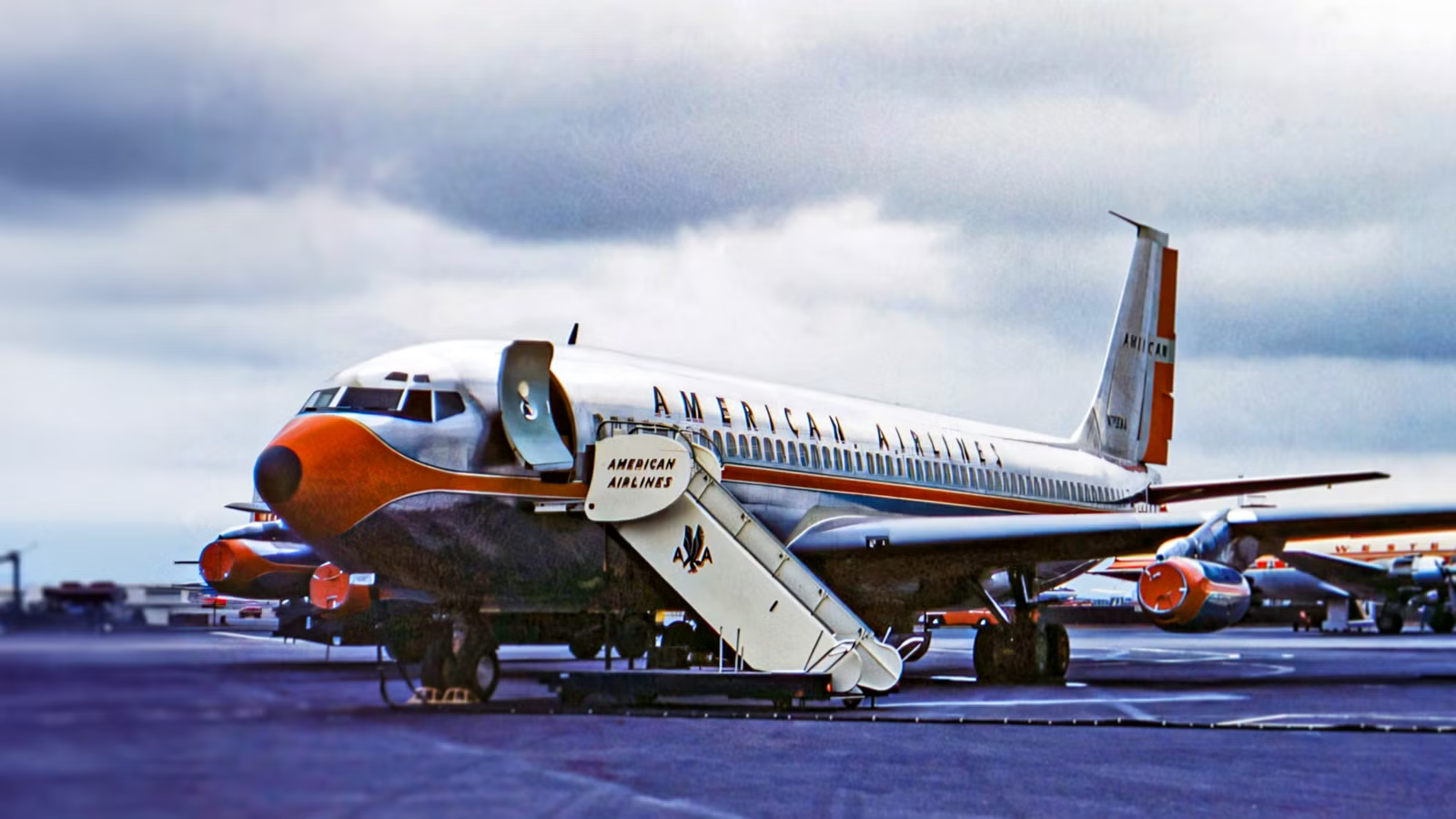
The ‘Jet Age’ officially began on January 25, 1959, when an  American Airlines Boeing 707 raced from Los Angeles to New York in just a few hours for the first time. The historic flight was heralded for effectively shrinking the nation in half as it slashed the travel time down by 50% over propeller planes.
The achievement was so great that its competitors even congratulated AA in their own advertisements at the time. Yet, even as American aggressively marketed the milestone as the official domestic dawn of the Jet Age, the achievement was technically preceded by Pan American World Airways flying transatlantic 707 routes.
Consequently, what American Airlines truly won that winter morning was a ruthless commercial race, securing a permanent marketing triumph whose success depended entirely on the high-stakes corporate maneuvering that allowed the airline to reach the runway first.
A Race That American Did Not Win Outright

American’s bold foray into the dawn of the Jet Age was facing stiff competition against its rivals also racing, to capitalize on the radical leap in performance over propeller-powered planes. Four years earlier, in October 1955, Pan Am chairman Juan Trippe originally ordered 20 Boeing 707s and 25 Douglas DC-8s and secured an exclusive contract that left Pan Am as the sole United States commercial jet operator for a full year.
Pan Am’s 707, dubbed the Clipper America, launched international service one year ahead of AA, flying from New York to Paris in October 1958. It stunned the industry when it completed the trip in eight hours and 41 minutes. Yet, Pan Am was technically beaten to the transatlantic crossing by three weeks after the British Overseas Airways Corporation flew a de Havilland Comet 4 from London-to-New York earlier that same month.
Amidst the flurry of historic firsts, American’s president C.R. Smith was building a unique strategy. Calculating that the DC-8 would arrive too late to launch on the domestic market, Smith ordered 25 707s in a high-stakes gamble to secure AA’s inaugural coast-to-coast jet route.
This domestic plan suffered a major setback in December 1958 when National Airlines leased a Pan Am 707 for winter service between New York and Miami. The move snatched away the title of first domestic jet itinerary from AA’s clutches. American was forced to change its marketing strategy and pivot to position itself as the first carrier to fly its own dedicated fleet of jets. The historic January 25, 1959, transcontinental flight became the culminating realization of that ambitious plan.
Speed Improvements And The Transformation Of Transit Times

The dramatic performance leap of the 707 was massive enough to be marketed on just one statistic. Introducing the new Boeing jetliner cut the standard scheduled transit time of American Airlines’ piston-engine DC-7C airliners exactly in half. Rows filled with actresses, WWII fighter aces, and other celebrities, Flagship California made the trip in an official time of 4 hours and 3 minutes, according to This Day In Aviation.
The Smithsonian’s Air & Space Magazine placed the 707’s standard airspeed at nearly 600 mph (966 km/h), which was a full 200 mph (322 km/h) faster than the Boeing Stratocruiser and Douglas DC-7 it rapidly replaced. Even the westbound return leg, battling severe winter headwinds, finished roughly two and a half hours ahead of the fastest propeller-driven aircraft.
The 707 had shrunk the scale of the trek across America down from a grand adventure to a trivial affair. For historic context, when Transcontinental and Western Air launched the first coast-to-coast passenger service on October 25, 1930, the multi-leg journey required 39 hours westbound and 34 hours eastbound, punctuated by 11 separate runway stops.
Engineering Decisions and the 2,800-Mile Nonstop Envelope

Aside from sheer speed, the longer range and eliminated refueling stops mattered just as much in making air travel faster than the previous generation of propeller planes. The early production 707-121 variant had a maximum unrefueled range of 2,800 nautical miles (5,186 km) that vastly overshadowed its prop-powered predecessors.
That performance envelope allowed American to fly its transcontinental route entirely nonstop from coast to coast. Conversely, Pan American World Airways’ early transatlantic flights to Paris were severely range-constrained, forcing the heavy jets to stop for fuel at Gander, in Canada’s Newfoundland.
Boeing’s Late Start And The Engineering It Produced

Despite the historic significance of the 707 and its capabilities, Boeing was not quite the first manufacturer to sell a commercial jet airliner. The British de Havilland Comet entered service in 1952. However, it was grounded after catastrophic structural failures caused three fatal crashes in less than two years.
The Comet’s demise left the Soviet Tupolev Tu-104 as the world’s only active commercial jetliner from 1956 to 1958, though the Russian plane lacked both the capacity and range required for profitable transcontinental operations.
Entering the market in third place allowed Boeing engineers to learn from their competitors’ design flaws. While the Comet embedded its engines directly inside the wing roots, Boeing pioneered hanging its Pratt & Whitney JT3C turbojets beneath the wings on specialized pylons. This pylon configuration kept airflow moving smoothly over the swept-wing surfaces, preventing aerodynamic stalls and rolls while isolating the engines in the event of an onboard fire.
The 707-123 would measure 145 feet 1 inch (44.2 m) long with a maximum takeoff weight of 257,000 pounds (116,573 kg), requiring a massive 11,000 feet (3,353 m) of runway to get airborne. Meanwhile, the Air Force widened the same prototype used to develop the 707 by 12 inches to make its KC-135 tanker. Pan Am, on the other hand, bought a custom-tailored variant with an extra 4 inches for high-density, six-across coach seating to outclass the rival Douglas DC-8.
The High Cost Of Winning First Place

Its rivals ran full-page ads congratulating American on its 1959 milestone. However, AA’s domestic lead was short-lived. After American’s momentous transcontinental flight, jetliners quickly evolved from a novel experiment in flight to an intense competition over passenger capacity and performance.
Less than eight months later, on September 18, 1959, the advanced Douglas DC-8 entered commercial service with Delta and United, challenging the Boeing 707’s market dominance. Just as quickly, the smaller de Havilland Comet 4 was made obsolete due to its 20% smaller seating capacity versus its American rivals.
Specification | Boeing 707-123 | Airbus A321XLR |
|---|---|---|
Introduction Year | Inaugurated January 25, 1959 | Transcon routes expanded through 2026 |
Debut Coast-to-Coast Route | New York (JFK/Idlewild) – Los Angeles (LAX) | New York (JFK) – Los Angeles (LAX) |
Engine Count & Type | 4x Pratt & Whitney JT3C Turbojets | 2x Ultra-efficient High-Bypass Turbofans |
Cruising Speed | 600 mph (Mach 0.82) | 540 mph (Mach 0.78) |
Maximum Range | 3,300 nautical miles (6,111 km) | 4,700 nautical miles (8,704 km) |
Max Takeoff Weight | 257,000 pounds (116,600 kg) | 213,840 pounds (97,000 kg) |
Cockpit Flight Crew | 4 (Pilot, Co-Pilot, Navigator, Flight Engineer) | 2 (Pilot, Co-Pilot) |
This aggressive jet expansion paralleled a fleet strain that would be compounded by tragedy. American Airlines introduced two entirely new aircraft types in the same week, launching its turboprop Lockheed Electra service just two days before the 707’s maiden flight. Less than two weeks later, an American Electra tragically crashed into New York’s East River, killing 65 people.
Ultimately, being first to cross the continent failed to secure the long-term industry dominance American pursued. By 1961, United Airlines absorbed Capital Airlines to become the nation’s largest carrier, stripping American of its long-standing “America’s Leading Airline” title and forcing a pivot to a newly re-engined Astrojet fleet.
From Flagship California To The A321XLR

The rapid evolution of the Boeing 707 proved how quickly Jet Age technology advanced. Upgraded in 1961 with efficient JT3D-1 turbofans, American Airlines’ original flagship airframe capped a 28-year career before being scrapped, a small piece of Boeing’s massive 1,010-aircraft production run.
That technological leap sparked an explosive era of commercial expansion, driving global passenger volume from 87.2 million in 1957 to 4.34 billion annually. Today, American Airlines continues to use the exact same marquee transcontinental corridor to showcase its most advanced aircraft technology.
AA deployed its cutting-edge Airbus A321XLR on its inaugural domestic coast-to-coast service between  New York JFK Airport(JFK) and
  Los Angeles International Airport (LAX) on December 18, 2025, packing more than 150 passengers into a premium narrowbody configuration. American’s Chief Customer Officer Heather Garboden said in a note to passengers on Flight 3:
“We’re excited that you’re here today to celebrate the debut of this new aircraft to our fleet. From premium design details to Bluetooth connectivity to elevated entertainment, every feature on this plane has been thoughtfully crafted so you can enjoy transcontinental travel in comfort.”
The long-range Airbus narrowbody is systematically displacing the older, dedicated A321T sub-fleet, eliminating the traditional standalone first-class cabin in favor of 20 sliding-door Flagship Suites, 12 premium economy recliners, and 123 standard main cabin seats.
Following its California debut, American expanded the long-range narrowbody’s premium domestic network to JFK-to-San Francisco and Boston-to-Los Angeles. Carrying 38 more passengers than the original 1959 Boeing jet, the steady fleet modernization with American’s 40 ordered A321XLRs will dictate how rapidly the standard of premium coast-to-coast air travel evolves for one of America’s oldest and most storied air carriers.