dailynewsnblog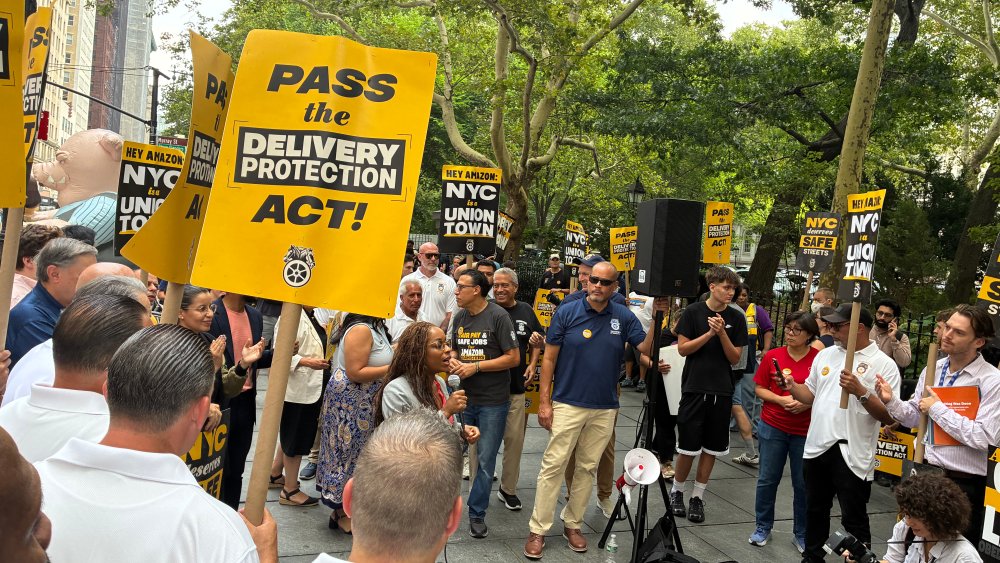
A coalition of Amazon workers and other labor unions picketed outside New York City Hall on Thursday demanding the city’s council pass a proposed bill that would require companies to directly employ their delivery drivers instead of using third-party subcontractors.
The Delivery Protection Act (DPA), which was reintroduced earlier this year by Queens councilmember Tiffany Cabán and slated for a hearing at City Hall on Thursday, would effectively make Amazon’s delivery service partner (DSP) program illegal within the city’s five boroughs.
The legislation appears to have a strong path to passage, with a more-than-two-thirds supermajority of co-sponsors in the 51-member council. But even with co-sponsorships, the bill would still need to pass a vote.
Dozens of workers representing labor and advocacy groups including the Amazon-affiliated Teamsters Union, the Alliance for a Greater New York and the Retail, Wholesale and Department Store Union (RWDSU) attended the rally, hoisting signs that said “Pass the Delivery Protection Act” and “Hey Amazon: NYC is a Union Town.”

Glenn Taylor
Cabán and other councilmembers Selvena Brooks-Powers and Alexa Avilés were in attendance, alongside Teamsters General Secretary-Treasurer Fred Zuckerman.
On Monday, the act gained its highest-profile proponent yet when New York City mayor Zohran Mamdani announced his support for the legislation. Mamdani’s office posted an 88-second video criticizing Amazon’s use of the subcontractor model.
The video includes drivers who are represented by the Teamsters, who have supported the Delivery Protection Act since it was first introduced last September.
“We’ve got a supermajority in the city council. We have the full weight of the Mamdani administration behind this bill. We’ve got workers in our communities behind this bill,” Cabán (pictured below) exclaimed at the rally. “But we need a vote, and we need it now.”

Glenn Taylor
Amazon’s DSP program has been a subject of controversy and litigation over the years, namely due to the control the tech titan often can exercise over the partnering companies and their employees.
“We want to pass the Delivery Protection Act because the workers are not protected right now,” Esly Paredes, a former Amazon driver, told Sourcing Journal at the event. “Amazon does what they want with us by using these subcontractors.”
While DSPs are not considered employees or franchisees of Amazon, the online marketplace can dictate near-total operational oversight over staff pay, assigned routes, the type of vans used and performance metrics. Critics have argued that Amazon relies on this business model to skirt liability for workplace injuries and poor working conditions, all while avoiding unionization.
“I want everyone to see that workers are standing up about this. I want people to see and understand the abuses that workers go through,” said Paredes. “Amazon is not the great company that it makes itself out to be because of all this treatment, and we want to inspire more people to learn about that and to get involved in this fight.”
Paredes worked at Amazon delivery partner Satriano Logistics, a last-mile delivery carrier that works out of the tech titan’s “DBK4” building in the Maspeth neighborhood of Queens. She said she was fired for posting videos about her work on social media, with one of the videos showing her support for the DPA.
Amazon has said that they had no involvement in Paredes’ termination.
“If the bill were passed, I would have already been able to get my job back and I’d be in a better position,” Paredes said.
Amazon partners with more than 40 local delivery partners that employ over 5,000 people in New York City and has stated that the bill’s passing could prompt it to move delivery operations outside the five boroughs.
As many as 10 distribution centers could potentially move if the bill were passed, Amazon says, arguing that it threatens local jobs and eliminates the perks of same-day delivery.
Amazon has provided roughly $5 million to the opposition campaign against the DPA, largely through a business coalition called the Five Borough Jobs Campaign. The campaign commissioned a study from environmental, planning and engineering consulting firm AKRF, which agreed with e-commerce giant’s job concerns, concluding that the act could threaten more than 10,000 positions in the city in the event delivery companies look elsewhere to fill the roles.
A full relocation scenario would push up annual household delivery costs by $664, AKRF said, identifying that small businesses dependent on delivery services could expect heightened operating costs due to the required shifts in their business models.
Local trucking companies have also stood against the proposed legislation.
The Trucking Association of New York (TANY) cited that the bill disrupts legitimate business relationships and makes it harder for small, local transportation companies to compete within city limits—effectively pushing the municipality toward relying on larger trucks brought in from farther away.
“There is also nothing novel about major suppliers diversifying freighting partnerships to efficiently move freight. Motor carriers, brokers, shippers, owner-operators, and other logistics providers have relied on contractual relationships to move goods through different stages of the supply chain for generations,” said Zach Miller, TANY’s vice president of government affairs, in a statement. “A shipment may move through multiple companies and modes before reaching its destination. Those relationships allow the freight network to effectively respond to changing environments.”
Across the Hudson River, New Jersey recently filed suit against the e-commerce giant over its application of the delivery service partner program, arguing that the company violates antitrust laws by restricting the workers’ unionization efforts and enforcing “no-poach” agreements.
According to the suit, these practices leave thousands of state residents earning less and enduring harsher working conditions than they otherwise would.