dailynewsnblog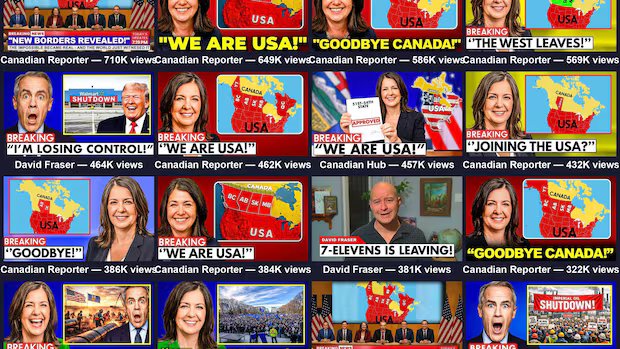
After a new report put a spotlight on popular YouTube videos with unclear origin promoting Alberta separatism, an independence leader said he’s unconcerned about foreign interference influencing a possible upcoming separation referendum.
Mitch Sylvestre, the CEO of the Alberta Prosperity Project, said claims of foreign interference in the Alberta independence debate are “overblown.”
He was responding to a new report about a network of inauthentic and coordinated YouTube channels, which the report’s authors argue is exploiting Albertans’ grievances with the federal government to advance the idea of separating from Canada and joining the United States.
“This foreign interference thing, as far as I’m concerned, is a fairy tale up to this point,” Sylvestre said.
The report, published Tuesday by the Canadian Digital Media Research Network, analyzes channels that post videos with such titles as “Danielle Smith Just ANNOUNCED the Biggest Separation in Canadian History Is About to HAPPEN!” and “Alberta & Saskatchewan Just GOT OFFICIALLY BACKED By The US! 51ST-52ND STATEHOOD INCOMING!”
Researchers analyzed 20 YouTube accounts that have totaled nearly 40 million views in the past year. The channels’ videos are designed similarly while drawing from the same subjects and news clips, while including “frequent and obvious lies,” the report said.
“Slopaganda” is how the report describes the videos, referring to inauthentic, low-quality, and seemingly mass-produced videos that use generative AI and promote a political message.
Chris Ross, one of the report’s authors, said his team couldn’t confirm the origin or intent of the videos, but they found several channels with the same template and “digital fingerprints,” indicating a coordinated production.
Calgary Eyeopener6:59A new report has identified a host of online sources promoting disinformation around Alberta’s separatist movement
Senior Analyst at the ‘Centre for Media Technology and Democracy’ at McGill University’s School of Public Policy, Chris Ross, joined us with what he’s learned about the rise of fake YouTube channels selling separation to Albertans.
“We think that the highly skewed, charged language they use is indicative of a political angle,” said Ross, a survey analyst for the Media Ecosystem Observatory, on CBC Radio’s The Calgary Eyeopener.
“But it might just be because this is a very salient topic, and they’re taking advantage of it to grow their YouTube presence.”
The inauthenticity of the videos can be seen, the report argued, in how the video’s human and AI-generated voiceovers often mispronounce, miscontextualize or misunderstand what they’re discussing. One example Ross pointed to was how city names like Regina were mispronounced.
It’s unclear where the videos are coming from or who is behind the channels, Ross said. The only person the report’s authors identified in the 20 channels is a Pennsylvania-based voice actor.
“They perform this western, Albertan perspective. But from what we can tell, they’re not Albertans,” Ross said.
CBC News reached out to two of the most popular YouTube channels identified in the report for comment, but did not receive a response before publication.
Separatist leader not worried about foreign interference
Sylvestre said he’s unconcerned about the prospect of the Alberta independence debate being influenced by people and organizations outside of Canada, because he doesn’t see it happening nor how it would benefit anyone outside the province.
He added he had never heard of the videos the report analyzed before being contacted by CBC News on Tuesday, and he doesn’t see how the YouTube channels would hurt the work of real separatist groups.

“If it’s telling the truth and people want to watch that, it influences the vote our way, then I can’t see how that would be negative for us,” Sylvestre said.
“If they’re promoting Alberta independence, that’s what I do. So if the information is not accurate, then that’s possibly not going to help us. [But] who’s going to determine the accuracy of the information?”
YouTube reviewing accounts
YouTube spokesperson Zaitoon Murji said Tuesday the website is reviewing the channels included in the Canadian Digital Media Research Network’s report, and will remove any content that violates its community guidelines.
“YouTube doesn’t allow spam, scam or other deceptive practices that take advantage of the YouTube community,” said Murji via email.

Ross would like to see the website go further.
He argued YouTube should disclose data about geo-targeted advertisements or other metrics that could provide more information about whether the videos are being directed at a specific region, and share information about the ownership history of the accounts.
“We think that these really important democratic conversations that Albertans are having should be by real Albertans with genuine opinions, not by people performing an Albertan perspective,” Ross said.
Alberta potentially unprepared for foreign interference
National security experts have previously warned that Alberta is not ready for the threat of online disinformation that could come from foreign actors ahead of a possible referendum on separation from Canada this fall.
Last month, Premier Danielle Smith said she’s started the process to seek a higher security clearance, so she can receive briefings from the Canadian Security Intelligence Service about foreign interference in Alberta.

Arthur Green, the press secretary for Alberta’s Ministry of Public Safety and Emergency Services, said on Tuesday that the Provincial Security and Intelligence Office provides analysis on issues affecting Alberta’s security, and reports any concerns to the RCMP.
Tip of the iceberg
Tuesday’s report is just the tip of the iceberg of what Jean-Christophe Boucher has seen on YouTube.
Boucher, an assistant professor at the University of Calgary who’s researched foreign interference, said he’s tracked these videos for roughly a year and a half, ever since they were first recommended to him. He was surprised to find so many AI-generated videos targeting Albertan audiences.

“It’s a very sophisticated group of channels,” said Boucher.
“The size of the content they’re producing, the quality of the content and the AI they’re using to create this requires a lot of resources.”
He said he found as many as 60 channels, designed in a similar way and trying to reach the same audience. Even when a channel would be deplatformed by YouTube, Boucher said they inevitably reappeared under a new name.
Boucher compared the videos to foreign interference that’s been researched in other parts of the world where political tension was amplified to undermine democratic institutions. Through this lens, he argued Alberta separatism could be seen as a strong faultline to exploit in Canada.
But he added he’s skeptical the videos are the work of real groups pursuing Alberta independence. While many of the videos analyzed in the report focus on separatism, he noted the channels also stoke Canada-U.S. divisions, and predate last year’s Canadian federal election and even Donald Trump’s 2024 election.
“They move in time with topical issues, and so their narratives change,” Boucher said.
“They’re kind of moving with the topic of the day, especially on the far right, and really kind of focusing on Alberta.”