dailynewsnblog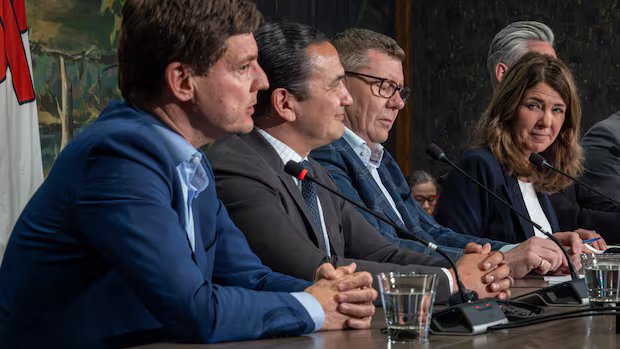

Listen to this article
Estimated 4 minutes
The audio version of this article is generated by AI-based technology. Mispronunciations can occur. We are working with our partners to continually review and improve the results.
Premier Danielle Smith and her Manitoba counterpart Wab Kinew got into a spat over separation and treaty rights Tuesday at the conclusion of the Western Premiers’ Conference in Kananaskis, Alta.
Smith, who called a referendum on Alberta’s future in Canada for Oct. 19, has mused that Section 35 of the Canadian Constitution, which affirms the rights of Indigenous people, requires a second look.
She said the duty to consult should be applied to major projects, but she believes the courts need to decide whether it should apply to a citizen initiative petition.
“We want to make sure that we have a very clear understanding of what the duty to consult really means and what it doesn’t mean,” Smith told the news conference. “And I think at the moment there’s a lack of clarity on that.”
Earlier this month, an Alberta judge quashed a potential separation question from separatist group Stay Free Alberta. The judge ruled that Alberta didn’t properly execute its duty to consult with First Nations.
Alberta intends to appeal the decision, with Smith noting Tuesday that she expects the issue to reach the Supreme Court of Canada.
Her statement prompted a swift reaction from Kinew, who said he met on Monday with representatives from First Nations in Alberta.
“I think we know that is not correct, a lot of what you just said there, Premier Smith,” said Kinew, who is Anishinaabe.
“It is not up to the petition gatherers to fulfil the duty to consult. It is up to you, as the Alberta government, to fulfil the duty to consult.”

At a news conference following the western premiers’ annual meeting, Manitoba Premier Wab Kinew disagreed strongly with Alberta Premier Danielle Smith’s characterization of the duty to consult First Nations. Earlier this month, an Edmonton judge overturned Elections Alberta’s approval of a petition by a separatist group, saying it failed to consider an earlier decision that said separation would violate Indigenous treaty rights.
Kinew said he agreed with the May 13 ruling from Justice Shaina Leonard, and added that First Nations should be thanked for “hitting the pause button” on the issue.
The application to Leonard was brought by four First Nations in Alberta: the Athabasca Chipewyan First Nation, Blood Tribe, Piikani Nation and Siksika First Nation.
Troy Knowlton, chief of the Piikani Nation, told CBC News that about 20 Treaty 6, 7 and 8 chiefs and proxies joined Kinew at the Calgary airport for a ceremonial and cultural gathering.
Knowlton said the majority of the discussion focused on Alberta separatism, resource governance and the United Nations Declaration on the Rights of Indigenous Peoples.
“He wanted to hear directly from the chiefs,” Knowlton said in an interview with CBC News on Monday evening.
“What he said to us was he’s very sympathetic and that he would carry some of our messages to [Smith] and [other] meetings with the prime minister.”
‘Let’s work together’
Kinew also urged Smith and other political leaders to delay discussions about a referendum for at least a year to see if Canada can get pipelines built.
“Now the rest of Canada, let’s work together and show Alberta just how appreciated they are in the rest of this country.”
At Tuesday’s news conference, Eby reiterated concerns he’d expressed the previous day about Smith’s decision to call a referendum on Alberta’s future in Canada at a time where the country needs to stand together against the United States.
While emphasizing the respect he said he had for Smith, Eby noted that he believes the tanker ban on the north coast must continue.
“One of the things that I do appreciate about my relationship with Premier Smith is even in the depths of significant disagreement on major priorities, we’re still able to come together and have frank and civil conversations,” Eby said.

The joint communique from the western and northern leaders didn’t mention the Alberta referendum, instead focusing on economic, trade, energy, major projects and Arctic sovereignty and security.
The premiers urged Ottawa to situate a planned Defence, Security and Resilience Bank in Vancouver. Montreal, Ottawa and Toronto are also vying to be the home of the new facility.
They also asked the federal government to change certification rules so that former military aircraft can be used to help fight fires.
The premiers called on the federal government to resolve the softwood lumber dispute with the United States that continues to hurt western Canadian workers, as well as tariffs on Canadian seafood, pork and canola imposed by China.