dailynewsnblog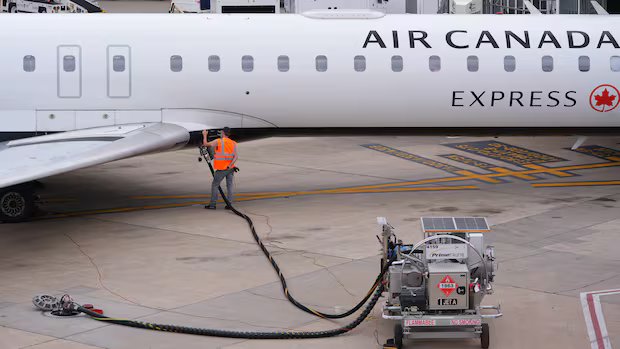

Listen to this article
Estimated 3 minutes
The audio version of this article is generated by AI-based technology. Mispronunciations can occur. We are working with our partners to continually review and improve the results.
Air Canada has temporarily suspended service from Toronto and Montreal to New York’s John F. Kennedy International Airport as the war in the Middle East drives up fuel costs.
The airline regularly monitors and reviews flights to make sure routes are profitable, a spokesperson said in a statement to CBC News on Friday.
“As jet fuel prices have doubled since the start of the Iran conflict and some lower profitability routes and flights are no longer economic, we are making schedule adjustments accordingly,” the Air Canada spokesperson said.
Flights from Toronto and Montreal to JFK will be suspended temporarily starting June 1, with plans to resume Oct. 25, Air Canada said, adding that any affected customers will be contacted with alternate travel options.
The cuts affect one flight from Montreal and three from Toronto, the airline said, noting that Air Canada will still offer 34 daily flights between Canada and LaGuardia Airport in New York and Newark Liberty International Airport in New Jersey.
The Air Canada announcement comes as air travel is facing an unprecedented fuel crisis. With the U.S.-Israeli war against Iran stretching past the six-week mark, fuel prices have more than doubled and costs are starting to be passed on to consumers.
WestJet announced earlier this month it would be consolidating flights on several lower-demand routes, reducing its capacity by one per cent in April and three per cent in May.
On Thursday, the head of the International Energy Agency said Europe has “maybe six weeks or so” of remaining jet fuel supplies and warned of possible flight cancellations if oil supplies remain blocked by the Iran war.

Planning an international trip this summer? The International Energy Agency warns Europe may run out of jet fuel in six weeks due to the global energy supply crunch amid war in the Middle East. Werner Antweiler, associate professor at UBC’s Sauder School of Business, spoke to BC Today host Michelle Eliot. He said people travelling to Asia and Europe, where countries rely on Middle East oil, should plan for flight cancellations while there.
John Gradek, a faculty lecturer on aviation management at McGill University in Montreal, told CBC News earlier this week that we’re in the midst of the worst crisis we’ve ever had in aviation and that even if the Strait of Hormuz reopens, it could take years to fix the region’s refining capacity.
“And without fuel, you can’t fly,” Gradek said.
Iran’s foreign affairs minister announced on Friday that passage for all commercial vessels through the Strait of Hormuz is completely open following a 10-day ceasefire agreement between Israel and Lebanon reached on Thursday, but U.S. President Donald Trump said the U.S. naval blockade on Iran will remain in place until a deal with Tehran is struck.
Oil prices tumbled 10 per cent after Iran’s announcement, which would allow oil tankers to exit the Persian Gulf again and carry crude to customers worldwide.