dailynewsnblog
Anthropic’s economic team, including Anton Korinek and Chad Jones, have a valuable new paper, Economic Scenarios for Transformative AI. They make their assumptions explicit and provide a scenario explorer that lets you change them. How capable will AI become? How quickly will firms adopt it? Will it augment workers or automate their tasks? You can see what different answers imply for growth, wages, and unemployment.
In their extreme scenario AI takes on a lot of tasks, GDP is 32.4% higher by 2030 than without AI and labor share declines from 60% to 45.2% but they make this striking point:
“Total labor income in 2030 in the extreme scenario is almost exactly what it would have been without AI: the labor share falls by a quarter while GDP rises by a third, and 0.45×1.32 ≈ 0.60.”
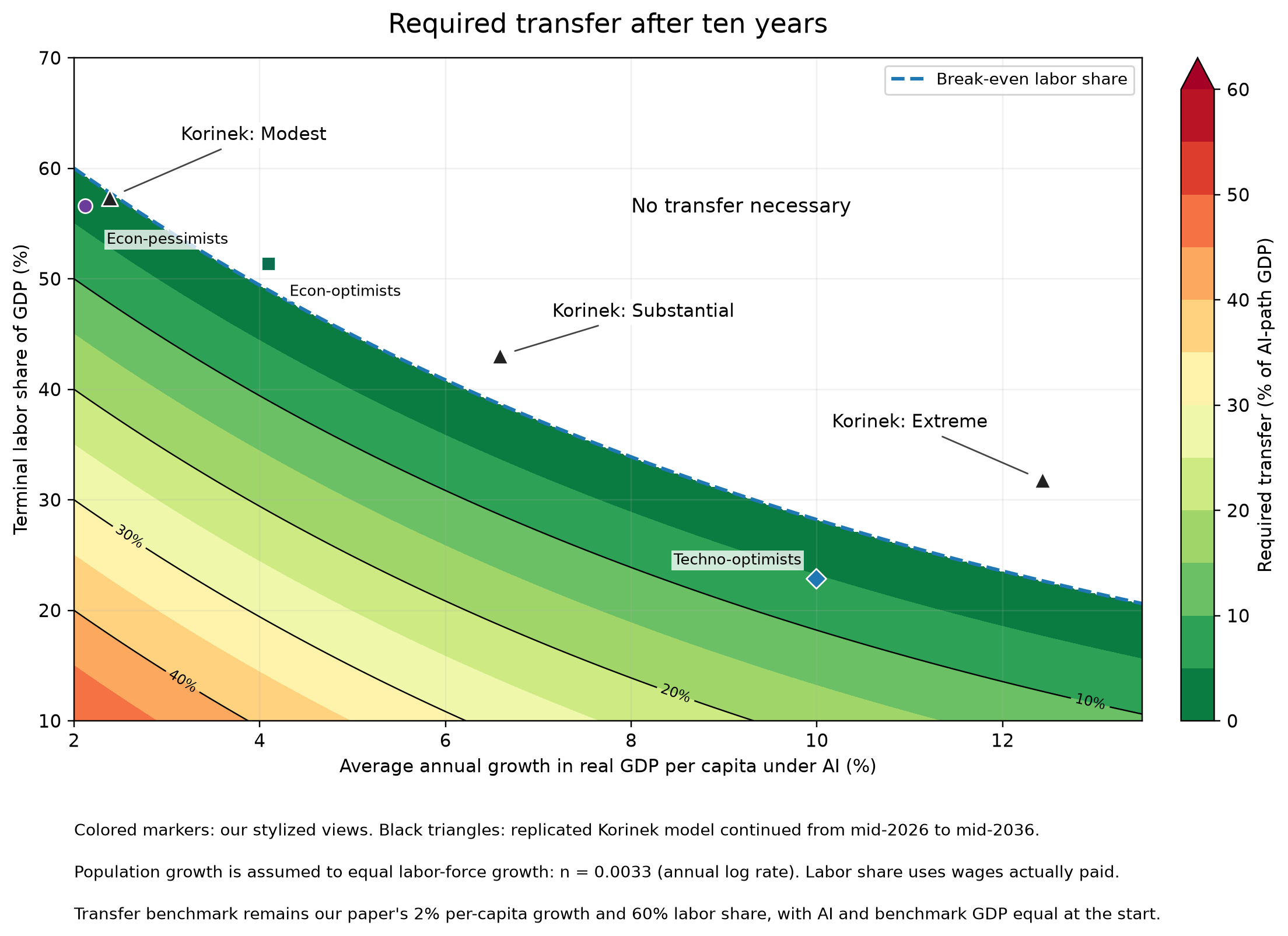
Exactly. That is the central point of my paper, How Much Redistribution Will AI Require. A falling labor share does not necessarily mean falling labor income. Workers can receive a smaller share of a much larger economy and still earn as much as they would have without AI.
Using the code behind their scenario explorer I updated their results to a 10 year horizon and plotted them on my redistribution graph. Only under the modest scenario is some net labor transfer required to make AI Pareto improving at the aggregate level.
Aggregate labor income, of course, conceals differences among workers. Korinek et al. find that cognitive occupations lose income while other occupations gain. In their extreme scenario, restoring the cognitive occupations’ wage bill to its no-AI level would require about 9% of GDP. They argue that compensation on this scale in response to technological change has no precedent.
I think this makes the adjustment problem look too pessimistic.
First, adjustment happens through retirement and entry. A retiring accountant need not retrain as a nurse. A young person enters nursing rather than accounting. Neither becomes unemployed even as labor reallocates. Korinek et al. understand these channels but give them limited scope in their model. Admittedly, those margins don’t do much work by 2030 but they matter over ten years.
Second, compensation can take the form of shifting taxes from labor to consumption. In the long run labor’s share of consumption tends to equal its share of GDP, so the lower labor’s share becomes, the more relief a given tax shift provides. At a 45% labor share, each dollar shifted from labor taxation to consumption taxation reduces labor’s net burden by 55 cents. Shifting taxes worth 5% of GDP would thus provide net relief to labor of 2.75% of GDP, without increasing total tax revenue. Unemployed workers would still need payments, but compensation need not come entirely through additional government spending.
Third, we do have experience expanding income support rapidly. U.S. unemployment benefits reached approximately 2.5% of GDP in 2020, and that during a contraction. Britain’s compensation to slaveowners following abolition amounted to roughly 5% of GDP in a one-time settlement. These episodes show that governments can mobilize substantial resources for compensation. Moreover, the extreme AI scenario brings an enormous increase in output from which to finance compensation.
Preserving aggregate labor income does not protect every worker. But even the extreme Korinek scenario reinforces the point that a dramatic decline in labor’s share can coexist with stable or increasing aggregate labor income. To the extent labor income does decline, growth makes compensation affordable and attrition, entry, and tax shifting can make the task smaller than it first appears.