dailynewsnblog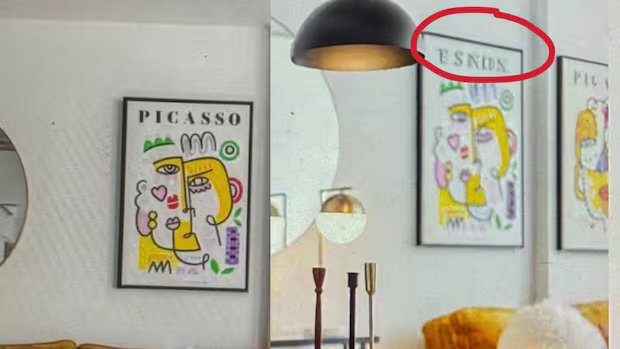
Josh Wells, a college student from Iowa, was excited to explore Montreal on his first trip outside the U.S. But as he scrolled through Airbnb listings in search of a place to stay, he began to notice something that didn’t seem quite right.
Several of the hosts renting out their properties had profile pictures that Wells suspected were generated by artificial intelligence.
“Your average person taking an iPhone photo, there’s obviously like a little bit of imperfections,” Wells told the CBC’s Cost of Living. “The AI photos, they just looked too perfect.”
Still, Wells kept browsing. He was even close to booking one of the properties when a final look at the listing’s photos raised another red flag.
He zoomed in on a piece of wall art depicting two halves of faces joined together. At the top, the artwork appeared to read “Picasso.” But in another photo of the same room, taken from a different angle, the artwork looked different.
“The text was all warped and funky,” he said. “I’m just like, ‘Yeah, OK, this is AI.”

When booking his trip to Montreal, Wells found extremely polished-looking photos of hosts appeared in numerous Airbnb listings, leading him to suspect they had been generated using AI. Short-term rentals in that city are subject to strict rules aimed in part at protecting the city’s housing supply. (Josh Wells/Reddit)
That was enough to put Wells off the listing — and ultimately using Airbnb for this trip. Unable to tell whether the photos showed a real place or an AI-generated version of one, he opted for an apartment-style hotel instead.
“The fake profile picture is one thing, but listings of the actual place that you’re staying at and spending thousands of dollars was an immediate no for me,” Wells said.
Wells isn’t the only traveller to question whether the photos found on Airbnb or similar short-term rental-style platforms accurately reflect reality.
In July, an Ottawa family reported that their daughter arrived at a Toronto Airbnb to find a room that looked significantly different from the listing photos, which they suspected had been generated or heavily altered using AI.
The family provided side-by-side photos showing differences in the room and bathroom. Airbnb said the listing did not match the property and refunded the guest, but did not confirm whether artificial intelligence had been used.
As AI makes it easier to alter photos, experts say travellers may find it increasingly difficult to know whether Airbnb-style listings accurately reflect reality, raising questions about consumer trust and protections in Canada.
When a photo makeover goes too far
The proliferation of free, quick and easy-to-use AI tools is making photo editing increasingly tempting, said Francis Syms, associate dean in the faculty of applied sciences and technology at Humber Polytechnic in Toronto.
Beyond the major AI platforms, such as ChatGPT, Claude by Anthropic and Google’s Gemini, countless other websites offer free tools for modifying images, said Syms. Hugging Face, for example, hosts thousands of AI tools that let users upload and edit photos.
“In a matter of 10 seconds, you can upload a picture to one of these sites and ask it to remove all the smudges or to change the furniture,” he said. “You’ll get that image back maybe 30 to 60 seconds later.”

Artificial intelligence platforms like ChatGPT allows users to quickly and easily edit photos. (Marco Bertorello/AFP via Getty Images)
It’s difficult to know where AI editing crosses into deception, said Daniel Guttentag, an associate professor of hospitality and tourism management at the College of Charleston in South Carolina.
“If you put in a fake hot tub on the back patio, I think basically everyone would agree that that is a blatant misrepresentation of what one’s unit offers,” he said. “Whereas if you just start to play with the lighting a little bit … I think most people would be comfortable with that.
“But then there’s a whole lot of space in between, when it crosses that line into, ‘Wait, this isn’t what I signed up for.'”
Guttentag said another concern is the use of AI-edited images to make it appear that guests have damaged a property, potentially leading to compensation claims.
In 2025, a guest from London, U.K., booked an Airbnb in Manhattan and was accused of causing more than £12,000 ($22, 665) in damage.
She disputed the claim after noticing inconsistencies in photos of a supposedly cracked coffee table, which she suspected had been digitally manipulated or generated by AI.
Airbnb initially said she owed more than £5,000 ($9,444), but later fully refunded her after the case drew media attention.
Can you trust what you see online?
Relying on listing photos to decide which property to book makes trust particularly important for Airbnb guests, said Guttentag.
“You can’t try it on in advance, like a pair of shoes,” he said. “You have to have the confidence and the trust that it’s going to live up to your expectations.”
Although AI-altered photos might help hosts attract bookings in the short term, guests who arrive to find something different than what was advertised may leave negative reviews, Guttentag said. If people feel misled “one too many times,” he said, it could prompt them to stop using the platform altogether.

Daniel Guttentag is an associate professor of hospitality and tourism management at the College of Charleston in South Carolina with research interests in Airbnb and artificial intelligence. (Submitted by Daniel Guttentag)
In a statement to CBC News, Airbnb says its rules require listings to be “accurately represented” and that the company may ask hosts to remove content that uses AI or other digital technology to “edit flaws, hide damage, add amenities or attributes that are not part of a listing, or otherwise materially misrepresent the listing.”
The company further said it encourages guests to report misleading listings and that those who find a property that doesn’t match its description can contact its 24/7 community support team. Under AirCover, Airbnb added, it may help guests find a similar place or provide a refund if the host can’t resolve the issue.
In August, California’s Artificial Intelligence Transparency Act (CAITA) took effect, requiring AI-generated images, videos and audio to carry information that can help consumers identify whether digital content was created or altered using AI.

A figurine in front of the logo of the AI assistant “Claude” built by the US artificial intelligence safety and research company Anthropic during a photo session in Paris on February 13, 2026. (Joel Saget/AFP via Getty Images)
Canada doesn’t yet have AI-specific legislation addressing misleading advertising, said Steve Szentesi, a Toronto-based competition and advertising lawyer. But he said existing laws can already apply to deceptive AI-generated images.
The federal Competition Act prohibits misleading advertising, whether the claims are made through text, photos, audio or other forms of media. Provincial and territorial consumer protection laws offer similar safeguards.
While AI-generated images are relatively novel, the underlying issue is not, Szentesi said. Courts have dealt with disputes over real estate listings for decades, including cases where photos of a property didn’t match the home itself or contradicted descriptions in the listing.
For consumers who believe a short-term rental listing misrepresents a property, Szentesi suggests first raising it with the rental platform. They can also file a complaint with the Competition Bureau or their provincial or territorial consumer protection act.
In the meantime, Syms suggests would-be bookers look for possible signs of AI-generated images in listing photos, such as crooked door frames, tile lines and countertops, oddly shaped furniture, inconsistent shadows or reflections, and blurry or jumbled words on books or wall art.
Travellers can also use a tool like Google Lens, he said, to search for the same image online and check whether it has been taken from another website rather than showing the actual property.
For Wells, the experience hasn’t ruled out him using Airbnb altogether — he had a positive experience booking with the platform in Kansas City in March. But his search for a place in Montreal has made him more wary, he said.
“I am open to it again as long as there’s just no fake AI listings involved.”