dailynewsnblog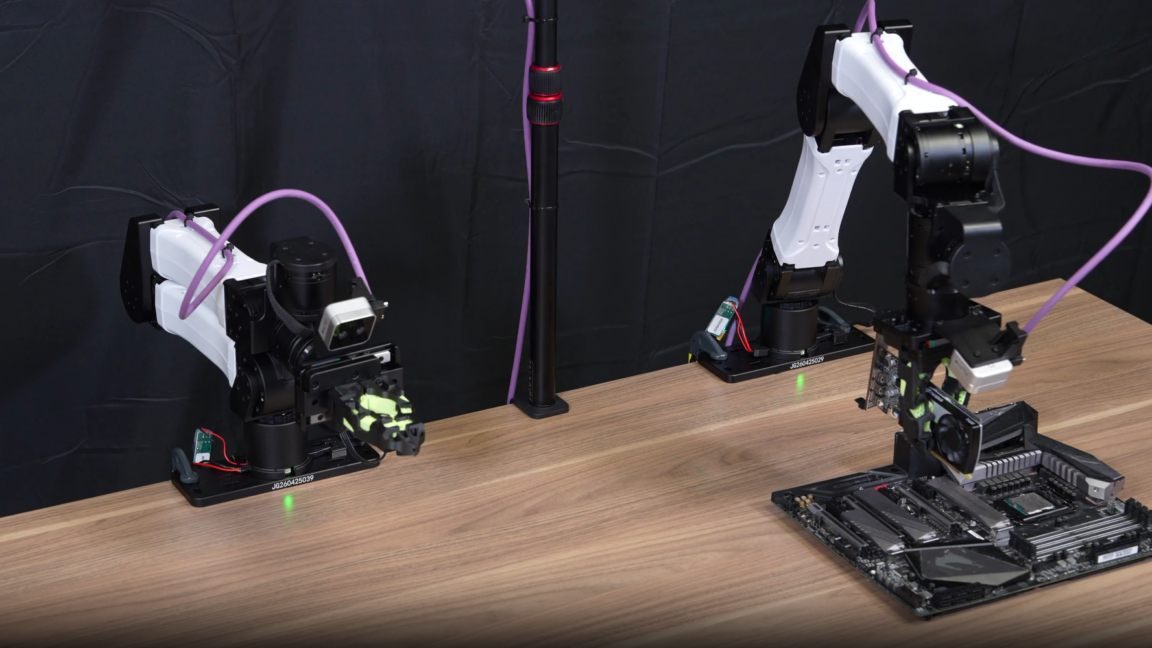
What happens when you give AI coding agents a lab full of robotic arms, some compute resources, and a “generous token budget” for teaching the robots various tasks? The agents can apparently figure out a training regimen that teaches the robots to successfully cut zip ties and even insert GPUs into thin sockets on motherboards.
That glimpse into how AI can act in a fully autonomous way to automate robot training was made possible by a new agent harness framework—software that wraps around AI models to enable their use of various tools while also providing capabilities such as memory, context, constraint, and feedback loops. That agentic harness, called ENPIRE, was developed by robotics researchers at the Nvidia GEAR (Generalist Embodied Agent Research) lab alongside collaborators from Carnegie Mellon University in Pittsburgh and the University of California, Berkeley.
“A part of our NVIDIA GEAR lab now self-improves tirelessly overnight,” wrote Jim Fan, director of AI at NVIDIA, in a LinkedIn post. “We just read the reports in the morning.”
Fan also jokingly described the goal of such AI-directed robot training, saying, “We all take a holiday and Jensen wouldn’t even notice,” in reference to Nvidia founder and CEO Jensen Huang. But it’s not only Nvidia robotics researchers who could benefit—Fan said the team would be open-sourcing everything so anyone can host their own “self-running robot lab at home.”
The ENPIRE harness has four modules that enable AI coding agents to perform automatic reset and verification on tasks, refine policies that guide robotic behavior, evaluate such policies across multiple physical robots working in parallel, and address failures by analyzing logs, ingesting research papers, and improving training infrastructure and algorithm code. More technical details are available in the research paper uploaded on June 16, 2026.
The harness was tested with three different AI coding agents, including OpenAI’s Codex with GPT-5.5, Anthropic’s Claude Code with Opus 4.7, and Moonshot AI’s Kimi Code with Kimi K2.6. Teams of the coding agents independently developed different algorithmic approaches to robot training, tested them in real-world experiments, and then retained whatever changes helped raise the overall success rate over repeated cycles of self-directed testing.