
 dailynewsnblog
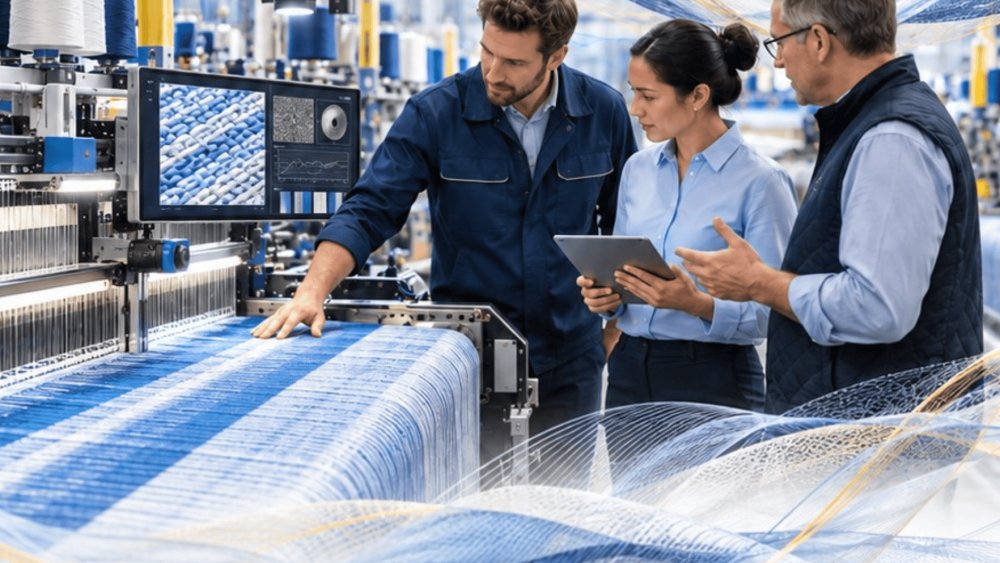
As the textile industry advances in investing in AI, new research from the International Textile Manufacturers Federation (ITMF) and the Institut für Textiltechnik of RWTH Aachen University (ITA) revealed challenges and successes so far. The research was derived from webinars held by the organizations over the past two years.
The recently published white paper, titled “AI in the Textile Value Chain: A Strategic Guide to Artificial Intelligence for the Global Textile Industry,” identified a disconnected industry structure. The authors found that the global textile industry is not under-digitalized but “digitally fragmented.” Decades of partial digitalization have created large volumes of data locked inside disconnected systems.
“Data is generated across machines, quality systems, logistics platforms and enterprise software, yet these streams are rarely fully interoperable,” the 49-page report noted. “This fragmentation has several consequences: decision-making remains distributed across organizational silos, information is duplicated, manually transferred or reinterpreted and opportunities for cross-functional optimization remain limited.”
The report’s authors said in many cases, digital systems are used primarily for documentation and reporting rather than for use in any active decision support. “Data is collected after the fact, not integrated in real time—limiting the industry’s ability to respond to demand variability, quality deviations or supply-chain disruptions.”
There are other challenges as well.
The research found the main barrier to AI adoption is poor data quality, not machine learning algorithms. Unstructured data and workforce skill gaps also play a role. The authors said AI does not fix bad data; it amplifies existing flaws.
There is good news. The report found AI is already generating measurable return on investment (ROI). It shows benefits in targeted areas such as computer-vision fabric/yarn inspection, predictive maintenance, demand forecasting, and energy optimization. One nonwovens production line case study showed causal AI reducing scrap by 10 percent.
The white paper also revealed that the industry is transitioning from pure decision support to direct action. The authors estimate that end-to-end autonomous AI workflows will become realistic within 2 to 3 years.
The authors of the report said for executives and senior managers in the industry, the central learning “is that AI is best understood as a capability for managing complexity, not as a shortcut to productivity gains.”
“Value emerges when AI is applied incrementally to well-defined problems—particularly quality management, planning and coordination,” the report stated. “Successful adoption depends less on choosing the ‘right’ algorithm than on investing in data foundations, skills, governance and trust.”
For those in the trenches, such as engineers, IT specialists and operational managers, the authors noted AI relies on an existing digital and organizational foundation. This includes data quality, system integration, and understandable outputs, which “are prerequisites for meaningful use.”
“Current evidence is strongest for decision support and bounded automation, but the appropriate level of autonomy depends on the task, its risks, the maturity of the system and the consequences of failure,” the report’s authors said. “Human expertise remains essential for defining objectives, interpreting unusual situations, managing exceptions and ensuring accountability.”
This assessment mirrors what other industries are learning. AI is a tool, but humans set its parameters. AI is redefining how work gets done and can redefine or eliminate positions. “Routine analytical, administrative and coordination activities are increasingly supported or performed by AI, while human work shifts toward judgment, orchestration, exception handling and interpersonal responsibilities,” the report stated. “This raises demand for digital literacy, data awareness and the ability to evaluate AI-supported outputs critically.”
The report’s authors said a common denominator emerges across all stakeholder groups. “The impact of AI on the textile industry will depend less on technological breakthroughs than on coherence—between data and systems, between human capabilities and machine autonomy, and between individual initiatives and collective action.”