dailynewsnblog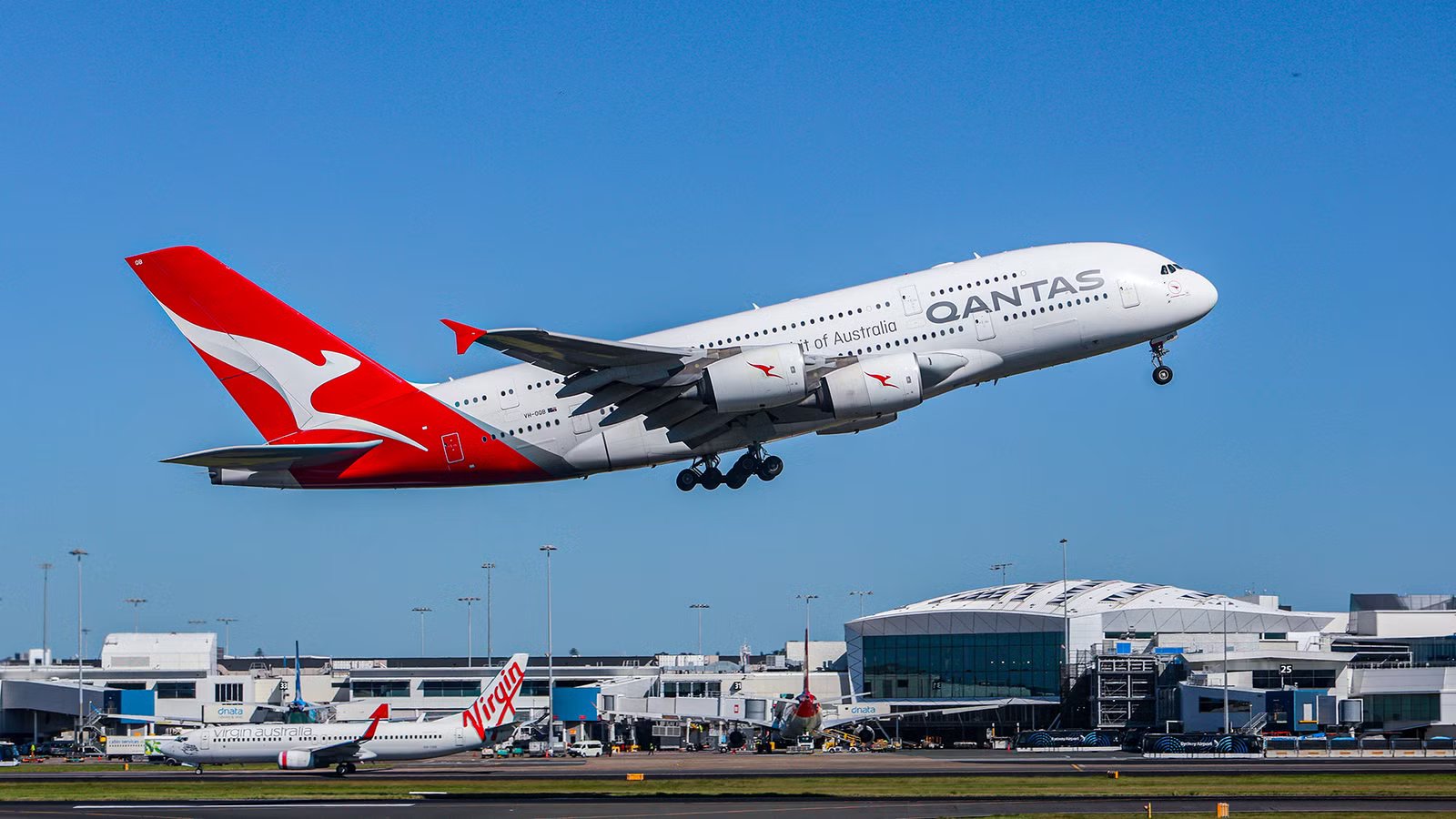
Qantas is on the verge of having its entire Airbus A380 fleet back in commercial service after a rare ferry flight sent one of the grounded superjumbos directly from  London Heathrow Airport (LHR) to
  Los Angeles International Airport (LAX) over the weekend. VH-OQG, which had been stuck at Heathrow since early July awaiting an engine change, flew as flight QF6007 from London to Los Angeles on July 11, an unusual routing for an aircraft that typically shuttles between Sydney, London, and Singapore rather than crossing the Atlantic and Pacific in one movement.
The aircraft’s return leaves just one Qantas A380 outside normal rotation. VH-OQI, which has been undergoing scheduled maintenance in Dresden since March, is expected to complete a ferry flight back to Sydney as soon as Tuesday. Once that jet lands, Qantas will have all ten of its serviceable A380s available for the first time since the London engine issue disrupted the airline’s July schedule.
Engine Trouble Sidelined The Fleet

The disruption began the week of July 3, when Qantas discovered a problem with one of VH-OQG’s engines while the aircraft was on the ground in London. A Qantas spokesperson said one of the airline’s A380s required an unscheduled engine change in London after an issue was discovered, and that a spare engine was shipped in from Los Angeles for the repair. The airline had originally expected the aircraft to return to service within days, but the timeline slipped.
The grounding forced Qantas to cancel A380 flights from Sydney on July 3 and July 8, as well as from Melbourne on July 4, all routes that would have connected to Los Angeles. The problem compounded an already tight schedule. According to Analytic Flying on X, Qantas typically needs either eight or nine of its ten A380s active on any given day, and VH-OQI’s ongoing maintenance in Dresden had already trimmed available capacity to nine aircraft before VH-OQG’s issue emerged. A separate, shorter-lived problem also touched the fleet in early July. VH-OQH was briefly pulled from service on July 2 because of air conditioning issues, though it returned to flying the very next day.
An Unusual Repositioning Flight

VH-OQG’s return trip stood out for its routing. Rather than heading back to Australia via the carrier’s usual Singapore stopover, the jet flew directly from Heathrow to LAX, a transatlantic and transcontinental crossing that A380s rarely fly in a single hop on Qantas’ network. The move likely reflects both the location of the replacement engine, which had been shipped from Los Angeles, and Qantas’ need to reposition the aircraft for its West Coast and Pacific operations as quickly as possible.
The London to Los Angeles ferry effectively skips the aircraft’s usual Asian leg, getting VH-OQG back into range of Sydney and ready to resume scheduled duty sooner than a return via Singapore would have allowed. The flight from LHR to LAX is about 1,300 miles (about 2,000 km) shorter than the normal leg between LHR and Singapore.
Dresden Departure Would Complete The Fleet

VH-OQI’s stay in Germany has followed a more conventional maintenance timeline than VH-OQG’s emergency repair. The aircraft has been at the Elbe Flugzeugwerke facility in Dresden since March for scheduled heavy maintenance, a routine Qantas has used for several of its A380s given the limited number of facilities worldwide equipped to service the type. Qantas has leaned on Dresden repeatedly in recent years as it worked to return its full A380 fleet to active flying, including bringing its tenth and final stored aircraft, VH-OQC, out of storage in December 2025 after nearly six years on the ground. That effort marked the first time since the pandemic that Qantas had all ten of its A380s in commercial service simultaneously.
Catch what other flight trackers miss
Emergency squawks, holds, NOTAMs — live signals, no signup.
Open tracker
Catch what other flight trackers miss
Emergency squawks, holds, NOTAMs — live signals, no signup.
Open tracker
If VH-OQI’s ferry flight to Sydney goes ahead as expected on Tuesday, Qantas will match that milestone again, restoring its full ten-aircraft A380 fleet just over a week after the London engine issue first disrupted operations. For a carrier that has invested heavily in keeping its superjumbos flying well into the next decade, with retirements not expected to begin until around 2032, a swift return to full strength underscores how central the aircraft remains to Qantas’ long-haul network, even as newer Airbus A350-1000s prepare to join the fleet from 2027.