dailynewsnblog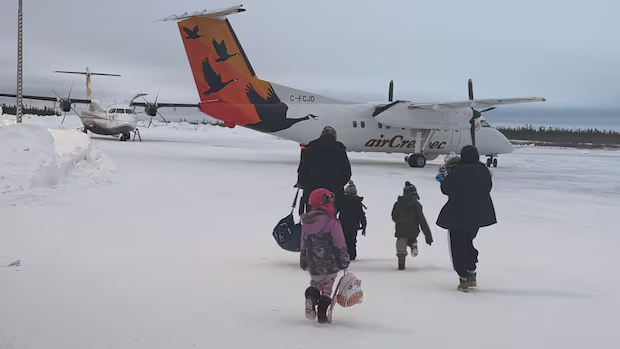

Listen to this article
Estimated 5 minutes
The audio version of this article is generated by AI-based technology. Mispronunciations can occur. We are working with our partners to continually review and improve the results.
Evacuees from Kashechewan First Nation, a remote Cree community in Ontario’s far north, will be able to return home starting Aug. 4, after nearly seven months away due to issues with the water treatment plant.
On Jan. 4, Kashechewan Chief Hosea Wesley declared a state of emergency because the tap water was no longer safe to drink.
Since then, most of the community’s 2,300 residents have been living out of hotel rooms across Ontario, including in Niagara Falls, Kingston, Timmins, Cochrane and Kapuskasing.
More than 60 people tested positive for the parasite cryptosporidium that can cause gastrointestinal issues such as nausea, diarrhea and vomiting.

But lab tests completed on July 27 confirmed cryptosporidium had been flushed out of the system, and the water was considered safe to drink.
Brent McCormac, a consulting engineer with JR Cousin Consultants, confirmed in a video call with the First Nation on July 27 that crews completed a number of upgrades to the water treatment plant over the summer.
McCormac said contractors found that filters at the plant weren’t functioning properly because they didn’t have the right media to filter out certain pathogens.
“We were able to top up the media to get the existing filter working properly,” he said.
“And the existing treatment system prior to ending upgrades meets all the Health Canada requirements for [cryptosporidium] and all other treatment treatment requirements.”
After those upgrades were completed, crews flushed the entire water system, including the fixtures in people’s homes, with a high concentration of chlorine dioxide to kill any remaining parasites.
McCormac said the final step is to finish installing an ultraviolet (UV) light disinfection system that would go “above and beyond” Health Canada’s minimum requirements for water treatment.
That work is expected to be done in early August, before evacuees return home.
McCormac said contractors also discovered propblems with the pumps designed to move water out of a tank and through the cartridges and UV system meant to remove harmful pathogens.
He said they replaced those pumps and also ordered backups in case anything goes wrong. In the coming days, Contractors will also try to repair the old pumps so they can also be used as backups.
Jordan Dickson, an environmental public health officer with Indigenous Services Canada (ISC), who also participated in the video call with the community, said the department will commit to testing the water in Kashechewan every three months.
“That will take place over at least for sure until the end of the year, or as long as needed,” he said.

Emotional time
Tyson Wesley, Kashechewan’s executive director, said it’s been an emotional time for the community now that people are learning it’s safe for them to return home.
“None of us expected to be out of the community for seven months in hotel rooms, and it’s just been quite an emotional roller coaster for the past seven months,” he said.
Wesley said people will return to the fly-in community gradually.
Starting on Aug. 4, he said the First Nation is aiming to charter four flights per day to return evacuees home.
The more than 1,000 people in Niagara Falls will be the first to fly back, which Wesley said will likely take more than a week due to the size of the aircraft involved.
Next will be the evacuees in Kingston, and then those who are in the northern Ontario communities of Timmins, Cochrane and Kapuskasing.
Now that the seven-month evacuation is nearing its end, Wesley said he and other leaders in the community are already starting to plan ahead for the next evacuation.
Due to its location along the Albany River, near James Bay, Kashechewan is at risk of flooding every spring.
People from the community evacuate every year because of that annual risk.
Chief Wesley has called on the provincial and federal governments to move forward with plans to relocate the community to higher ground.
The federal government promised in 2019 to move Kashechewan about 30 kilometres to the south to a location known as Site 5 within 10 years.
Indigenous Services Canada announced last year that it was approving around $8.4 million to undertake detailed planning studies for Kashechewan’s long-term relocation.
“I wish I could spend more time doing other things besides planning for evacuations every year,” Tyson Wesley said.
“That’s the reality that we live in and we’re working hard to push for relocation.”