dailynewsnblog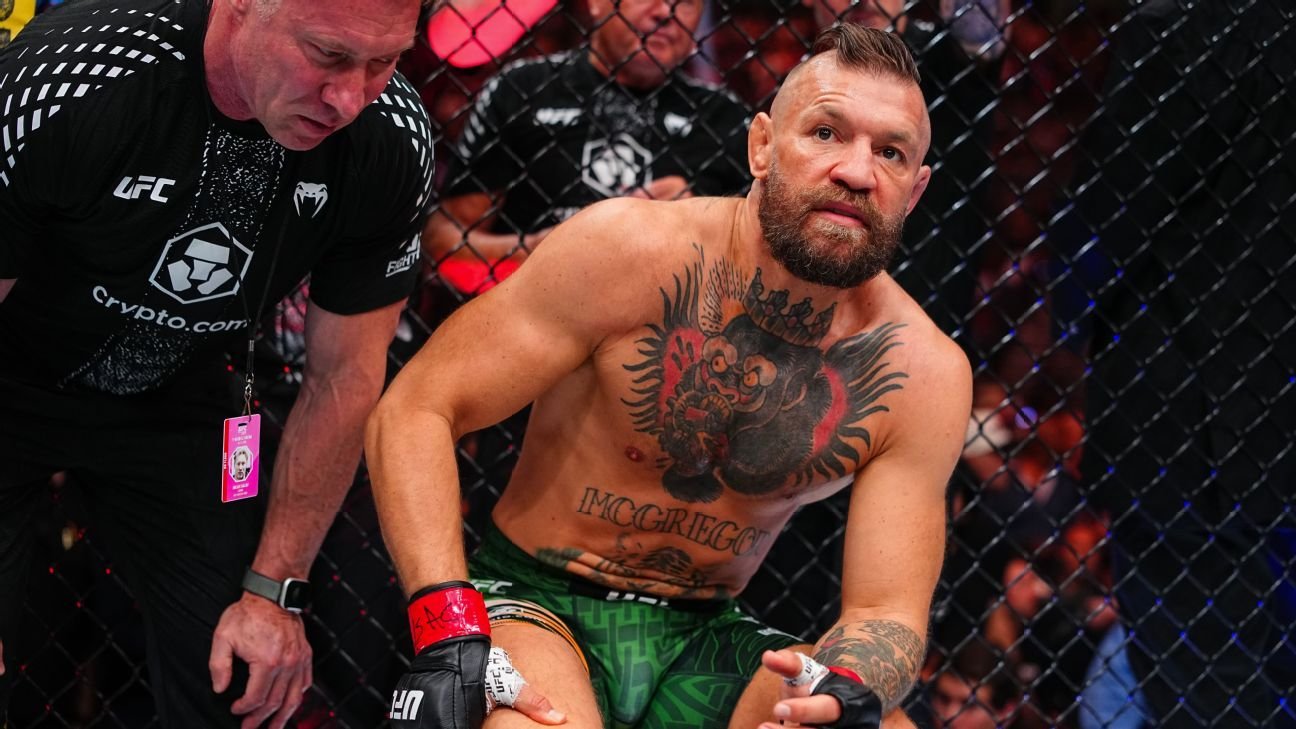
The big Conor McGregor comeback card had great fights and moments worth cheering. Sadly for the biggest draw, McGregor wasn’t involved in any of them. Just the opposite, in fact, as McGregor suffered a leg injury upon his first move toward his opponent, Max Holloway, in the UFC 329 main event. After landing awkwardly on his right leg during a flying kick attempt, McGregor recovered only to fall to the canvas a second time seconds later. Before long, the fight was ended and McGregor left Las Vegas’s T-Mobile Arena with a limp and a lot of questions about what just happened.
Chief among them is whether McGregor can be trusted to try to fight again. After Saturday, it will be harder to convince anyone that another return is possible for McGregor. And what about Holloway? Could his next fight after McGregor be the stealer of the UFC 329 show, Paddy Pimblett, who submitted Benoît Saint Denis in the co-main event in under a minute?
Brett Okamoto, Andreas Hale and Jeff Wagenheim give their takeaways from those fights and on the brilliant debut of Gable Steveson, who could soon be a major player in the heavyweight division.
If Conor McGregor fights again, his biggest challenge will be trust
Saturday was the worst-case scenario for McGregor. The loss wasn’t super surprising, because beating Holloway following a five-year layoff was always going to be a tough task.
But Saturday’s result goes well beyond a loss. We don’t know the extent of the injury, but UFC CEO Dana White said in the postfight news conference his team was “assuming a blown ACL.” McGregor turns 38 years old in three days, and trying to return from a significant injury at his age would be difficult enough, but he’s also suffered multiple past knee injuries, including a torn ACL, and a broken left leg in July 2021. And he had a broken toe that forced him to cancel a fight in 2024.
The concerns don’t stop there. McGregor, admittedly, has not treated his body like a temple over the past decade. The wear and tear of his lifestyle might not be the culprit behind his injuries, but it likely doesn’t help.
Leading up to UFC 329, McGregor released little footage of his preparations and closed off his gym pretty much entirely. It’s unlikely he went into Saturday with a significant knee injury (McGregor has denied he was injured prior to the fight). It’s more likely he came out in the opening seconds of the fight wanting to send a message that he was still himself after all that time off, and as it turned out, he wasn’t. We saw an older athlete rev himself up for a high-octane kick that his body seemingly couldn’t support, especially under the stress and pressure of the moment.
If McGregor chooses to fight again, he will not be able to talk his way out of this one. Whether he was injured going into the fight or not, it will be hard to change the minds of people who already have made up their minds about what happened. Ahead of another comeback, McGregor will need to open up the blinds on his entire recovery. Document it and show it to fans, as it happens. Give the public a reason to believe his body can handle a fight, because right now they don’t. — Okamoto
Paddy Pimblett owns his moment
Pimblett was due for a level-setting challenge, and he got it by being booked at UFC 329 against Saint Denis, a pressure fighter who is ranked higher than him at lightweight and was on a winning streak. How did “The Baddy” do on Saturday? He owned the night, that’s how.
By choking BSD unconscious in a mere 52 seconds, Pimblett all but erased the bitter aftertaste of January’s loss to Justin Gaethje, a fight in which he looked overwhelmed. Let’s not forget, however, that Pimblett hung in for five tough rounds that night — something the seemingly indestructible Ilia Topuria could not do against Gaethje last month. So a decision loss to the man who went on to become champion looks not so dreadful in retrospect.
Before this weekend, Pimblett’s previous “big name” victories had come against Michael Chandler and Tony Ferguson, both onetime stars who had badly faded. Saint Denis, on the other hand, is a legitimate top-10 lightweight, No. 7 in ESPN’s rankings — three spots above Pimblett.
Those ranking placements will surely change after Pimblett blocked a head kick seconds into the co-main event, then was ready for when Saint Denis lunged for a takedown. Pimblett immediately locked in a front choke, and it was all over but the celebration and callouts.
“I’ll beat Ilia up, I’ll f—ing rematch Justin, I’ll fight Conor or Max next,” Pimblett said, his arm around the shoulder of smiling interviewer Joe Rogan at center cage, the crowd roaring approval at every word. “Give me anyone, and I’ll punch their f—ing head in.”
The McGregor callout soon would be moot, after the main event ended by injury in barely a minute. But Holloway? Topuria? Gaethje? All formidable possibilities, all big reaches even after Saturday’s performance. But confidence paired with skill and technique is a combination not to be doubted. “Paddy the Baddy” just put on a performance that tells us he is a bad man capable of great things. — Wagenheim
Gable Steveson will be a problem at heavyweight
Steveson’s UFC heavyweight debut was the most anticipated since Brock Lesnar’s arrival at UFC 81 in 2008. Like Lesnar, Steveson’s amateur wrestling pedigree at the University of Minnesota preceded him, though Steveson, a 2020 Olympic gold medalist, is more accomplished than Lesnar. And after he smashed Elisha Ellison in the first round, the expectation that he’ll challenge for a UFC title in a shallow heavyweight division mirrors the expectations surrounding his predecessor.
It wasn’t the win that was surprising. Steveson was a massive betting favorite heading into the fight. More impressive was how he performed. Instead of deploying his wrestling to ground Ellison, Steveson showcased varied striking. He used oblique kicks like his mentor, Jon Jones, and used all his limbs to incapacitate his opponent. Surprisingly, he made only one takedown attempt, which Ellison defended well. But Ellison was unable to deal with Steveson’s striking and was eventually overwhelmed and stopped after 2 minutes, 31 seconds of action.
In a way, this was a warning shot to the rest of the heavyweight division that Steveson isn’t just a wrestler. He’s only four fights into his professional MMA career and is demonstrating that he will be a threat everywhere. His sheer athleticism could be enough to overwhelm the majority of heavyweights, and his wrestling will almost certainly nullify a ranked opponent. But if you add the striking to the mix? Good luck, heavyweights. And given the shallow state of the division, it won’t be long before Steveson is in the mix for a title opportunity.
Remember, Lesnar challenged for and won the UFC heavyweight title in just his fourth MMA fight. The talent pool is deeper now, so Steveson’s ascent may not be as rapid, but nobody should be surprised if he’s in the title mix by this time next year.
“He looked like a mixed martial artist; he didn’t look like a wrestler to me,” UFC CEO Dana White said. “It’s gonna be fun.”
Yes, it is. — Hale