dailynewsnblog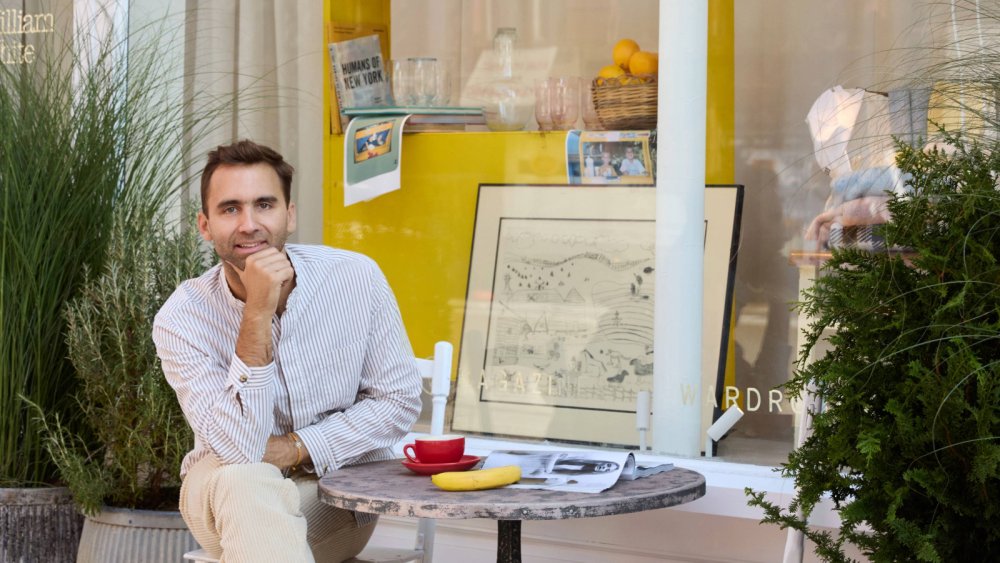
From the gourmet sandwiches served on hand-painted ceramic plates and sparkling water poured into hand-blown glasses, to the soft, modular duvet seats and martini tables with a center tube to hold a taper candle or single flower stem, it’s clear that a visit to the William White Emporium is not just another apparel industry market appointment.
Yes, there are a few racks of clothes, but the store on New York’s Canal Street — and its studio across the street — serve to truly immerse visitors in the world of Will Cooper and his lifestyle brand, William White.
Cooper has had an entrepreneurial bent since he was a child. He started his first business when he was 10 — Party Players Production — serving as a DJ and working weddings, bar mitzvahs and school dances. But he was always obsessed with retail and started working at Neiman Marcus in Dallas before moving on to the Ralph Lauren Rugby store.
During college, he interned for the designer at the company’s New York Rugby store as well as the company’s Madison Avenue headquarters. And the day he graduated from Southern Methodist University, he joined the company full-time.
“Ralph to me was school,” Cooper said. During his time at the company, he absorbed everything he could, from store development and product development to design. “What I took away was vertical integration,” he said. “In a world like Ralph Lauren, you’re controlling everything from product development all the way through delivery to consumer messaging, PR, presentation. It was all-consuming and world building. That’s what the school of Ralph teaches very well: the fantasy, and teaching the consumer to dream.”

William White creates a wide variety of products beyond apparel.
Brett Wood
So with that knowledge in his back pocket, Cooper switched gears and, together with a business partner, created Ash, a business that bought historic real estate and redeveloped the sites into boutique hotels.
“What I took from Ralph was that vertical integration idea, so we took a real estate development company and a design company and merged them into one,” Cooper said. “We bought the blank canvas of a building and started to build an entire world on top of it.”
The first property was in Providence, R.I., where they bought a former strip club and brothel and turned it into a 52-room hotel. That was followed by other projects in Detroit, New Orleans, Baltimore and Richmond, Va. — all cities they believed had “cultural interest.” As Cooper explained: “I like to sit between art and commerce, that’s where I thrive. Is there good art, are there good museums, is there great food, is there a creative class?”
The hotels they built were all-encompassing. “We created everything sensory, from the music to the scent, to the texture of the bed — every component that makes a great hotel.”
After a successful decade at Ash, Cooper felt it was time to move on. “Hospitality became this big word and there were tons of venture capital and private equity money being pumped into the sector,” he said. “And the originality of the product and the product started to disintegrate.”

The William White apparel collection.
Brett Wood
That led him to launch William White, a business he describes as “very analog, tactile, human,” a juxtaposition to our “increasingly digital world.”
It started with an apparel collection, an edited assortment of essentials for men such as a corduroy jacket with a covered placket and flap patch pockets, paired with extra-wide wale cotton corduroy pants with elastic on the side and a special phone case — the brand’s hero products. In addition, there are cashmere sweaters; cotton batiste striped shirts with Nehru collars and horn buttons; a double-breasted alpaca overcoat; an organic cotton belted trench; cotton shorts; a linen denim jacket with matching pants, and long- and short-sleeve T-shirts in Japanese cotton.
“The genesis of the wardrobe is that everything you need to get dressed,” he said. “You need a great pant, you need a great jacket, you need a great shirt, you need a great T-shirt. Then you can layer in a coat or a jacket — but that’s the baseline idea.”
Prices range from $250 for the short-sleeve T-shirt and $500 for the sweaters to $740 for the corduroy pants and $1,290 for the matching jacket.
“I spent 18 months really learning the apparel trade,” he said. “I went to the mills in Italy, learned the whole pattern-making process, learned fabric development. Of course, there’s not one place in New York that does everything. So you’re going to the buttonhole man, the person that does the fusing and the collars, the person that does the cutting — there’s like 65 different stops that a garment takes en route to its final destination in New York. It’s a beast. But to me, the origin of garment manufacturing was the Garment District.”
He applied the same philosophy to the home products he offers. “It’s a system,” he said. “We have a chair that pulls out to be a bed, or you can pull it apart for a dinner party and lounge around on it. There’s a side table that goes next to it that’s the same size. It’s the same idea as the wardrobe: there are five pieces you need to make any configuration in your home or your wardrobe. It’s like editing on your behalf.”

Pieces from the William White furniture collection.
Brett Wood
He also sought the origin story for the other products within the William White world. Glassware traces its roots to Egypt, so that’s where his collection is made. The ceramics are all hand-painted in Italy. Cooper said his goal is to “show the human hand in everything that we’re making. In an increasingly consumerist society where you can expect things you ordered on Amazon to be there before you ordered it, there’s something nice about a jacket where only 20 were made or a glass that is one of 50. We’re giving the power to the consumer to have a point of view: take from it what you want and build your world on top of it.”
William White officially launched in 2024 and is sold exclusively online as well as in the William White Emporium at 325 Canal Street. In March, Cooper brought chef Brownie Brown on board to create the menu for The Kitchen at William White, where customers and passersby can grab a bite served on the plates and glassware designed by Cooper or sip a coffee while sitting on one of his chairs.

The William White Emporium on Canal Street.
Copyright Brett Wood
Cooper said there are no plans to wholesale any part of his collection. “Wholesale is just an operational and financial beast to deal with,” he said. Instead, he sought to develop a community of clients who embrace his philosophy and appreciate that his collections are available in limited quantities, but are extremely well made with the best materials in the best places.”
Cooper’s latest venture is with The Rug Company, a U.K.-based brand, which has named him creative director. In the past the business has created carpets with fashion designers including Alexander McQueen, Vivienne Westwood, Diane von Furstenberg, Thom Browne and others. Cooper is hoping to help serve as a liaison between designers and the company because of his experience with both industries. The first will be with Sir Paul Smith.
Beyond rugs, Cooper is hoping to add other stores. A pop-up in the Hamptons last year was quite successful and he will return again this summer, and he’s also considering locations in other cities. In addition, beauty and fragrance are on his to-do list for the future. “That would be something quite fun, because I think all the senses need to be touched in a world creation environment.” And eventually he’d like to do footwear and accessories.
But he’ll be taking baby steps.
As of now, the business is completely self-funded, although Cooper has begun considering the idea of fundraising. “The brand is on its way to being proven so we’re at the point where we might put some fuel in it to help it grow naturally.”