dailynewsnblog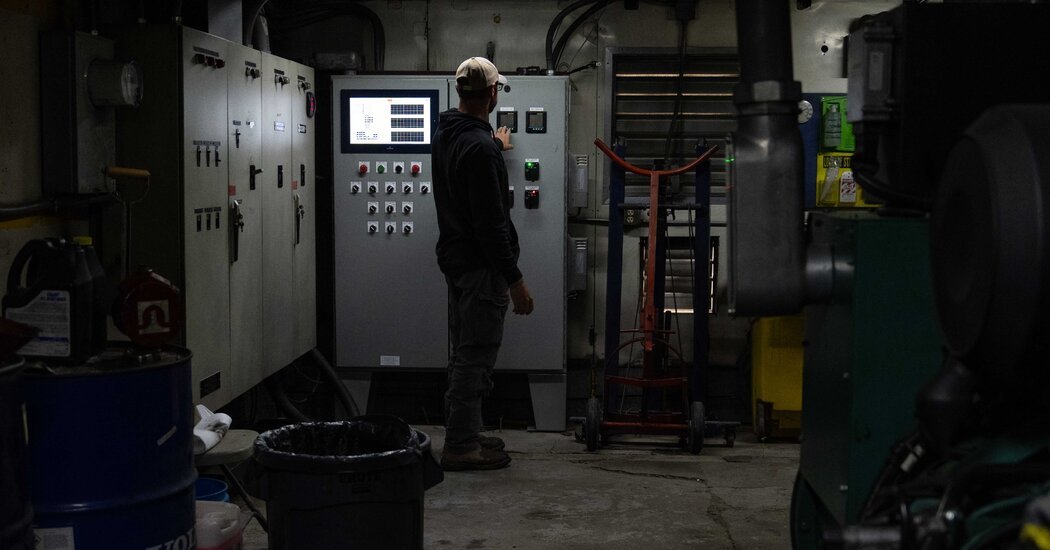
One hundred miles south of the Arctic Circle, at the end of the Elliott Highway in the center of Alaska, Sabie Jervsjo has done everything she can to lower her energy bills.
She replaced the incandescent lightbulbs in her Manley Hot Springs home with LEDs, installed motion sensors and switched appliances from electricity to propane. She’s teaching her grandchildren to turn off the lights and decide what they want before opening the refrigerator.
More than 190 rural communities in Alaska depend on diesel for electricity and heat. Alaska pumps more than 400,000 barrels of crude oil a day, but much of the diesel burned in remote villages comes from crude drilled and refined in other parts of the world. Higher global oil prices boost state revenue, but they also drive up energy, heating and transportation costs in places that can least afford them.
Rural Alaskans are “having to choose between feeding their families and having a warm home,” said Dominique Pride, a deputy director for research at the Alaska Center for Energy and Power in Fairbanks. “We wouldn’t accept that in New York or Miami,” she added. “Why is it OK up here?”
The strain is coming in a heated political moment: One of the state’s senators, Dan Sullivan, a Republican, is locked in a tight race with a former Democratic representative, Mary Peltola, that could determine control of the Senate next year. Alaska’s lone House seat is competitive, and 17 people are running to be Alaska’s next governor. The high cost of living in rural Alaska is an issue in every race.
State lawmakers in Juneau, about 885 miles south of Ms. Jervsjo’s home, have spent months fighting over a proposed 800-mile natural gas pipeline from the North Slope to the “Railbelt” around Anchorage, where most Alaskans live. But that project would do nothing for farther-flung communities like Manley Hot Springs, which sits 155 miles west of Fairbanks at the edge of Alaska’s remote, rural interior.
The road to Manley is called a highway, but the pavement gives way to gravel and dirt about 80 miles before it ends at the Tanana River. Gold miners came first. Wealthy tourists followed for the hot springs. At its peak, around 5,000 people lived in the area. Now, about 75 year-round residents remain.
“It’s not a place you stumble across,” said Pam Redington, whose father-in-law helped found the Iditarod Trail Sled Dog Race. She arrived in 1977 with two children and 57 sled dogs.
People in Manley hold three or four jobs, and during the long winters, they gather for craft nights and dances at the tribal hall. Many still haul water from the community well and shower and do laundry at the town “washeteria.”
A local pilot first generated electricity with a diesel generator for his home and hangar in the late 1970s before gradually extending power lines through town. In 1981, when Ms. Redington wanted lights at her house a mile from the center of town, she had to buy the poles and dig the holes herself.
Like most rural Alaska communities, Manley is powered by a microgrid, with two diesel generators maintained by a staff of two, who also answer late-night outage calls and clear fallen trees after storms. Only one works full time.
Even with a state subsidy, electricity in Manley is among the most expensive in the country.
“You’re always thinking ahead: If I do this, it will cost me this. If I do this other thing, it will cost less,” said Heather Redington, Pam Redington’s daughter. “Every choice matters.”
A few years ago, Ms. Jervsjo’s household used around 700 kilowatt-hours of electricity a month, shy of the national average. That cost her between $500 and $600 each bill. Now, she tries to stay below 300 kilowatt-hours a month, enough to bring her bill down to $300 or even $250. In the winter, Ms. Jervsjo cooks on a wood stove.
“It’s everything I do, everywhere I go,” she said of her extreme conservation. “It’s the only way to afford to live.”
That requires real sacrifice in a place that sees only a few hours of twilight in winter and where wolves recently carried off a family dog.
Business owners, who aren’t covered by the state’s residential subsidies, have it even worse. John Dart farmed in Manley for 18 years but was paying more than $1 per kilowatt-hour — the average U.S. business pays 13 cents, according to the U.S. Energy Information Administration, and the average commercial rate in Alaska is about 26 cents.
Mr. Dart’s monthly electric bill exceeded $1,000. Combined with $7-a-gallon diesel for his delivery truck, even his experiments in geothermal heating wasn’t helpful enough. He and his wife let their farm go fallow this summer.
“I can’t lose tens and tens and tens of thousands of dollars,” he said.
Electricity is only half the equation. Heating is largely unsubsidized in rural Alaska, and Manley homeowners typically burn hundreds, sometimes thousands, of gallons of diesel each winter. That’s where the wars in Iran and Ukraine have brought the biggest pain. Every family must truck in its own fuel before the cold arrives.
The Elliott Highway winds over mountains and through forests and can turn into a mud track in the summer and an ice sheet in the winter. Many residents make the four-hour drive to Fairbanks several times each summer to stock up, and most try to return the same day to avoid hotel prices.
How much to buy is a guessing game. Last winter, after three weeks when temperatures never rose above 50, Ms. Redington ran out of heating oil and had to buy more in Manley, where fuel costs 23 percent more. A few hundred dollars can be life-altering in Manley, where the median age is 75 and most live on fixed incomes.
When much of rural Alaska was electrified in the second half of the 20th century, building on military power grids from World War II, diesel generators were the obvious choice as they were inexpensive, reliable and easy to maintain. Few questioned whether villages scattered across Alaska should depend almost entirely on a product that had to be imported and, in many cases, delivered by seasonal barge or airplane.
Now some reminisce about the days before electricity.
“We got along without it,” Ms. Jervsjo said. “We could do it again if we had to.”
State agencies, utilities and nonprofits are experimenting with solar, wind and hydroelectric projects and battery storage to reduce diesel use and extend generator life. In late 2023, TDX Power installed a solar array with battery storage in Manley. In the sun-filled summer, the system can power the village for more than half a day while the diesel generators sit idle.
But residents mostly notice what hasn’t changed: high power bills and frequent outages.
“There is no silver bullet,” said Curtis Thayer, executive director of the Alaska Energy Authority.
Rural Alaska is important, even if “you get the sense some people wouldn’t care if places like this disappeared,” Ms. Jervsjo said.
The vast hinterlands hold the nation’s most promising sources of fossil fuel and rare earth minerals, vital to high-tech, military contractors and even the auto industry. Miners, drillers and the military will need villages in hard-to-reach places as base camps, just like the miners who first settled in Manley.
“This is not just about doing the right thing,” said Ben Mallott, president of the Alaska Federation of Natives, which serves 192 federally recognized tribes and 152 village corporations. “Having those communities in there, it’s a national security matter.”
Their continued existence isn’t guaranteed. Built in 1903, the Manley Roadhouse is still the social hub of Manley Hot Springs, cluttered with photos of old sled dog races and taxidermied animals.
A mining crew surveying soil for future projects around Manley has made the roadhouse its home for much of this summer. Still, Pam Redington, now 80, worries about the town’s future. Most residents are older, there are few full-time jobs, and the local school closed in 2019 because Manley didn’t have the 10 children needed to meet the state minimum. High energy prices, with no relief in sight, are one more reason to leave.
“In a way, it’s a dying community,” Ms. Redington said. “I’m worried we’re going to have to put up a sign that says, ‘Last person out, shut off the light.’”