dailynewsnblog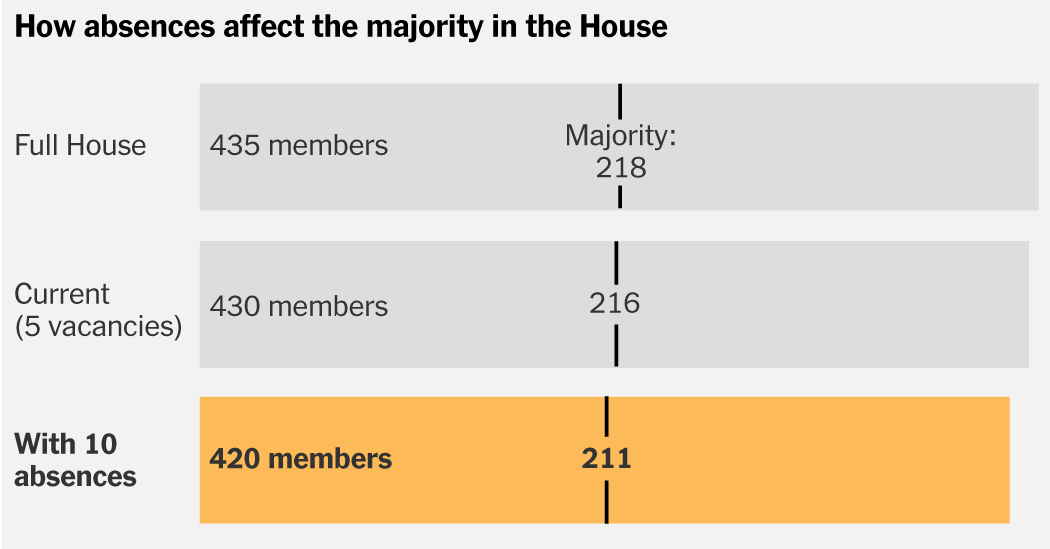
Democrats on Thursday appeared poised to finally have the support they needed to pass a resolution calling for the end of the war in Iran. When Republican leaders realized that defections from their members, plus a high number of absences, meant that they did not have the votes to block the measure, they pulled it at the last minute.
So far, only three House Republicans have been willing to break with their party on the issue of President Trump’s handling of the war in Iran; that number alone is not enough to pass the resolution. But in a Congress that has been plagued by resignations and untimely deaths — along with consistently poor attendance on both sides of the aisle — it is often unclear how a vote might shape up until moments before it happens.
That was the case on Thursday, when a dozen House members were absent during the chamber’s first scheduled vote, part of a series that was scheduled to include the war powers vote, until leaders halted it.
Both vacancies and absences in Congress can change the number of votes needed to pass a bill in either chamber. In the House, if every seat is filled and all members are present to vote, a bill needs 218 votes to pass. The House currently has five vacant seats, so the majority number, without absences, is 216.
Because of Republicans’ razor-thin majorities in both the House and the Senate, party leaders can afford only a few defectors. Absences complicate that math even more.
Last week, the House voted on a war powers resolution for the third time since the conflict in Iran began. Six absences — along with defections by one Democrat and three Republicans — resulted in a tie, the closest House Democrats had come to passing such a measure. (A tie vote in the House means that legislation fails.)
Absences played a role in the Senate this week as well: Democrats were able to advance a war powers measure on their eight attempt after three G.O.P. absences gave them the margin they needed. Because of those absences and four Republican defections, the resolution passed.
In a world of slim margins, absences plague both parties. Last June, a Republican-led bill to claw back $9 billion for foreign aid and public broadcasting narrowly passed in the House, 214 to 212. Four House Democrats did not show up for that vote; if they had been present, their “nay” votes, along with the four Republican defections, would have been enough to sink the measure.
In January, a Venezuela war powers measure would have passed in the House, had Speaker Mike Johnson not repeatedly delayed the vote while Representative Wesley Hunt, Republican of Texas, rushed from the airport to the Capitol to cast the decisive vote to sink the resolution.
Members of Congress are often absent for health reasons or, especially during an election year, campaigning events in their home state. Mr. Hunt, who was running for Senate, missed nearly 60 percent of votes in the first three months of the year, according to GovTrack, a nonprofit website that tracks congressional activities.
Representative Frederica Wilson, Democrat of Florida, was recently absent for about a month before releasing a statement explaining that she was unable to fly back to Washington while she was recovering from eye surgery. Representative Thomas Kean Jr., Republican of New Jersey, has not cast a vote in nearly three months, citing an unspecified “personal medical issue.”
The House war powers vote that was postponed on Thursday had originally been scheduled to take place after another vote that saw 10 absences, eight Republicans and two Democrats. If that math had carried over to the war powers vote, Democrats — if all united — would have only needed one Republican defection to pass the measure. Three Republicans voted with the Democrats on a similar measure last week.
Megan Mineiro contributed reporting.