 dailynewsnblog
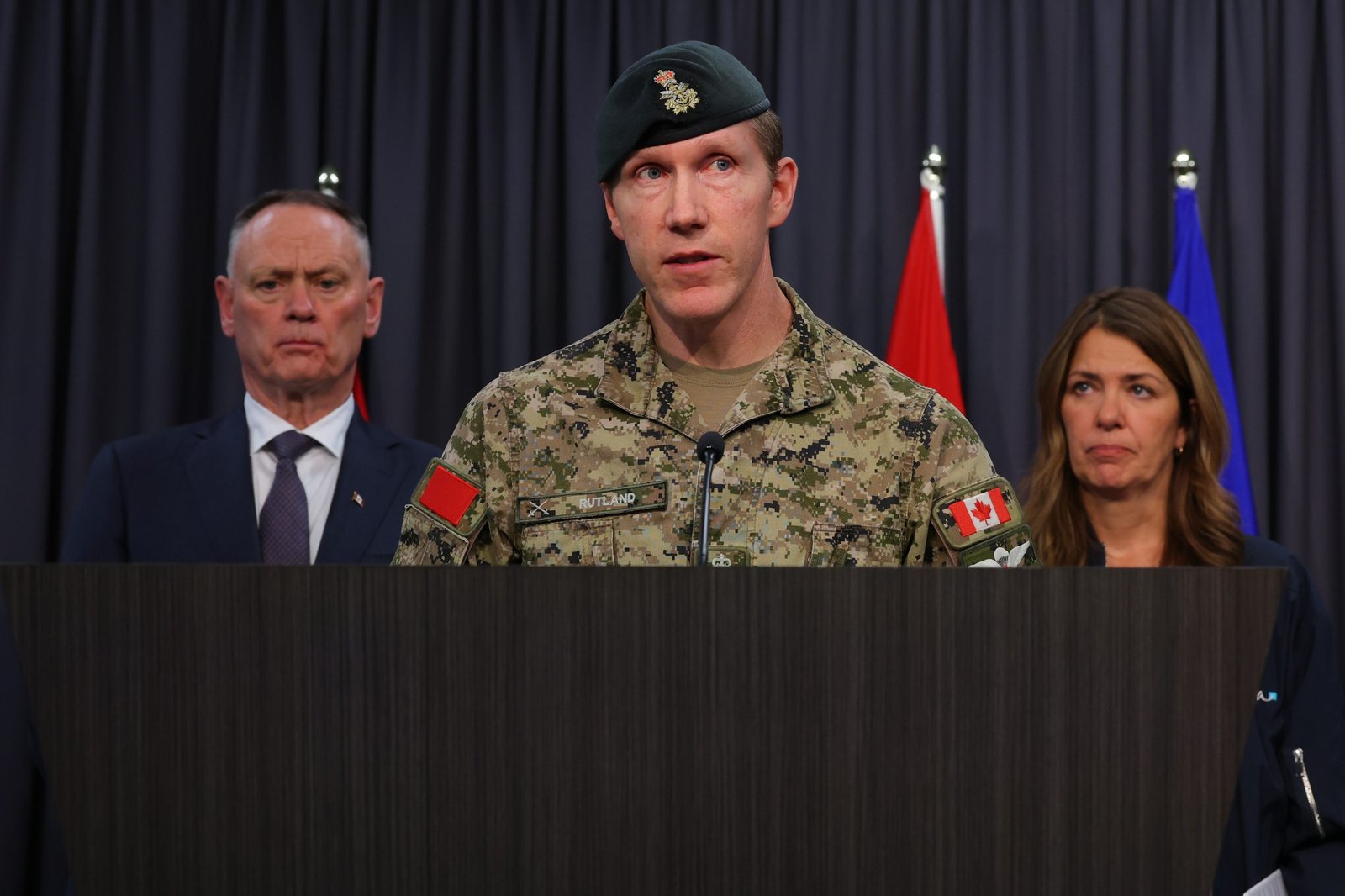
Maj.-Gen. Wade Rutland, commander of 1st Canadian Division, says the grass fire was a kilometre away and considered sufficiently under control that training exercises were allowed to continue Saturday afternoon at Canadian Forces Base Wainwright in central Alberta.
Canada’s military says a grass fire that killed four soldiers and sent scores more to hospital with bad burns was known well beforehand but not considered a threat.
Maj.-Gen. Wade Rutland, commander of 1st Canadian Division, says the grass fire was a kilometre away and considered sufficiently under control that training exercises were allowed to continue Saturday afternoon at Canadian Forces Base Wainwright in central Alberta.
However, he said conditions — including a violent, sudden windstorm — sent those flames racing over the Prairie landscape at lightning speed, landing right on top of the soldiers.
“This was a very uncommon occurrence,” Rutland told a news conference Sunday.
“I spoke to my commander on the ground. He said within 30 seconds to a minute they saw no fire, and then there was a fire right on top of them.”
Rutland said there is a lot to consider. Did the fire move that quickly because of the wind? Or did it move unseen through foliage to surprise the soldiers? Or was it both?
“This is why we’re going to do a complete investigation as to the topography, field conditions, foliage, etc., because it all plays into what happened,” he said.
The fire killed four soldiers and injured 39 more, nineteen of whom are in critical condition.
Alberta Premier Danielle Smith announced the casualty count and confirmed many have serious burns.
“The loss of life and injuries are heartbreaking,” Smith said.
The four deceased have been identified as: Sgt. Morgan Wong of Edmonton; Pte. Shaun Farrell of Prince Albert, Sask.; Pte. Aidan Goulding of North Vancouver; and Pte. Hayden Lykkemark of Langley, B.C.
The wounded are being cared for in four hospitals in Edmonton, Calgary and Red Deer.
Rutland spoke at a news conference with Smith and Defence Minister David McGuinty.
McGuinty said those affected were soldiers and reservists from across the country.
“This loss reaches communities in every province,” he said.
Earlier Sunday in Ottawa, Prime Minister Mark Carney called it one of the “worst tragedies for the (Armed Forces) on Canadian soil in peacetime.”
Flags on all federal buildings were lowered to half-mast to pay tribute to the deceased.
CFB Wainwright is 200 kilometres southeast of Edmonton. It is one of Canada’s busiest bases and is used mainly to train soldiers and prepare units for combat operations.
On Saturday, savage winds, gusting at times to 100 kilometres an hour had been racing through the province, toppling trees, knocking out power, slamming signs, and sending garbage cans and other debris skittering down alleys and roads.
Rutland said the affected unit was Charlie Company of the 3rd Battalion of the Princess Patricia’s Canadian Light Infantry. He said when the fire hit, the 84-member company was doing two exercises. Most were throwing hand grenades on a range while 10 soldiers were doing a simulated attack on an enemy when they found themselves suddenly caught in the path of the roaring fire.
After overwhelming the soldiers, the blaze then jumped the base fence and threatened nearby rural areas and the town of Wainwright.
Fire crews scrambled throughout Saturday night to contain it and, by 11 p.m., had it under control. No one had to be evacuated from the area.
Bruce Pugh, Wainwright’s mayor, said he regularly hears the booming sound of artillery and cannons being launched during training from the base, so he didn’t think much when his windows rattled Saturday afternoon.
“But what was different was that everything went silent after the rattle,” Pugh said in an interview Sunday outside his home, about five kilometres from the base.
“After that, we have friends who are physicians, nurses, (who) were hearing through personal channels that everybody was being called to help with a mass casualty event.”
Moments later, he recounted, came the sound of sirens and helicopters.
The response was rapid and massive — 22 ground ambulances, six planes, two helicopters.
Just before midnight, Armed Forces medical staff members dropped through the inky black sky, their parachutes illuminated by flare lights as they glided to the ground.
Alberta health officials invoked a Code Orange on Saturday night for hospitals in Edmonton and beyond. Code Orange is a call for hospitals to essentially clear the decks, find staff and free up beds as necessary to handle a mass casualty incident. That alert was lifted Sunday afternoon.
Smith said flags at provincial buildings in Alberta would also be flown at half-mast in the days ahead.
The base is in the Battle River—Crowfoot riding, represented by federal Conservative Leader Pierre Poilievre.
Poilievre, speaking to reporters in Wainwright, said he has heard about incredible acts of bravery. Some soldiers, he said, ran toward danger to help and are now fighting for their lives in hospital.
“Please pray for Wainwright,” he said.
The King said in a statement Sunday that he and the Queen “send our special thoughts and prayers to the people of Alberta, and to the Canadian Armed forces and their families.”
“We extend our particular admiration and gratitude to the military and civilian emergency services, health-care workers and all those who have responded with such courage and dedication in the most challenging circumstances.”
The tragedy comes as Albertans are to deliver their final votes Monday on whether it’s time to look at leaving Canada. In Edmonton, the deadly fire was on the minds of pro-Canada supporters rallying at the legislature.
Rally organizer Gil McGowan, the head of the Alberta Federation of Labour, said it was heartwarming to see first responders from around the country jump to help.
“That is a reminder why we’re so much better staying in the Canadian federation,” he said.
This report by The Canadian Press was first published Oct. 18, 2026