dailynewsnblog
“If you need to build ad hoc perception models for every such task and embodiment, that just doesn’t scale,” Kapil Katyal, a senior applied science manager at Amazon Robotics, said during a presentation attended by Ars at the Intelligent Robots & Systems conference held in Pittsburgh on September 29.
“So one of the initiatives we took up in our team was to design a foundation model which could work for any new embodiment of robots that we deploy, and across all of the perception tasks that we need to perform over those,” Katyal said.
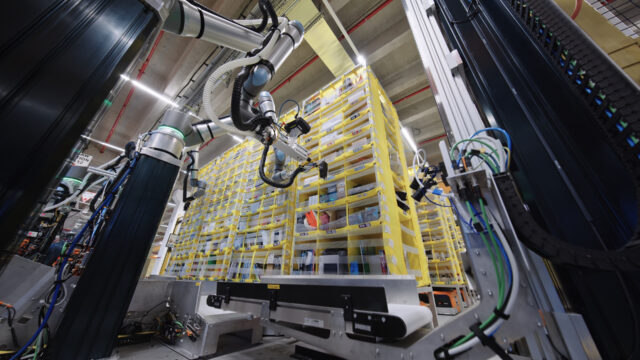
Most of the robotic arms have relied primarily on vision. But Amazon’s newest robotic arm, Vulcan, is the first to combine vision with force feedback sensors capable of providing a sense of touch. This enables the robot to accurately pick out or stow away items within the fabric-covered inventory pods.
“You need to be able to insert an item, create space, or pull something out,” Dresser said. “Those are really hard things to do with traditional non-touch-based systems today, like the suction-based systems that are part of Sparrow.”
Vulcan initially began operating at Amazon fulfillment centers in Spokane, Washington, and Hamburg, Germany, starting in 2025. It is not widely deployed yet, but Dresser said the company expects to scale up use of this robotic arm in 2027.
Credit:
Amazon
Parsing the human impact
Each new robot has benefited Amazon’s human workforce, according to the company. For example, Vulcan focuses on picking and stowing items located in the top rows of inventory pods that would otherwise require a person to use a step-ladder, along with handling items located just above the floor. That enables employees to focus on picking and stowing items that are within more comfortable reach.
But investigations by labor advocacy groups, journalists, and the US Congress have painted a less rosy picture of Amazon’s automation drive over the years. The Strategic Organizing Center (SOC), a coalition of trade unions headquartered in Washington, DC, published reports in May 2021 and April 2022 showing higher injury rates at Amazon’s robotic warehouses compared to non-robotic warehouses. That analysis drew on injury data reported by companies to the US government from 2017 through 2020.