dailynewsnblog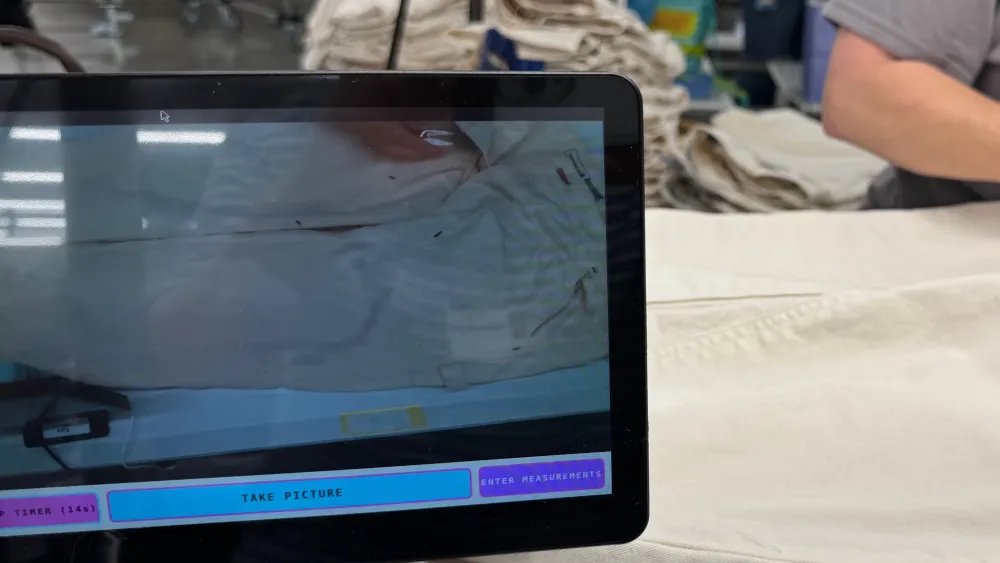
Kyle Valade, founder of Rust Coast Manufacturing Technology, describes the company as a next-generation manufacturing quality platform “that will save companies millions by ensuring correctly sized products are always shipped.”
The company’s turnkey solution uses cameras that are installed across factories to take pictures “and run them through visual AI to automatically measure the clothing made by suppliers—comparing them with the spec in real-time,” he told Sourcing Journal.
The photos and data are sent up to the company’s app where they go through a more intensive processing that generates analytics and alerts, which then gores the brand’s portal. “What we’re building towards is having a picture of each piece of clothing all through the manufacturing process,” he said. “The cameras passively take measurements without getting in the way of the people on the floor.”
Here, Valade explains the challenges apparel brands face in manufacturing and how his company’s solution can help.
Sourcing Journal: What specific gaps or recurring issues in traditional garment manufacturing quality control inspired you to found Rust Coast?
Kyle Valade: We’re building a platform to automate quality inspections for garments—starting with measurements. Before settling on measurements, I had originally founded Rust Coast around the general idea of digitizing manual processes in the factory. Many of the processes in a factory are pencil-and-paper, even if some of the machines are very advanced and digital.
So, I started going through parts of the manufacturing process for beanies, which are, on the face of things, maybe the easiest thing to make. But as you get into it, there are a number of steps that all need to be done correctly or the whole thing is ruined: the yarn has to be knit; fabric cut, folded and sewn; then the label has to go on. Then at the end, the measurements have to be right, the label can’t be crooked, the machines all have to be calibrated so there aren’t skipped stitches, etc.

Kyle Valade
I worked on data at Rivian for a few years, helping to pull in and organize petabytes of vehicle data. This data was used in the factory so the workers would know if the vehicle were behaving correctly, or to inspect certain components. Once on the road, the data could be used to detect issues and to improve the driving experience, without needing to wait for complaints or returns. Other industries have these automated inspections, as well. We’re building this capability for the apparel industry.
In apparel, there are lots of different people in different factories in different countries making millions of garments on lots of different types of machines. How can brands and factories be sure those things are consistently following the design? There are tech packs to follow and inspections, but there are so many different variables, and inspections take a lot of time to do by hand—particularly measurements.
Measurements tie directly into garment fit. Fit is hugely important to brands, but they have almost no visibility into what is being produced, let alone their measurements, as they come out of the factory. Fit is also very important to the consumer—if they put on a pair of pants it’s immediately clear if they don’t fit. If they don’t, the pants are getting returned, which is why over half of returns are due to fit.
It’s hard or impossible for brands to know whether those fit issues are consumer preference or if they’re rooted in the way the clothes are being made at the factory. Rust Coast is helping to close that gap.
SJ: What are the biggest operational and financial challenges apparel brands face today when relying on standard manual sampling rates and delayed defect reporting?
K.V.: Operationally it is consistency and quality. Supply chains are getting increasingly complex. How do you affordably ensure consistency across tens or hundreds of different factories? There’s a lack of data. Right now, a consumer might return something and say it doesn’t fit. Meanwhile, the factory might send back a report saying that all of the measurements are exactly right. The brand doesn’t have much other data to go off of—they don’t know if the return was just an outlier that slipped through the cracks or if it’s a bigger issue.
And then there’s delayed discovery. Order lead times can be months. If there is an issue discovered late in the manufacturing process, it could impact inventory and sales.
Financially, returns are expensive and brands want to reduce the number of returns due to fit and defects. For e-commerce, about a quarter of items are returned, and most of those are due to fit. According to data from Coresight Research the end-to-end cost of handling a return can end up costing two-thirds of the product cost.
Sampling rate is based on the idea that it is too expensive to inspect everything. So, a small percentage of items are inspected (maybe 1 to 2 percent or less). Brands and factories hope that those items are representative of everything else, and they accept that there is some risk that they are not. Rust Coast reduces the cost of inspecting garments. It doesn’t replace human inspectors, but it augments what they are able to do. If placed inline in the factory workflows, it has the potential to inspect 100 percent of garments. Maybe not as thoroughly as a person—but far better than no inspection at all.
SJ: How does Rust Coast’s non-disruptive hardware and real-time AI computer vision integration transform how factories catch and fix spec errors before garments leave the station?
K.V.: Defects get more and more expensive to fix as they go through the manufacturing process. It’s cheaper to find out immediately after sewing that the pants are too tight, rather than putting more work and materials into the product and having it fail inspection later.
However, it is expensive to measure a garment, so it isn’t done very often. To fully measure a pair of pants by hand, it could take 20 minutes. Rust Coast can do it with visual AI in seconds.
This real-time check gives the factory additional flexibility in handling the garment, as well. Suppose for instance a batch of pants is closer to the spec for a different size than originally intended. They could potentially relabel the pants for that size, repair them or reject that batch and save on shipping.
A lot of the existing measurement solutions on the market require the factory line to change their workflow. Adding a new step is a large additional cost for a factory, and a lot of the people on the floor are paid based on their output. In the end, it means those solutions don’t get used much.
Rust Coast can work with or without human interaction, which lets us perform more quality checks across more parts of the manufacturing process. Meaning that we can potentially audit all of your products at every station where they are touched with minimal change in workflow.
Overall, factories have more opportunity to save money by finding defects earlier in the process, and the time it takes to inspect products is significantly reduced. On top of that, all of these stations are generating data that can be used to pinpoint the source of any defects, as well as be used in AI initiatives down the road.
SJ: What is Rust Coast’s overall value proposition to brands seeking to reduce high return rates, increase measurement accuracy, and improve supply chain visibility?
K.V.: About 25 percent of items are returned, and fit is the reason for half of them (at least for e-commerce). Reducing that by even 10 percent could easily save millions of dollars for a larger brand. Measurements are usually only taken on a subset of the inspection sample size. Our goal is to measure 100 percent of garments.
It might take a quality inspector 20 minutes to fully measure a garment. Our system is able to measure all visible points of measurement in seconds. Our measurements are accurate within one-eighth inch of a manual inspection over 90 percent of the time. Always working to bring that to 100 percent accuracy. Trained quality auditors are often off from each other by one-quarter inch.
Our stations are designed to be able to work with or without inspector input and can be positioned across a wide variety of stations in the factory. Training inspectors to use the system has taken 5 minutes.
Brands have little to no data about their products outside of returns, reviews, and high-level quality summaries from the factory. Rust Coast gives a picture and statistics for everything it is tracking. Quality teams are stretched thin and can’t be in twelve countries at once. They can offload some of their inspection work to Rust Coast and focus more on proactive processes. Garments can be tracked through each manufacturing process, with the goal of an end-to-end record per garment across its lifecycle.
SJ: How do you see Rust Coast’s data integration and digital product passport capabilities changing the way fashion and apparel executives manage quality assurance across global suppliers?
K.V.: Instead of just a quality summary from the factory, brands can now have direct visibility into the quality of their products. This data can be synced into supplier scorecards.
Connecting with return data enables visibility across the product lifecycle. For example, brands can connect the purchase order number of a returned garment (found on the sewn-in tag) into the app and see images from the production batch, along with measurement data.
Connecting with returns data lets companies determine the blast radius of any issues flagged by consumers. Was it just this one item that is defective, or is it the whole batch? Or that SKU across the whole supply chain? Brands can now say things like, “We’re getting some complaints around fit for this color of denim. Looks like it’s shrinking in the wash more than expected—let’s tell our suppliers so they can account for that.” Lots of connections like this become possible.
The quality team has the visibility and data to be able to stop issues from ever making it to the consumer. Teams can focus less on measurements and visible defects, and more time on the processes around them so that defects can be prevented.