dailynewsnblog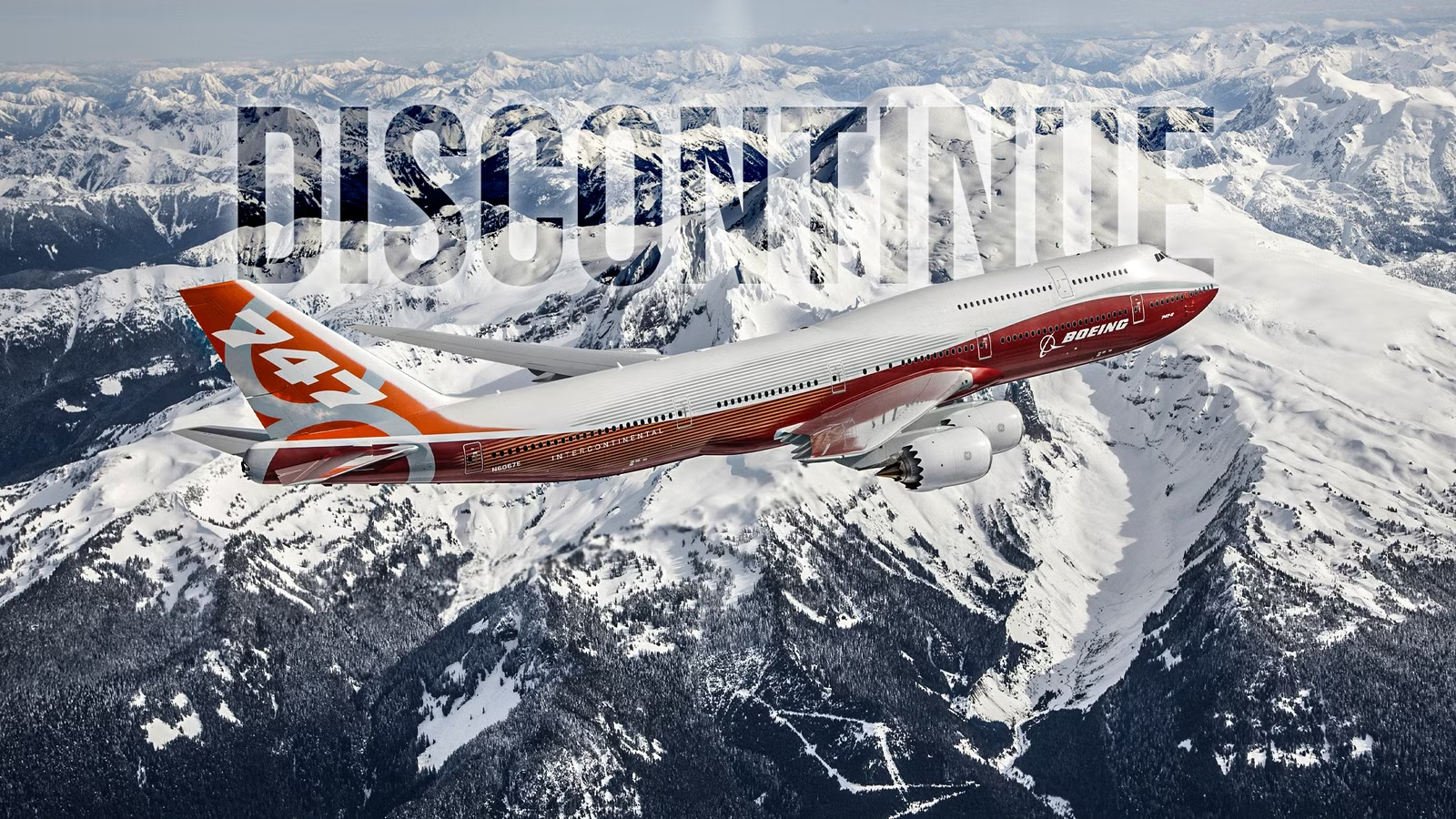
The demise of the ‘Queen of the Skies’ came with very little pomp and ceremony. When  Boeing announced it was shutting down the assembly line of its iconic 747 double-decker jumbo jet, it simply told investors in a bookkeeping note rather than a proper eulogy for the icon of air travel’s golden era.
The industry buyers who once demanded hundreds of seats and transoceanic quad-engine reliability had been disappearing for a generation, squeezed out by highly efficient twin-engine jets. The most recognized commercial airliner ever built was not being canceled due to a failure in design, but because the market for four-engine widebodies had evaporated.
This market shift raises a critical question about the ultimate demise of the Queen: did the global pandemic fundamentally decide the aircraft’s fate, or did the crisis simply arrive in time to make an inevitable retirement official? The answer lies in the aerospace industry’s mistaken vision of the future of flying as much as it does with fuel consumption and air carrier penny-pinching.
The Sinking Math Of A Shrinking Assembly Line

By the time the end date became public, the historic assembly line in Everett, Washington, was crawling at a rate of one airplane every two months. Boeing’s filings formalized a final shutdown date in 2022. The announcement came during a grim July earnings call, when the planemaker also delayed the 777X and slashed 787 output in a series of cuts to preserve cash as air travel and aircraft orders withered during the COVID-19 pandemic.
The same ‘belt-tightening’ measures reduced 777 production, while executives reportedly considered consolidating the entire 787 program into a single factory. Solely considering these circumstances strongly implies that COVID-19 killed the jumbo jet. Yet the preceding trend in widebody aircraft sales reveals a longer, more systemic decline that began years before the Delta crisis delivered the final blow.
The Billion-Dollar Warning Bells

The accounting at Boeing headquarters had devolved into a bloodbath long before a global pandemic ever grounded the world’s airlines. In 2016, executives quietly suffocated any lingering hope of keeping the iconic 747 assembly line moving at a steady pace.
Recognizing that the market was in a terminal nose-dive, the company deleted 19 planned airframes from its lifetime production target, as Reuters covered. It swallowed a staggering $1.19 billion forward loss in a single quarterly ledger. This was the corporate equivalent of admitting that every single 747 left to be built would actively drain cash from the company’s bank accounts.
The billion-dollar hit came directly on the heels of an $885 million loss in late 2015 and another $70 million hemorrhage in early 2016. Boeing finally stopped spinning the numbers and pinpointed the brutal reality.
Global cargo growth had flatlined, and airlines had completely lost their appetite for massive, four-engine passenger queens. For the first time in history, the legendary playmaker officially warned that it might pull the plug on the jumbo jet program entirely.
Shifting The Blame From The Pandemic

Boeing was already sounding the alarm on a permanent shutdown nearly half a decade before the coronavirus shut down global aviation. The pandemic merely shortened a final descent that had been sloping sharply downward since 2015. This paper trail shifts the focus back to why the world’s premier airlines stopped wanting large, four-engine aircraft in the first place.
Until the mid-1980s, twin-engine jets were legally restricted to flight paths that hugged coastal diversion airfields. This rigid safety margin left vast oceans and remote continental corridors as the exclusive domain of three and four-engine aircraft. The breakthrough that shattered this monopoly came in 1985 with the introduction of ETOPS (Extended-range Twin-engine Operational Performance Standards).
Early that February, a Trans World Airlines Boeing 767 made history by flying from Boston to Paris with government observers aboard and successfully demonstrated that a twinjet could safely make the trek ‘across the pond.’
The financial advantages of this regulatory relaxation ignited the industry’s attention overnight. On that inaugural transatlantic route alone, the twin-engine 767 burned roughly 7,000 pounds (3,175 kg) less fuel per hour than the tri-engine Lockheed L-1011 it replaced. The economic incentive opened the floodgates to twinjet market domination.
Shifting The Geography Of Global Aviation

The regulatory ceiling lifted again in 1988 when the Federal Aviation Administration extended the ETOPS limit to 180 minutes, a threshold that effectively unlocked 95% of the planet’s flyable routes for twin-engine operations. Environmental and transportation studies soon followed, proclaiming the penalties for operating four powerplants.
The Boeing 777 solidified the paradigm shift. It entered commercial service in 1995, backed by immediate approval of ETOPS-180. The evolution was undeniable when data clearly showed that large quad-jets flying transpacific routes had roughly 25% lower fuel efficiency per passenger than modern twinjets.
By 2011, the FAA completely dismantled the ceilings, granting the 777 a 330-minute rating that allowed twinjets to cross even the most remote stretches of the Pacific Ocean. With each subsequent expansion of the ETOPS rulebook, twin-engine aircraft became increasingly capable of taking over the grueling, long-haul routes where the 747 had once reigned supreme.
The Technological Limits Of The Final Jumbo

Boeing attempted to engineer its way out of the quadjet death spiral with its final variant, the 747-8. Maximizing advanced aerodynamics and new General Electric GEnx engines, the upgraded jumbo delivered a 16% improvement in fuel efficiency and a 30% reduction in noise compared to the older 747-400.
Following design refinements and software upgrades, they managed to trim fuel burn by a couple more percent. Yet these hard-fought efficiency gains ultimately distracted from the bigger trend. Despite its modern wings and advanced composite materials, the newest jumbo still carries the immutable weight and maintenance penalties of a four-engine layout.
The 747-8’s performance improvements were measured against its own legacy variants rather than the new twinjets that airlines were actually buying. To survive, the 747-8 needed niche markets where its massive size offered an advantage a twinjet could not replicate, but a look at the passenger order books shows how quickly those markets evaporated.
An Order Book That Never Filled

Across the entire production run of the 747-8 Intercontinental, or 747-8I, Boeing sold just 48 airframes. Only three commercial airlines in the world ever operated the type. Lufthansa took 19, Korean Air bought ten, and Air China signed for seven, while the remaining handful went directly to VIP or government sales. Meanwhile, the freighter factory floor turned out 107 dedicated 747-8F cargo haulers. These utility airframes outnumbered passenger configurations by nearly two to one. The final chapter of the order book played out on an even smaller, purely industrial scale.
The final 747 ever built was part of a modest four-ship order for new freighters placed by Atlas Air in the dark middle of the global pandemic. Boeing’s early investor warnings had already foreshadowed the inevitable outcome. Global demand for jumbo jets had cratered well below factory output assumptions.
While the freighter version retained an operational edge with its specifically hinged, nose-loading cargo door for oversized military and industrial freight, the market for such niche sales was simply too small to sustain a multi-billion-dollar assembly line. The pandemic swept away what little remained of the iconic jet’s business case.
The Looming Freight Capacity Crunch

The historic line in Everett, Washington, finally fell silent when the last 747-8 Freighter rolled out of the widebody assembly bay, concluding a monumental 54-year production run of 1,574 airplanes. Delivered to Atlas Air to operate under a long-term logistics agreement for Apex Logistics, this final 250-foot (76.2-meter) giant carried a custom flight-deck art installation honoring Joe Sutter, the legendary engineer dubbed ‘the father of the 747.’
It was a fitting, full-circle moment. Throughout its three decades of operation, Atlas jumbos flew into more than 800 airports across 170 countries, sustaining critical US troop movements and hauling vital medical cargo during international humanitarian efforts. Yet, as the last Queen of the Skies departed for the flight line, it left behind a market gap for outsized freighters that the aerospace industry is still struggling to fill. Without a next-gen successor, international authorities recently granted Boeing a critical reprieve to sell an additional 35 current-generation 777 Freighters past the 2028 emissions deadline.
Boeing argued that a sudden manufacturing gap would freeze billions in international exports while its highly efficient next-gen replacement, the 777-8F, fights through a highly volatile, unsettled certification process. With the new 777-8F delayed until at least 2029 and Airbus’s competing A350F still progressing toward its initial test flights, global logistics networks face a highly compressed timeline.
The very same logic that permanently grounded the four-engine jumbo now dictates the fate of its twinjet successors, turning the next few years into a high-stakes race to certify new airframes before heavy global shipping capacity dangerously tightens. The absence of the long-overdue 777X freighter, which was supposed to debut in 2022, has left the entire industry with no other option. Without this waiver, global carbon emission standards would have legally blocked new airworthiness certificates for the largest-capacity widebody twin-engine cargo jets Boeing still makes, thereby threatening to halt large freighter jet production entirely.