dailynewsnblog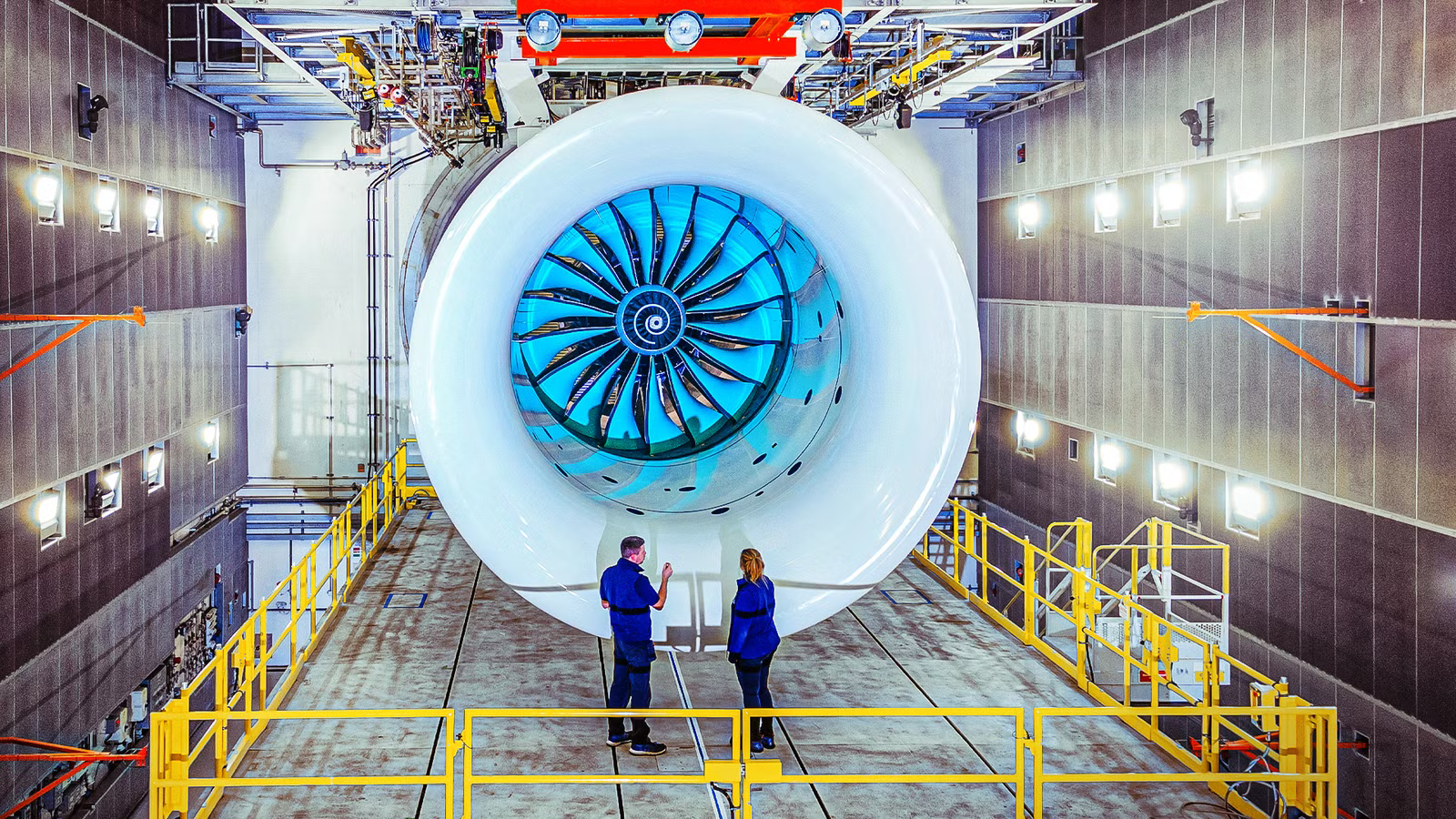
The prototype engine in development by Rolls-Royce set to herald its return to the narrowbody market is known as the UltraFan. That moniker isn’t just hyperbole; its name draws directly from the exceptionally wide face of its turbine blades. Behind that huge first stage of air intake is a proportionally very high bypass ratio to maximize both thrust and fuel efficiency.
The project is a $4 billion corporate risk for the future of commercial aviation architecture. Rolls-Royce is making a significant wager that the world’s top planemakers will be inclined to reimburse a new generation of turbofans as they design the next gen of single-aisle airliners of tomorrow. After the debacle of the Pratt & Whitney GTF turbofan series, RR is banking on a once-in-a-generation opportunity for its comeback.
Still, there is stiff competition. Airbus is in the process of developing a radical open fan engine in partnership with CFM International under the RISE program. However, such a significant departure from conventional engine design may not be well received on the heels of the GTF crisis. That leaves Rolls-Royce in a position to capture a massive market share. The ultimate question is whether its new design has genuine market appeal or if it simply relies on competitors stumbling.
What The Concept Design Review Fixed On Paper

In mid-2026, Rolls-Royce completed the concept design assessment for its UltraFan 30, a geared turbofan concept scaled down from its larger UltraFan 80 widebody demonstrator. By integrating a 20-megawatt power gearbox between the driving turbine and the front fan, the engine can achieve an ultra-high bypass ratio of up to 15:1. This mechanical separation allows the enormous 90-inch blades to spin at slower, quieter speeds while the inner core runs at maximum operational efficiency.
Until recently, only a model representation of the full-scale 90-inch fan model was displayed during early investor conferences. The next functional ground demonstration unit will have a core taken from the Pearl 10X business jet. But it has a much smaller fan diameter. Built for the 30,000-pound thrust category, the design cuts down on drag using a short inlet and trims noise via curving, bird-inspired guide vanes.
Specification | Rolls-Royce UltraFan 30 |
|---|---|
Fan Diameter | 90 inches (229 cm) |
Thrust Class | ~25,000 to 30,000+ lbf |
Bypass Ratio | 12:1 to 15:1 |
Overall Pressure Ratio | 50:1 |
Engineering teams already stripped down the original UltraFan 80 for a full analysis, setting up a second round of validation testing late this year. The ultimate goal for the ground trials in 2028 is to squeeze out a 20% improvement in fuel burn compared to existing powerplants. That represents a 25% jump over classic Trent powerplants. For now, these figures remain ambitious targets since no physical UltraFan 30 hardware has fired up, leaving its future to a market cornered by two long-standing suppliers.
A Market That Rarely Opens

Since leaving the International Aero Engines consortium in 2012, Rolls has been totally absent from the single-aisle engine market. CFM and Pratt, whose Geared Turbofan serves as the main competitor to the UltraFan, now control the entire narrowbody market. Reentering this very competitive space demands facing deeply entrenched giants that have controlled international airline fleets for more than a decade.
As it recovers from a large engine parts recall that caused hundreds of planes to be grounded, P&W is currently in a precarious situation. The GTF Advantage, a revised update intended to double the durability of its base engine, is the key to the company’s recovery. Shipments reached Airbus in May, with plans to make it the standard build by early 2028. Despite the recent groundings, Pratt still boasts a backlog of over 8,000 engines.
This massive market footprint is a tough barrier to crack, and the real timing for any competitive opening sits entirely with the airframers. While Airbus plans to launch an A320neo successor around 2030, Boeing and major airlines like Ryanair are pushing their new narrowbody timelines much further out. Acknowledging these financial risks, Rolls is working to seek a strategic partner rather than fund a solo comeback as it awaits the industry’s final verdict on open fan technology.
The Open Fan Case And Its Unfinished Homework

CFM’s radical RISE program promises a massive 20% cut in fuel burn by ditching the outer engine casings entirely. The R&D team has already wrapped up early design reviews for its compact core and unshielded open fan module, targeting a full ground test demonstrator before 2030.
Meanwhile, GE Aerospace is pushing for advanced technology readiness levels by the turn of the decade. It claims to have already logged over 1,000 hours on the low-pressure turbine and thousands of test cycles on its core.
Many of the remaining technical challenges are directly related to the engine’s integration with the aircraft. Critics caution that armoring the fuselage to protect passengers adds significant structural weight that might totally negate any fuel savings, and that an uncontained blade failure could cut directly into the passenger compartment.
Instead of mounting these enormous 13-foot (3.96 meters) fans at the rear of the aircraft, Airbus is currently researching ways to do it beneath a conventional wing. Ultimately, Airbus holds all the cards here, and its cautious middle-ground approach will decide whether Rolls-Royce’s massive multi-billion-dollar gamble actually pays off.
Airbus Is Testing The Open Fan, Not Banking On It

Airbus and CFM have locked in a deal to flight-test an early version of the RISE engine on a massive A380 test bed. However, Airbus executives emphasize that the open fan is easily the most ambitious option on the table, meaning the company still needs to prove real-world performance and maintenance costs before committing.
Crucially, both aerospace manufacturing giants, Boeing and Airbus, are quietly hedging their bets behind the scenes. Internal leaks reveal that CFM has secretly been studying a backup engine called the Advanced Ducted Large, a conventional ducted design that serves as a practical fallback if the open rotor fails.
Even if the open fan gets the primary slot, Airbus’ next-generation single-aisle plane may have numerous engine options, which would open the way for a second supplier like RR. While maintaining flexibility in its industrial alternatives, Airbus is devoting significant technical resources and flight test hours to the RISE program, and CFM is retaining a conventional backup engine on standby.
Boeing And Pratt & Whitney Complicate The Wager

Industry insiders postulate that Boeing remains highly skeptical of the radical RISE architecture, leaning heavily toward lower-risk propulsion options instead. However, Boeing Commercial Airplanes chief Stephanie Pope refuses to completely rule out the open-fan concept for their next clean-sheet airplane design.
Pope insists the company judges fuel efficiency and airframe integration first, noting that a brand-new jet depends on stabilizing corporate finances and wrapping up delayed 737 MAX and 777-9 certification programs. This lukewarm stance from Boeing does not automatically hand a victory to Rolls-Royce.
Pratt executives are also pushing back on RR’s public requests for a manufacturing partnership, choosing to protect their own market share while eyeing a major comeback on future Boeing and Airbus narrowbodies. P&W has entirely ruled out open-fan designs, calling an advanced version of its current Geared Turbofan both its Plan A and Plan B for the future.
Breaking into these established relationships between the major industry players is the primary hurdle for the UltraFan project despite RR’s long history as a top Aerospace house. Its decades-long focus on widebody aircraft engines has left it at a disadvantage in this segment of the broader commercial aviation market. If the open-fan concept fails, the biggest winners will be Pratt’s upgraded engines and CFM’s traditional fallback design. For Rolls, an industry rejection of the open fan merely unlocks a crowded battlefield where timing and cash flow rule.
What The 2028 Test Must Prove

The other problem RR is facing as it pushes into new territory is the financial stability required to make it possible. The company suffered a massive blow when its Trent 1000 turbofans for the Boeing 787 Dreamliner series experienced major technical difficulties. It drove the company into crisis mode and forced enormous cutbacks, as it had done damage control for years. Today, the situation has significantly improved, but there remains great risk with a new venture of such scale.
The defense side of RR is doing well with contracts for the US military, including a high-profile US Air Force deal for the re-engineering of its Legacy Boeing B-52 Stratofortress fleet. It is also chasing up to £200 million ($260 million) in UK government funding to jump-start a certified narrowbody engine program. The total research and development is expected to cost roughly £3 billion ($3.9 billion) total, meaning any additional funding takes a great burden off of Rolls. This brings the final price tag to nearly $4 billion when factoring in earlier investments.
The upcoming industry events of the next two years are likely to shape up as the ultimate competitive crossroads for the battle between next-gen narrowbody designs. Rolls-Royce plans to debut its physical UltraFan 30 ground test unit in 2028. That is scheduled right as P&W finishes upgrading its global GTF fleet to the more durable Advantage engine grade. Meanwhile, CFM does not expect to fire up its rival open-fan ground demonstrator until the very end of the decade.
Any major development delays could completely ruin Rolls’ front-runner advantage. If planemakers push new narrowbody rollouts closer to 2040, the open-fan RISE project will gain a much longer window to refine its technology while RG is stuck carrying an expensive R&D bill without buyers.