dailynewsnblog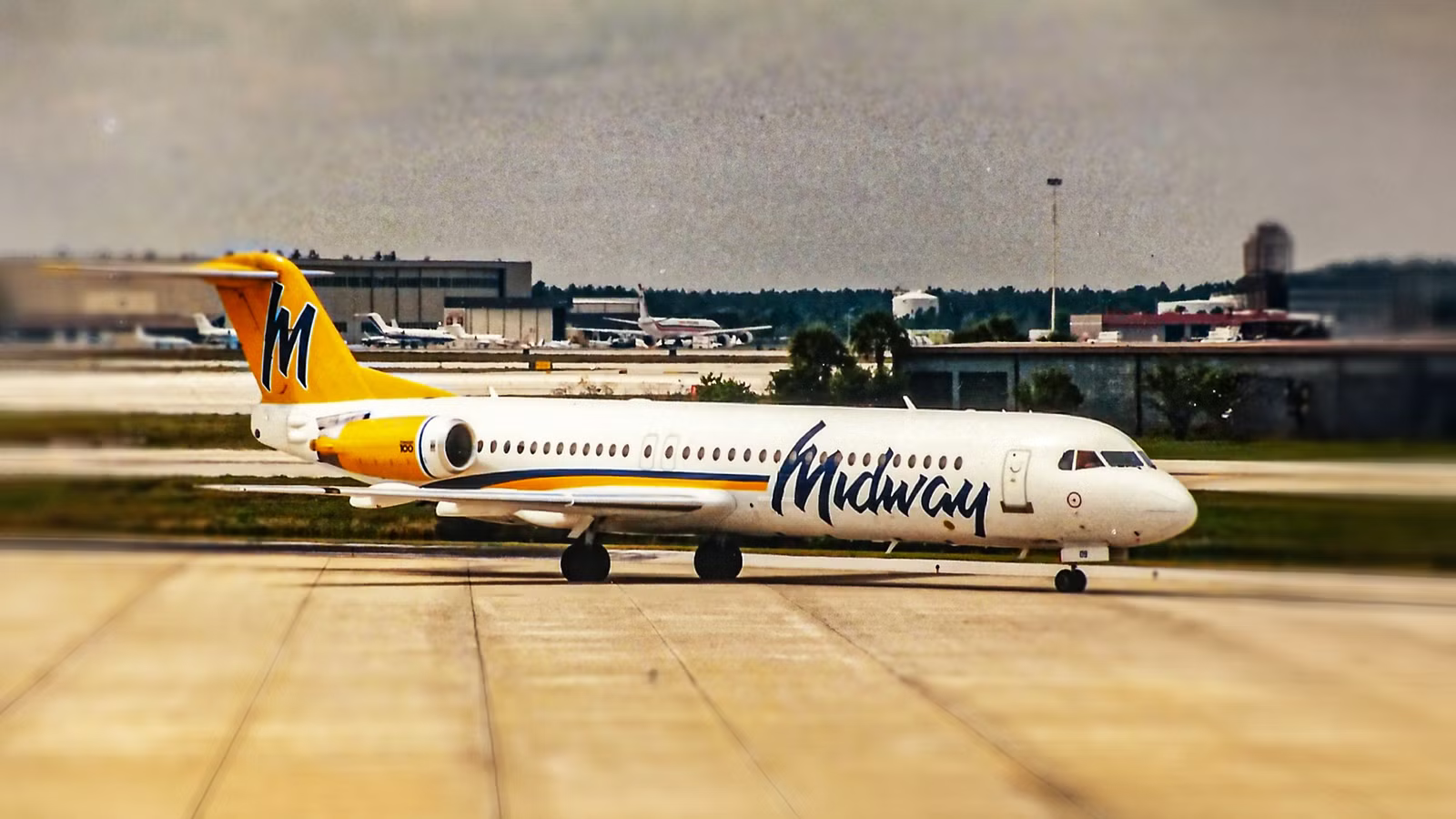
Midway Airlines was incorporated in 1976 for a single purpose: to revive Chicago Midway International Airport (MDW), which had once been the busiest airport in the world before the major carriers abandoned it for O’Hare. The founders took the airport’s name for the airline because reviving the airport was the entire business plan. Service began on November 1, 1979 with three DC-9s, and within a few years the carrier had rebuilt Midway into a functioning hub handling millions of passengers. The airline filed for bankruptcy in 1991 and shut down on November 13 of that year.
A group of investors bought the name out of the liquidation for $20,000. The relaunched Midway Airlines began flying from Chicago Midway again in November 1993, lasted 18 months in a battle with Southwest Airlines at the airport, and relocated to Raleigh-Durham (RDU) in 1995. It operated from North Carolina for the next eight years, roughly 640 miles (1,030 km) from the airport on its aircraft, before ceasing operations permanently in October 2003.
The Airline Was Created To Save The Airport It Was Named After

Chicago Midway Airport was once the busiest airport in the world. Located 11 miles (18 km) from downtown Chicago, it handled the majority of the city’s commercial traffic until the major carriers shifted operations to the newer and larger O’Hare International Airport (ORD) through the 1960s. By the mid-1970s, Midway was nearly deserted. A handful of lightly loaded flights operated from a facility that had once defined American commercial aviation, and the airport’s terminals sat largely empty while O’Hare grew into the busiest airport in the country.
A group of airline executives saw an opportunity in that emptiness. Irving T. Tague, a former Hughes Airwest executive, joined Kenneth T. Carlson and William B. Owens to incorporate Midway Airlines on October 13, 1976. The plan was modeled on what Southwest Airlines had done at Dallas Love Field: build a carrier around an underused close-in airport that larger competitors had abandoned, offering fares and convenience that the congested primary hub could not match. The founders named the airline after the airport because reviving the airport was the entire premise of the business.
Raising capital proved difficult. Chicago investors were largely uninterested in funding a startup airline at a facility everyone else had left. On August 2, 1979, Midway announced it had secured $5.7 million from 16 private investors, enough to begin operations. The airline received its operating certificate from the Civil Aeronautics Board before the Airline Deregulation Act passed in 1978, but it is widely regarded as the first post-deregulation startup in the United States. Service began on November 1, 1979, with a staff of 200 and three McDonnell Douglas DC-9s linking Chicago to Cleveland, Detroit, and Kansas City. Within a few years, Midway Airlines had rebuilt the airport into a functioning hub attracting millions of passengers and drawing other carriers back to the field.
Three Business Models In Twelve Years, Then Bankruptcy

Midway Airlines went through three distinct business models in twelve years. It launched as a discount carrier, undercutting the legacy airlines at O’Hare on the same city pairs while operating from a less congested airport closer to downtown. In the mid-1980s, the airline pivoted to an all-business-class configuration, removing coach seating and targeting corporate travelers with a premium product on short-haul routes. That experiment did not generate the yields the airline needed, and Midway transitioned again to a conventional hub-and-spoke model with a mixed-class cabin.
David R. Hinson took over as CEO and pursued expansion. In 1986, the airline ordered a dozen new jets to serve growing traffic. In 1989, Hinson placed a $900 million aircraft order and moved to establish a second hub at Philadelphia International Airport (PHL) to build an East Coast operation alongside the Chicago base. The timing was poor. Recession, rising fuel costs, and direct fare competition from Eastern Air Lines, which was still flying at the time, prevented Midway from ever making the Philadelphia hub profitable. The expansion that was supposed to diversify the airline’s revenue base instead consumed the cash reserves it had built in Chicago.
Midway sold the Philadelphia hub to USAir for $65 million and sold newly acquired slots at New York and Washington in leaseback arrangements, but the proceeds were not enough to satisfy creditors. The airline filed for Chapter 11 bankruptcy protection in 1991 while continuing to operate. A deal was negotiated to sell the company to Northwest Airlines, which would have preserved the operation and the jobs, but Northwest withdrew at the last minute. On November 13, 1991, Midway Airlines ceased operations permanently. The carrier had grown from three aircraft to 44 over twelve years and never suffered a fatal crash. Northwest ultimately agreed to hire most of Midway’s 4,300 former employees after outbidding Southwest for the airline’s assets.
Investors Bought The Name For $20,000

The airline was dead. The name was not. When Midway Airlines liquidated in late 1991, its brand, trademarks, and goodwill went onto the auction block alongside its aircraft, gates, and ground equipment. A group of investors that included Kenneth T. Carlson, one of the three men who had incorporated the original Midway Airlines in 1976, purchased the name for $20,000. The price reflected what a defunct airline’s brand is worth to anyone who is not planning to use it, which in this case was almost nothing.
The buyers did plan to use it. Jet Express Inc., a commuter air carrier incorporated in 1983 that had operated codeshare feeder services for Trans World Airlines and USAir through the late 1980s and early 1990s, acquired the Midway name in 1993. Jet Express had an operating certificate, a small fleet, and experience running scheduled service, but no brand recognition of its own. Buying the Midway name gave the company an identity that travelers in Chicago already associated with an airline that had served the market for twelve years and had built the airport it was named after from nothing.
The new Midway Airlines began operations in November 1993 with two Fokker 100s flying between Chicago Midway Airport and New York LaGuardia Airport (LGA). The route selection was deliberate. Operating from Midway under the Midway name on a high-demand business route was the most direct way to establish the relaunched carrier as a continuation of the original rather than a new airline wearing a borrowed logo. The strategy depended on Chicago Midway remaining a market where a smaller carrier could compete for gates, slots, and passengers. That assumption held for roughly eighteen months.
Southwest Pushed Midway Out Of Midway

Southwest Airlines had entered Chicago Midway Airport in 1985, four years before the original Midway Airlines filed for bankruptcy. When Midway ceased operations in 1991, Southwest absorbed much of the traffic the collapsed carrier left behind and expanded steadily through the early 1990s. By the time the relaunched Midway Airlines began flying from the airport in November 1993, Southwest was the dominant operator at the field and growing. The new Midway was competing for gates, slots, and passengers against a carrier with lower unit costs, a larger network, and an established position at the airport.
The competition was not close. The relaunched Midway operated two Fokker 100s on a single route while Southwest ran dozens of daily departures across the Midwest, the South, and the West Coast. Gate availability at Chicago Midway tightened as Southwest added flights.
Midway relocated to Raleigh–Durham International Airport (RDU) in 1995 and moved its corporate headquarters to Morrisville, North Carolina, between Raleigh and Durham. The timing was opportunistic. American Airlines had just shut down its RDU hub after years of losses, vacating Terminal C and its gates. American subleased those gates to Midway as part of an arrangement to service the $113 million in bonds that had financed the terminal’s construction. The airline that had been created to revive Chicago Midway Airport now operated from a terminal in North Carolina, roughly 640 miles (1,030 km) from the airport whose name it carried on every aircraft in the fleet.
Eight Years In North Carolina Under A Chicago Name

The Raleigh-Durham years were the most successful period in the relaunched airline’s history. Midway built an East Coast network connecting the Northeast to Florida through RDU, serving Boston, Hartford, Newark, New York, Philadelphia, and Washington in the north and Fort Lauderdale, Jacksonville, Orlando, Tampa, and West Palm Beach in the south. The airline employed 2,250 full-time workers in the Research Triangle region and partnered with American Airlines on the AAdvantage frequent flyer program, giving Midway passengers access to American’s loyalty currency while American’s revenue management team handled Midway’s pricing. CEO Robert Ferguson produced 13 consecutive profitable quarters. A 1997 initial public offering raised approximately $38 million.
The decline began in 1999 when Southwest Airlines entered the Raleigh-Durham market. The same carrier that had pushed Midway out of Chicago arrived at its new home and applied the same pressure. Low-fare competition eroded the yields on the Northeast-to-Florida routes that generated Midway’s connecting traffic. The airline severed its relationship with American in 2000, launched its own frequent flyer program, brought revenue management in-house, and switched to smaller Canadair regional jets to cut costs. The stock price kept falling.
September 11, 2001 ended the operation. Midway suspended all flights and laid off its workforce. The airline returned in 2002 with a reduced schedule, then abruptly discontinued service again on July 17, 2002, disposing of its Boeing 737 fleet and laying off all employees a second time. It remained closed until February 2003, when it resumed flying as US Airways Express with six CRJ-100s serving East Coast cities from RDU and Washington Reagan National (DCA). The final shutdown came on October 30, 2003, through a Chapter 7 bankruptcy filing. The Midway Airlines name, purchased for $20,000 twelve years earlier, had outlived the airline that created it, survived a relocation roughly 640 miles (1,030 km) from the airport it referenced, and finally disappeared for good in a state where it had never meant anything to begin with.