dailynewsnblog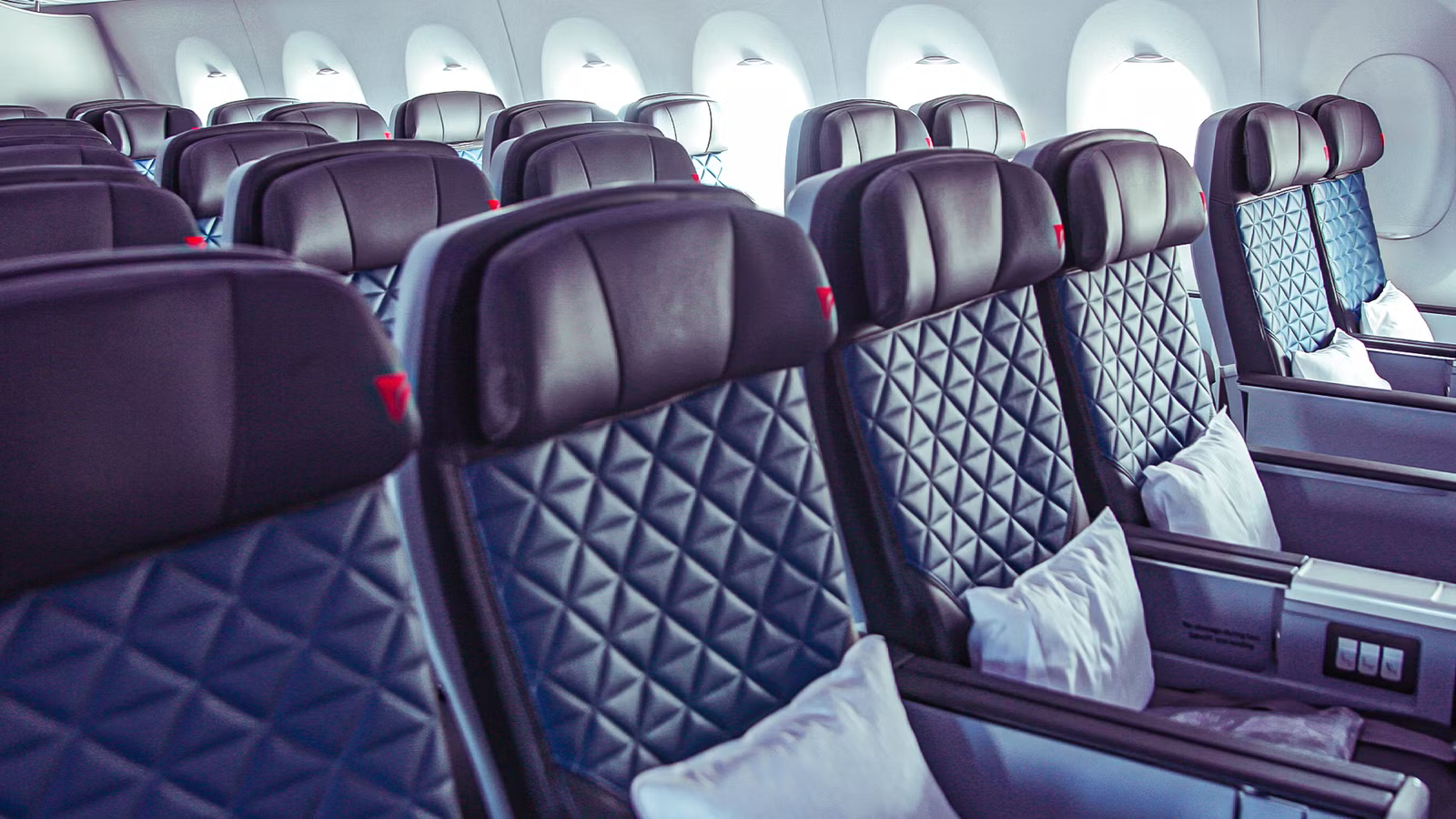
In  Delta Air Lines‘ fourth-quarter financial results for 2025, a single line item eclipsed every other figure on the income statement. For the first time in the history of commercial aviation, ticket sales categorized as premium revenue outpaced traditional main cabin revenue, pulling in $5.695 billion against $5.620 billion. Industry headlines immediately heralded the moment as proof that long-haul business class and luxury recliners had truly reshaped airline economics. In actuality, the most consequential detail of that milestone was not the revenue figure itself, but what remains hidden beneath it.
In its official Form 10-K filing with the Securities and Exchange Commission, Delta defines its premium category as an aggregated umbrella containing four distinct products: Delta One, First Class, Delta Premium Select, and Delta Comfort+. Crucially, the airline provides no dollar-for-dollar breakdown showing how much money each of those four products actually generates. Comfort+ is an extra-legroom economy seat rather than a dedicated premium cabin, so a figure that appears to be a triumph for high-end suites could equally be driven by economy passengers paying modest cash buy-ups or redeeming SkyMiles. So, which product is genuinely driving Delta’s record revenues, and why is the airline keeping the answer hidden?
Keeping Analysts In The Dark

The best place to begin when looking at Delta’s revenue shift is inside Item 1 of its annual SEC filing, where the airline outlines its commercial revenue streams. Instead of separating intercontinental business class from domestic extra-legroom upgrades, Delta groups Delta One lie-flat seats, domestic First Class recliners, Delta Premium Select cradles, and Delta Comfort+ seats into a single consolidated revenue figure. Bundling these four distinct seating options together, Delta presents a unified narrative of premium growth to Wall Street and withholds the specific yield performance of individual cabin tiers.
Accounting consolidation carries massive commercial implications for how the airline’s financial health is evaluated. Reporting from Fortune highlights how chief executive officer Ed Bastian has overseen a 15-year strategic repositioning aimed at selling every premium seat rather than filling them with free frequent flyer upgrades. However, bundling a $200 domestic Comfort+ seat assignment with a $6,000 intercontinental Delta One suite obscures whether growth stems from high-margin luxury travel or high-volume economy add-ons. Without granular accounting, external observers cannot determine if intercontinental business class is expanding or if standard economy passengers are secretly doing the heavy lifting.
If Delta’s reported growth combines cheap legroom upgrades with multi-thousand-dollar business class fares, how do analysts know where the new money is actually coming from? The only real way to grasp some kind of idea is by looking into the wider impact that a particular seat has on the balance sheet.

Dissecting the operational mechanics of Delta’s fleet shows that extra-legroom Comfort+ seats account for a massive share of the airline’s total non-standard seating inventory. Even though a Boeing 767 or Airbus A330 might carry only 20 to 30 Delta One suites, that same aircraft contains dozens of Comfort+ seats embedded directly within the main cabin structure. Analysis from Simple Flying shows that much of Delta’s recent premium revenue momentum has not come from corporate travelers purchasing full-fare business class, but from main cabin passengers buying up or redeeming SkyMiles into Comfort+ at check-in.
Financial reporting analyzed by Engine Cowl confirms that full-year 2025 premium revenue reached $22.0 billion, driven by continuous capacity expansion across non-standard seating blocks. Additionally, data from Cirium demonstrates that Delta’s premium seat capacity growth (up 4.8%) has far outpaced standard economy additions (2.7%) across domestic and short-haul international routes. Comfort+ requires no additional galley infrastructure, separate lavatories, or specific catering, meaning that its profit margins significantly exceed those of dedicated luxury cabins. As a result, small buy-ups from price-sensitive travelers generate an outsized share of net yield.
Comfort+ generates attractive margins, but the refusal to isolate its financial contribution is what generates these significant blind spots for market watchers. Delta keeps investors and competitors guessing about the true elasticity of premium leisure demand by treating $50 legroom add-ons as equivalent to $5,000 long-haul suites.
The True Effect Of Cabin Bundling

Combining diverse seating products into one financial metric provides Delta with a powerful strategic buffer against shifts in corporate travel budgets. When macroeconomic pressures cause business travelers to downsize from business class to economy, airlines typically suffer sharp revenue drops in their premium cabins, as noted by McKinsey. However, because Delta includes domestic Comfort+ upgrades in its premium revenue line, steady demand for extra legroom from leisure travelers offsets any reduction in corporate business class spend, preserving the appearance of uninterrupted growth.
The financial structure allows airline management to control the narrative presented to equity markets during quarterly earnings calls. Reporting from NBC News notes that Delta president Glen Hauenstein pointed to the main cabin’s tier structure as a model for how the airline plans to segment its premium offerings further. The concept is to offer multiple fare bundles within the same cabin, such as unbundled or restricted premium seats, giving Delta the ability to extract maximum yield from different passenger segments without ever needing to report which specific fare tier generated the cash.
Now that Delta is moving to bring main-cabin-style fare segmentation into its premium cabins, the boundary between distinct travel classes will blur even further. What happens to financial transparency when Wall Street, trade analysts, and passengers have to evaluate an airline using a single reported figure that hides four or five different micro-tiers inside it?
Hyper-Segmentation Could Prove To Be Game Changing

Hauenstein’s comments regarding premium segmentation suggest that Delta plans to introduce basic and flexible versions of First Class, Premium Select, and Delta One fares, as covered by Aerospace Global News. In practice, this means a passenger buying a basic business class fare without lounge access or seat selection will be tallied in the same financial column as a full-fare passenger receiving door-to-door chauffeur service.
Delta’s hyper-segmentation strategy is part of a dramatic evolution from how airlines historically managed cabin inventory. According to McKinsey margin data cited by Simple Flying, premium cabins yield up to 15% better profit margins than standard economy, making product unbundling the logical next step for revenue optimization. If Delta creates four or five micro-tiers within business class and extra-legroom economy, then it can squeeze higher yields from every row while consolidating all the proceeds into the same aggregated disclosure line.
The consequence of this strategy is that financial statements will increasingly reflect marketing classifications rather than real aircraft economics. Wall Street analysts will continue to evaluate Delta’s premium momentum using a metric that deliberately conceals whether passengers are upgrading out of comfort or stepping down from luxury.
Casting A Shadow On Competitors

For investors, the lack of product-level granularity brings a hidden risk into long-term valuation models. If Delta’s premium revenue growth is predominantly fueled by Comfort+ buy-ups, that revenue stream is still vulnerable to changing consumer confidence among middle-tier leisure travelers. Conversely, if growth is concentrated in Delta One, the airline’s earnings are heavily reliant on ultra-wealthy individuals and corporate accounts. The 10-K filing merges these extremes, so shareholders cannot accurately measure Delta’s exposure to economic crises.
Competitors like  American Airlines and
  United Airlines face a parallel challenge as they attempt to benchmark their own premium cabin performance against Delta’s numbers. United separates its Premium Plus intermediate cabin from Economy Plus extra-legroom seats in marketing materials, though rival commercial planning teams cannot verify if Delta’s strategy of combining Comfort+ into premium revenue gives it a genuine yield advantage or merely a superior reporting narrative.
Could regulators or market pressures ever push Delta to break down its $5.7 billion headline figure, or has the airline permanently changed how aviation revenues are reported? That is something that is not clear at this stage and is unlikely to change any time soon. It would take a great push from competitor carriers to gain some kind of intervention into the way 10-K filings are numerically represented, but it would give Delta’s rivals as well as analysts the data that they need to uncover what is actually going on inside of the cabin.
The Unresolvable Milestone

Delta Air Lines leaving behind its identity as a traditional network carrier to become a premium-focused consumer brand is one of the defining commercial stories of modern aviation. Despite this, as long as the airline aggregates four distinct seating products into a single financial line item, every milestone celebration carries an asterisk. The headline triumph of premium revenue overtaking the main cabin is undeniably real, but the precise mechanism driving that victory stays locked inside Delta’s corporate headquarters.
Soon, fleet deliveries will bring hundreds of new segmented seats into service across the next decade. Whether Wall Street continues to accept consolidated premium figures without demanding a line-by-line accounting breakdown is something that most definitely will shape whether other global airlines follow Delta’s lead in obscuring where their profits truly originate.
Catch what other trackers miss
Emergency squawks, holds, NOTAMs — live signals, no signup.
Open tracker
Catch what other trackers miss
Emergency squawks, holds, NOTAMs — live signals, no signup.
Open tracker